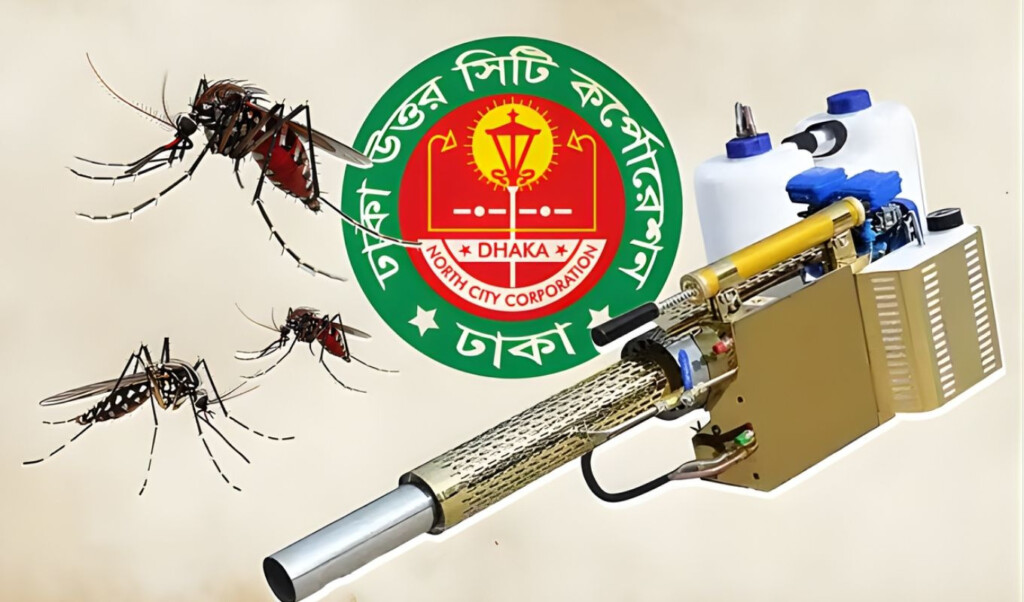
The Dhaka North City Corporation (DNCC) has published a weekly schedule for mosquito control operations on its official website, detailing which workers are assigned to which areas and on what days. The “Mosquito Control Work Plan” lists staff names and their responsibilities for each ward, including Ward 2 (Mirpur).
However, an investigation by Prothom Alo has revealed a glaring discrepancy: the name of Afur Ali, a mosquito control worker who passed away approximately two and a half years ago, still appears on the schedule. According to the website, Afur Ali was supposed to operate in Mirpur’s Sagufata Residential Area (Roads 1–5) and Beguntila Bosti every Monday and Thursday from 8:30 a.m. to 11:30 a.m.
A visit to Sagufata on Thursday morning, around 9 a.m., found no sign of him. Attempts to reach his listed mobile number were unsuccessful, as the line was switched off. Reporting slightly farther to Swapnanagar Residential Area, a working team was observed near a building—but the workers were not actively spraying insecticide and soon left on a motorcycle.
The motorcycle driver identified himself as Rokibul Alam Khan, supervisor for Ward 2, and the accompanying worker as Shah Alam. When informed that Afur Ali could not be located, Rokibul confirmed that Ali had died over two years ago but declined to comment on why his name remained on the official roster.
DNCC sources acknowledge multiple inconsistencies on the online “Mosquito Control Work Plan.” The city’s Health Department, responsible for mosquito control, confirmed the list has not been updated for a long time. Brigadier General Imrul Kayes Chowdhury, Chief Health Officer of DNCC, told Prothom Alo:
“The information on the website is outdated and does not reflect the current workforce.”
Residents of Mirpur and surrounding areas describe the mosquito problem as severe. Arafat Hossain of Swapnanagar said, “Mosquitoes make it impossible to sit on the balcony at night; coils and sprays do little to help.” Similarly, Jahid Hasan of Sagufata noted that mosquito swarms begin in the afternoon, forcing residents to keep doors and windows closed after sunset.
Currently, DNCC conducts mosquito control twice daily. Morning operations, called larviciding, target stagnant water with insecticide, while evening fogging disperses a chemical-laden smoke to kill flying mosquitoes.
Local residents and sector welfare associations report limited effectiveness. Nazrul Islam Bhuiya, secretary of Uttara Sector 3 Welfare Association, said:
“Workers often only pose for photographs with the spraying equipment. Meanwhile, mosquitoes continue to breed in local lakes and drainage channels.”
A summary of the daily mosquito control schedule for Ward 2 is shown below:
| Worker Name | Days Assigned | Areas Covered | Time (Local) |
|---|---|---|---|
| Shah Alam | Mon & Thu | Sagufata Roads 1–5, Beguntila Bosti | 08:30–11:30 |
| Afur Ali* | Mon & Thu | Sagufata Roads 1–5, Beguntila Bosti | 08:30–11:30 |
| Supervisor | Mon & Thu | Entire Ward 2 | 08:30–11:30 |
*Deceased
Experts, including Professor Kabirul Bashar of Jahangirnagar University, warn that ineffective coordination and neglected drainage management exacerbate mosquito breeding. The Chief Health Officer emphasises that insecticide alone is insufficient: effective drainage and waste management must complement larviciding and fogging operations.
The DNCC now plans to integrate waste management and drainage maintenance into mosquito control programmes to improve effectiveness, though residents remain concerned about persistent mosquito infestations across Mirpur, Mohammadpur, and Uttara.