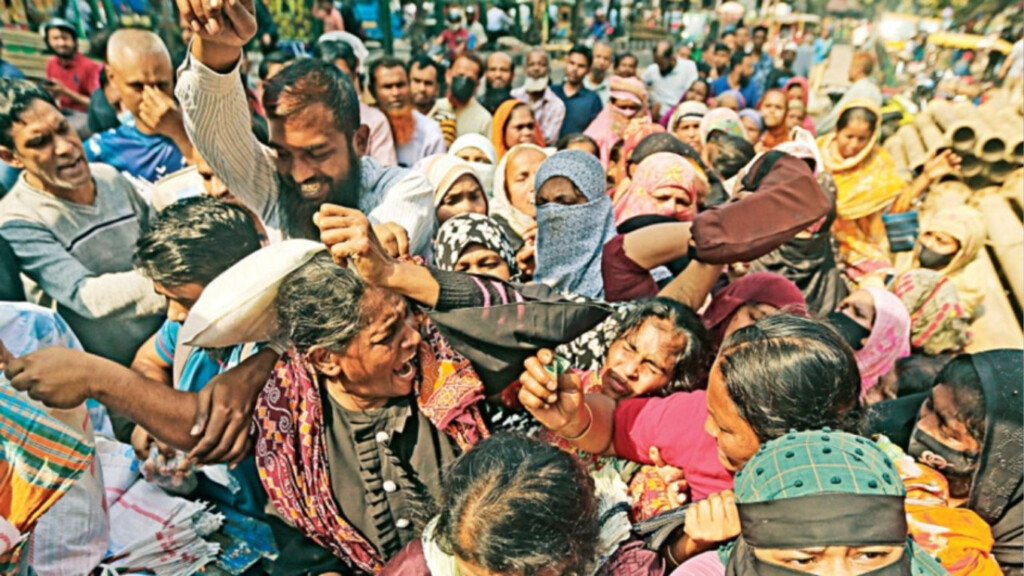
At 2:12 PM last Thursday, beneath the concrete pillars of the Kazipara Metro Station in Dhaka, a Trading Corporation of Bangladesh (TCB) truck stood as a beacon of both hope and hardship. Behind it stretched a weary, undulating line of people—mostly women—waiting with stoic patience to purchase essential commodities at subsidised rates. For these individuals, the “TCB package” is not merely a government scheme; it is the thin line between a full stomach and a night of hunger.
The Mathematics of Survival
The economic incentive to endure these queues is stark. A standard TCB package costs approximately 550 BDT, whereas the equivalent items in the open market would fetch nearly 950 BDT. For a low-income family, this 400 BDT saving represents a significant portion of their daily survival budget.
Table: TCB Subsidised Rates vs. Market Estimates
| Commodity | TCB Quantity | TCB Price | Estimated Market Price |
|---|---|---|---|
| Soybean Oil | 2 Litres | 230 BDT (115/L) | 330–350 BDT |
| Lentils (Masur) | 2 KG | 140 BDT (70/kg) | 220–240 BDT |
| Sugar | 1 KG | 80 BDT | 135–145 BDT |
| Chickpeas (Chola) | 1 KG | 60 BDT | 100–110 BDT |
| Dates (Khejur) | 0.5 KG | 80 BDT | 150–200 BDT |
| Total Cost | – | 550 BDT | ~950 BDT |
Human Stories of the Crisis
Among those waiting was 40-year-old Nasir Khan, perched on a rickshaw with his left leg encased in plaster. A former waste-collector, Nasir has been unemployed since his van overturned four months ago. His wife, Mahinur, works as a domestic helper in three houses, earning a meagre 9,000 BDT a month to support their two school-going daughters.
“Living like this is impossible,” Nasir told reporters. Recognising his physical distress, TCB officials allowed him to bypass the queue after thirty minutes—a rare mercy in a line where others, like coconut seller Md. Shakil, waited four hours, losing half a day’s earnings in the process.
The desperation is further highlighted by 70-year-old Mulkuch Bibi, a widow who arrived at 8:00 AM after preparing her water bottle and bag the night before. “If I cannot buy from the truck, I simply cannot afford to buy these things elsewhere,” she whispered, resting on the metro station stairs. Similarly, Minuara Begum from Agargaon was seen breastfeeding her one-year-old child while standing in line, as she had no one at home to mind the infant.
The Macroeconomic Backdrop
This micro-level suffering reflects a grim national reality. Data from the Bangladesh Bureau of Statistics (BBS) indicates that food inflation surged to 8.29% in January 2026, up from December. The World Bank’s 2025 report warned that the national poverty rate could climb from 18.7% to 22.9%, potentially pushing an additional 3 million people into extreme destitution.
Dr Selim Raihan, Executive Director of SANEM, noted that three years of sustained high inflation have exhausted the coping mechanisms of the poor. “The current TCB reach is insufficient for the soaring demand,” he remarked. He urged the new government to expand the programme, particularly in industrial zones and low-income hubs, to ensure that the “cost” of the discount isn’t a lost day of wages for the working class.