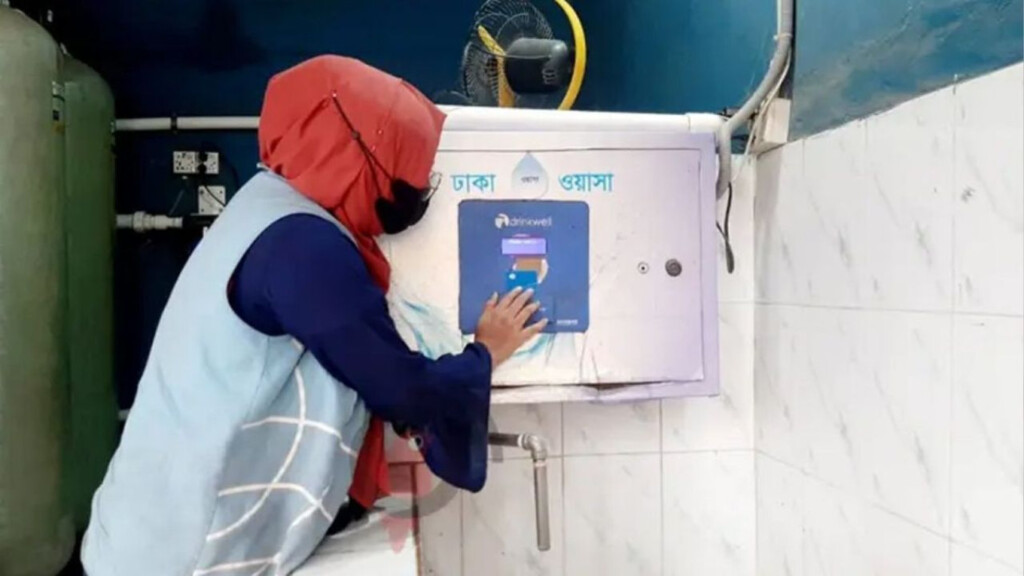
In a move that is set to impact thousands of low-income households and commuters across the capital, Dhaka WASA (Water Supply and Sewerage Authority) has officially sanctioned a price hike for its automated water dispensing booths. The new tariff, which comes into immediate effect, represents a significant adjustment in the cost of accessing purified drinking water via the city’s popular “Water ATM” network.
Official Mandate and Rationalisation
The announcement was formalised through an official directive signed by SM Jahangir Hossain, the Secretary of Dhaka WASA. According to the executive order, the decision to revise the pricing structure was reached during the 14th meeting of Dhaka WASA’s “Performance Support Committee,” held on 28 January.
The primary justification cited for the price surge is the escalating cost of Operations and Maintenance (O&M). Officials have noted that the rising expenses associated with electricity, filtration technology, and logistical upkeep of the booths across the metropolitan area made the previous tariff unsustainable. Consequently, the price per litre has been raised from 80 Paisa (inclusive of VAT and taxes) to 1 Taka (inclusive of VAT and taxes).
A Look at Historical Price Trends
This latest adjustment follows a pattern of incremental increases as the utility provider struggles to balance its books against inflationary pressures. Notably, it has been less than three years since the previous substantial hike, indicating a tightening of fiscal policy within the authority.
Table: Historical Price Evolution of Dhaka WASA ATM Water
| Effective Date | Price per Litre (Paisa) | Percentage Increase | Primary Driver |
|---|---|---|---|
| Prior to August 2023 | 40 | — | Initial Subsidised Rate |
| 1 August 2023 | 80 | 100% | Infrastructure Expansion |
| March 2026 | 100 (1 Taka) | 25% | O&M Cost Escalation |
Socio-Economic Impact on the Capital
The Water ATM project, originally launched as a collaboration between Dhaka WASA and various international partners, was designed to provide safe, drinkable water to residents—particularly those in “slum” areas or high-traffic zones—at a fraction of the cost of bottled water.
While 1 Taka per litre remains considerably cheaper than commercial alternatives (which often retail for 15–30 Taka), the cumulative effect on large families who rely solely on these booths for their daily consumption is substantial. Analysts suggest that for a family of five consuming roughly 20 litres per day, this represents a meaningful increase in monthly utility expenditure during a period of broader economic volatility.
The administration has reiterated that the increase is necessary to ensure the long-term viability of the project and to maintain the high purification standards required to prevent waterborne diseases in the megacity.