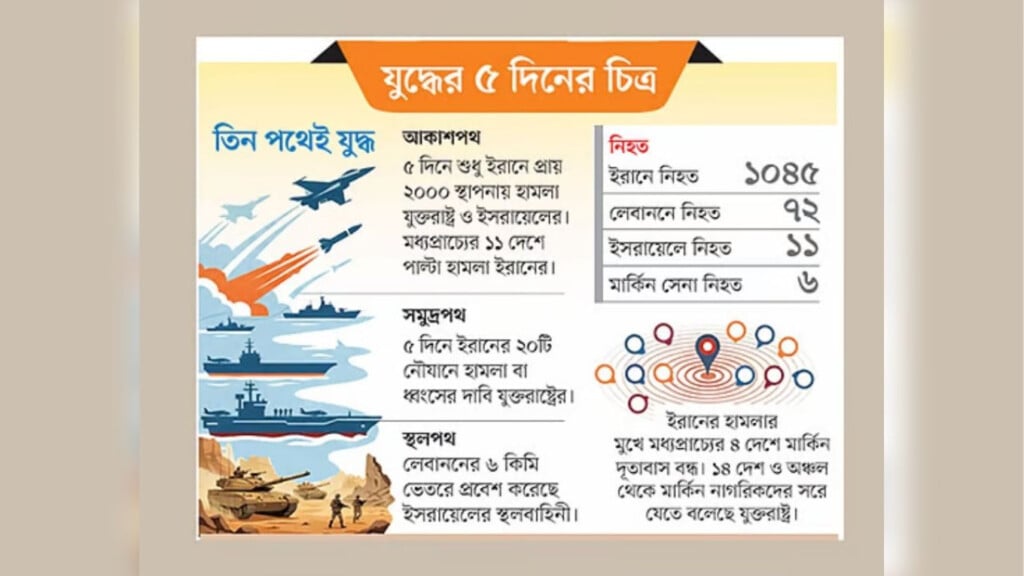
The geopolitical landscape of the Middle East has shifted from precarious instability to a state of total, devastating warfare. As of Wednesday, marking the fifth day of a rapidly expanding conflict, the United States and Israel have significantly intensified their combined military offensive against Iranian and Lebanese targets. The human cost has already surpassed grim milestones, with Iranian state media reporting over a thousand fatalities, while retaliatory strikes by Tehran have set the entire region ablaze.
The Scale of Strategic Escalation
What began as a targeted aerial campaign last Saturday has evolved into a multi-domain conflict involving land, sea, and air assets. The U.S. Central Command (CENTCOM) revealed a staggering increase in sorties; while 1,039 strikes were recorded by Tuesday, that figure nearly doubled within twenty-four hours to approximately 2,000 facilities. U.S. Defence Secretary Pete Hegseth stated boldly that the coalition intends to achieve total “air superiority” over Iranian sovereign territory in short order.
Under the banner of “Operation Epic Fury,” the American military has deployed:
Over 50,000 ground troops.
Two carrier strike groups.
Strategic long-range bomber wings.
Iranian Retaliation and the “Narco-Terror” Parallel
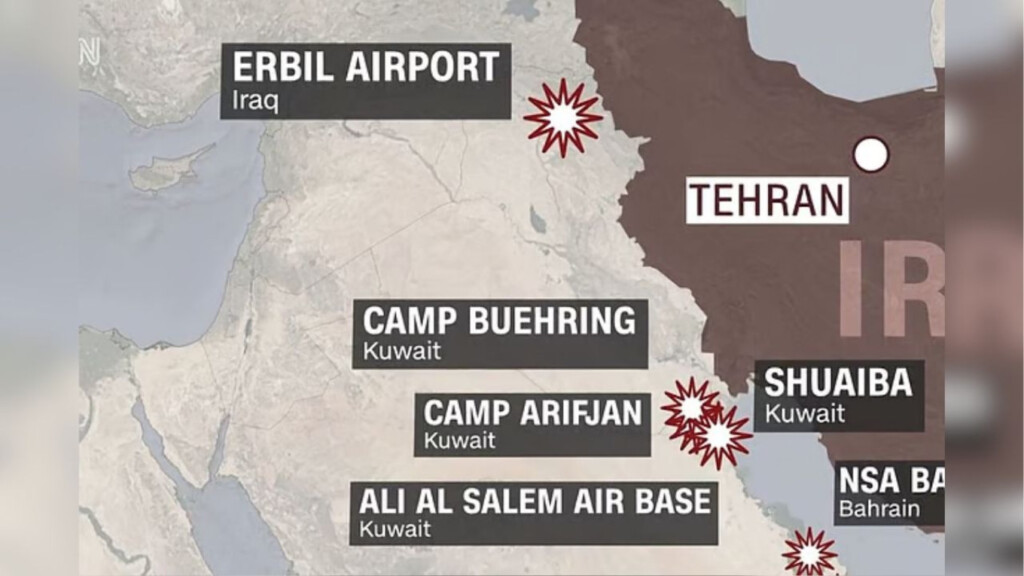
Tehran has not remained passive. In a series of sophisticated asymmetric responses, Iranian ballistic missiles successfully struck Al-Udeid Air Base in Qatar—the largest U.S. military installation in the Middle East. Simultaneously, suicide drones targeted the U.S. Consulate in Dubai, causing significant structural damage and prompting the immediate closure of all American diplomatic missions in the United Arab Emirates.
The conflict has now bled into twelve nations, with the Islamic Revolutionary Guard Corps (IRGC) claiming functional control over the Strait of Hormuz, a vital chokepoint for global energy security. In a startling maritime escalation, a U.S. submarine reportedly torpedoed an Iranian warship off the coast of Sri Lanka, resulting in at least 87 deaths.
Casualties and Humanitarian Impact
The toll on civilian life is catastrophic. While the military objectives focus on IRGC infrastructure and Basij paramilitary headquarters, residential areas have caught the brunt of the fire.
Conflict Casualty Summary (As of Day 5)
| Region / Entity | Fatalities reported | Key Infrastructure Hit |
|---|---|---|
| Iran (Total) | 1,045+ | IRGC HQ, Tehran Gov. Buildings |
| Tehran (Civilian) | 1,097 (per HRANA) | Inqilab Square, Residentials |
| Lebanon | 72 | Khiam, Baalbek, Beirut Hotels |
| US/Allied Sites | Multiple (Unconfirmed) | Al-Udeid (Qatar), Dubai Consulate |
| Maritime | 87 | Iranian Warship (Sri Lanka coast) |
Political Friction in Washington
President Donald Trump’s administration faces mounting domestic scrutiny. Despite Secretary Hegseth’s claims that the invasion was a pre-emptive strike to thwart a 2024 assassination plot against Trump, Democratic lawmakers remain unconvinced. Senator Elizabeth Warren lambasted the mission as an “illegal war built on lies,” while Senator Richard Blumenthal warned that a full-scale ground invasion—essential to meeting current objectives—would dwarf the complexities of the 2003 Iraq War.
The sheer geography of Iran, being nearly four times the size of Iraq, presents a logistical nightmare that experts at the Stimson Center suggest the U.S. is currently ill-equipped to handle for a prolonged duration.
The Lebanon Front
Simultaneously, the Israel Defense Forces (IDF) have pushed six kilometres into Lebanese territory, engaging in fierce urban combat with Hezbollah in the town of Khiam. The Lebanese Social Welfare Ministry reports that 65,000 citizens are currently in shelters, with tens of thousands more sleeping in the streets as Beirut and Baalbek endure relentless bombardment.
As Washington prepares to meet with defence giants like Lockheed Martin to replenish dwindling munitions, the world watches a region on the brink of total collapse. Analysts argue that if the war becomes one of attrition, Iran’s low-cost drone and missile technology may eventually exhaust the high-cost precision inventories of the Western coalition.