The initial joint offensive launched by the United States and Israel against the Islamic Republic was predicated on a singular, ambitious doctrine: Rapid Regime Collapse. On paper, this objective remains the official stance of the coalition. However, the strategic communiqués emanating from Washington in recent days suggest a sobering recalibration. The “Shock and Awe” phase, intended to decapitate leadership and incite a popular uprising, has notably failed to trigger the expected internal implosion.
Instead, as the conflict enters its second week, the war has metastasised. Far from collapsing, the Iranian state apparatus has demonstrated a resilient stability, pivoting from a defensive posture to a sophisticated campaign of “Cost Distribution.” This shift is forcing Pentagon planners to confront a harrowing reality—they may be entering the very “endless war” they sought to avoid.
The Failure of the ‘Decapitation’ Strategy
The assassination of Supreme Leader Ayatollah Ali Khamenei was envisioned as the catalyst for a total systemic breakdown. Yet, the anticipated vacuum was rapidly filled. While Iranian officials admit to a temporary “communication blackout” on the first day, by the second morning, command and control had been restored.
“The loss of our leader was the highest price we could pay,” an Iranian military official stated. “But the price the United States will pay will be far higher. Our reserves and multi-layered contingency plans allow us to sustain this level of resistance for months, not days.”
Strategic Attrition: Data on the Shifting Conflict
The following table outlines the discrepancy between the initial Western assumptions and the current operational reality:
| Strategic Pillar | Initial US/Israeli Assumption | Current Observed Reality |
|---|---|---|
| Governance | Immediate collapse of the Clerical/IRGC structure. | Regime stability maintained; transition of power underway. |
| Public Response | Mass anti-government uprisings in major cities. | Nationalist consolidation; limited civil unrest. |
| Regional Reach | Contained within Iranian borders. | Conflict spread to 6+ countries; strikes on US bases. |
| Energy Security | Minimal impact on global markets. | Skyrocketing oil/gas prices; closure of major refineries. |
| Conflict Duration | Short-term tactical “punishment” raids. | Pentagon warnings of “protracted, lethal engagement.” |
The ‘Cost Distribution’ Doctrine
Tehran’s new strategy is as cynical as it is effective. Recognising that they cannot defeat the combined technological might of the US and Israel in a conventional vacuum, they have opted to globalise the pain. This involves three specific vectors:
Assault on the Security Architecture: By striking US bases in Qatar, the UAE, and Kuwait, Iran is testing the durability of Washington’s regional alliances. Gulf nations, despite being US allies, are now expressing fury that they are bearing the brunt of Iranian retaliation.
Economic Sabotage: The threat to the Strait of Hormuz has sent insurance premiums for maritime trade into a spiral. With Saudi Arabia’s largest refinery and Qatar’s LNG plants facing operational halts, the political cost for the Trump administration—highly sensitive to domestic fuel prices—is becoming unsustainable.
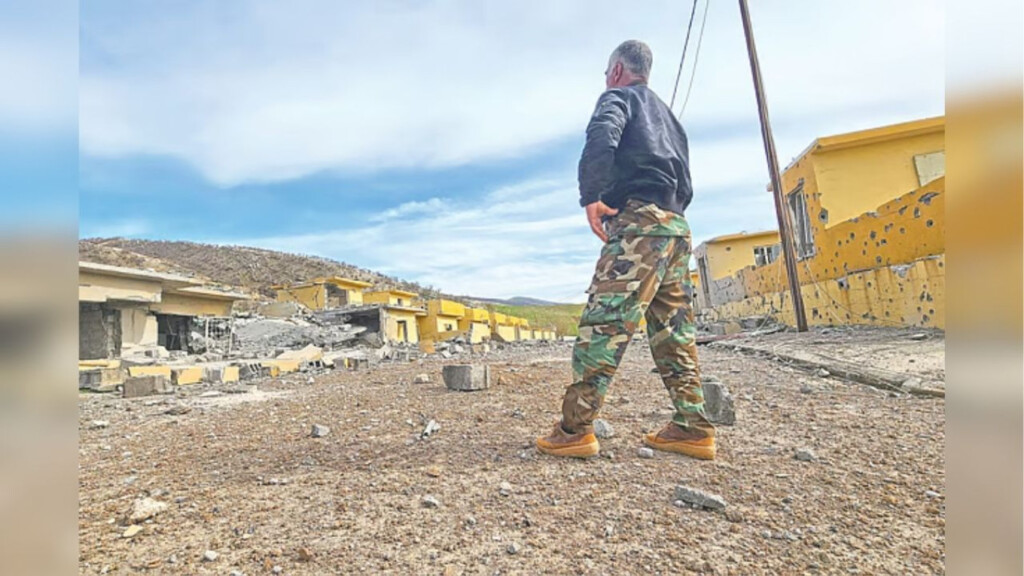
The Proxy Ground War: While US Secretary of State Marco Rubio insists that a ground invasion is not currently on the table, the activation of Kurdish and Azeri insurgent groups suggests a desperate search for a “cheap” alternative to US boots on the ground. Iran has countered this by pre-emptively striking Kurdish camps (KDPI and PAK) near Erbil, Iraq.
The Looming Shadow of China
Perhaps the most significant concern for Washington is the “demonstration effect.” If Iran can successfully employ a cost-distribution strategy to stall a superpower, it provides a blueprint for larger adversaries.
The Pentagon’s Joint Chiefs of Staff Chairman, General Dan Kane, has warned of “significant loss of life” ahead. This admission, coupled with the systemic failure to achieve a quick victory, raises a haunting question: Has the US military machine, in its zeal to redraw the map of the Middle East, walked into a sophisticated, long-term trap designed to bleed its credibility and resources dry?
The conflict is no longer a test of Iranian survival; it has become a test of American endurance.