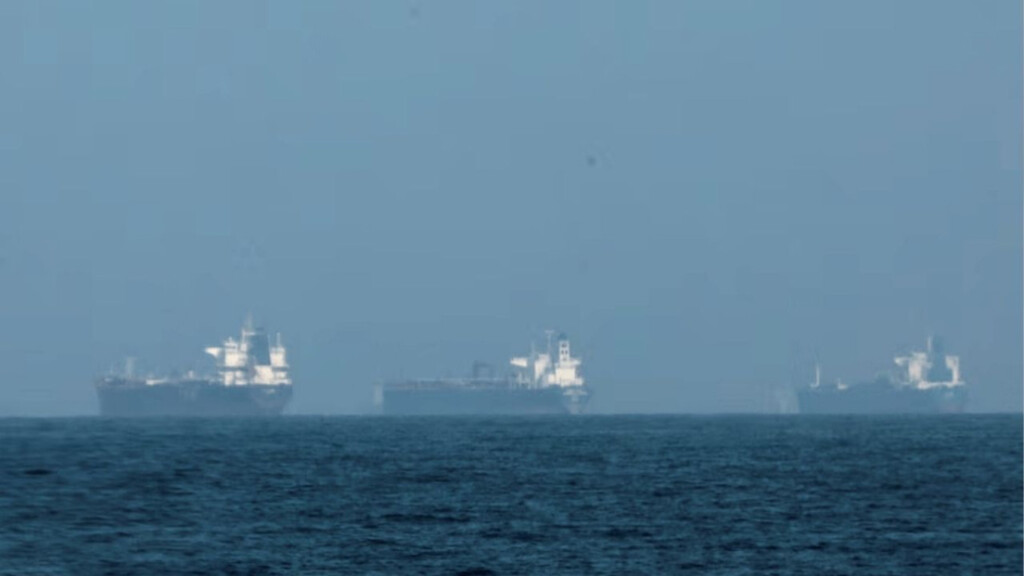
The maritime security landscape in the Middle East has reached a critical flashpoint, with the United Kingdom Maritime Trade Operations (UKMTO) reporting a surge in kinetic activity over the last 24 hours. According to official dispatches, five commercial vessels were targeted in the Arabian Gulf and surrounding waters, marking a significant escalation in the regional conflict.
The Anatomy of the Strikes
The latest cycle of violence focused heavily on the strategic approaches to the Strait of Hormuz. Off the coast of Fujairah, two oil tankers sustained direct hits from missiles. Preliminary assessments suggest the damage was largely confined to the ships’ funnels and external steel plating; however, the psychological impact on global shipping remains profound.
Further west, a container vessel was engaged while transiting the Strait of Hormuz, a chokepoint that Tehran recently declared a restricted military zone. In addition to these direct hits, “near-miss” explosions were reported in the waters off the Omani coast and west of Dubai. These incidents typically involve sea mines or loitering munitions designed to intimidate commercial crews and disrupt insurance stability.
Maritime Security Log: Last 24 Hours
| Vessel Type | Incident Location | Nature of Attack | Reported Damage |
|---|---|---|---|
| Oil Tanker | Fujairah Coast | Missile Strike | Funnel and hull integrity compromised |
| Oil Tanker | Fujairah Coast | Missile Strike | Minor structural damage |
| Container Ship | Strait of Hormuz | Direct Engagement | Under assessment |
| Commercial Vessel | Off Oman | Near-miss Explosion | No structural damage reported |
| Commercial Vessel | West of Dubai | Near-miss Explosion | Shockwave impact only |
The Economic Chokepoint
The volatility follows an explicit warning issued by Tehran on Monday, wherein the Islamic Revolutionary Guard Corps (IRGC) announced the total closure of the Strait of Hormuz. The Iranian military has vowed to seize or destroy any vessel attempting to traverse the waterway, which serves as the primary artery for global energy exports.
Data from the energy market intelligence firm Kpler underscores the severity of the blockade. Since the commencement of US and Israeli operations against Iranian targets, tanker traffic through the Strait has plummeted by an unprecedented 90%. This near-total cessation of movement has sent shockwaves through the Brent and WTI crude markets, as the “security premium” on oil reaches levels not seen in decades.
Strategic Implications
The systematic targeting of non-combatant commercial vessels indicates a shift in Iranian strategy toward “asymmetric economic warfare.” By rendering the Gulf unnavigable, Tehran aims to compel the international community to pressure Washington into a ceasefire. For the British and American navies, the challenge has transitioned from protecting specific military assets to the monumental task of securing vast, contested sea lanes against a barrage of low-cost, high-impact weaponry.
As global insurance premiums for Gulf transits soar to prohibitive heights, the maritime industry is bracing for a prolonged period of disruption that could fundamentally redraw the map of global trade routes.