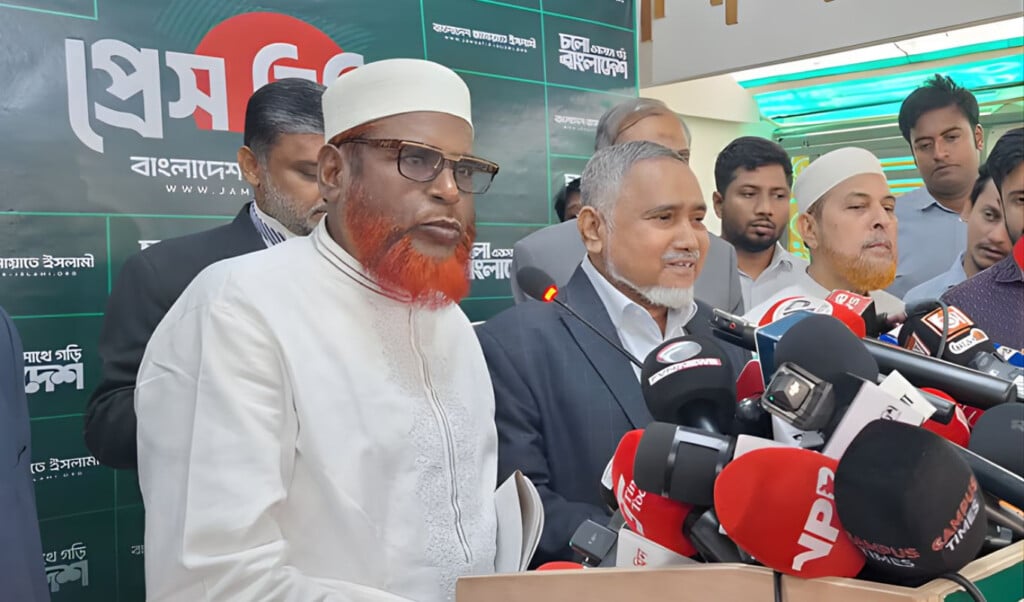
Bangladesh Jamaat-e-Islami has called for the interrogation and trial of two former government advisers, Syeda Rizwana Hasan and Khalilur Rahman, alleging their involvement in manipulating the electoral process. The demand was made during a press conference held on Thursday afternoon at the party’s central office in Moghbazar, Dhaka.
Speaking at the briefing, Jamaat’s Nayeb-e-Ameer and Deputy Leader of the Opposition, Syed Abdullah Mohammad Taher, accused the former advisers of engaging in what he described as “election engineering” designed to prevent the party from emerging as a major political force. According to Taher, remarks recently attributed to Rizwana Hasan in a media interview suggested that certain political actors had been deliberately sidelined despite public support.
Taher claimed that Hasan’s comments amounted to an implicit admission that political calculations influenced the electoral environment. He said Jamaat now expected the authorities to investigate how such alleged interference might have taken place and to clarify whether the entire government apparatus or only specific officials were involved.
He further questioned whether administrative and law-enforcement officials were deployed in ways that influenced the outcome of the election. Taher argued that positions such as Deputy Commissioners (DCs), Superintendents of Police (SPs), Upazila Nirbahi Officers (UNOs), Officers-in-Charge (OCs) and presiding election officers might have been strategically appointed to achieve predetermined electoral results.
“People deserve to know whether state institutions were used to favour a particular political party,” Taher said. He urged the government to summon Rizwana Hasan for questioning and disclose the findings of any investigation to the public.
Taher also raised concerns regarding Khalilur Rahman, who had served as a security adviser in the interim administration before later taking oath as Foreign Minister. According to the Jamaat leader, the interim government had earlier pledged neutrality comparable to that of a caretaker government and had indicated that its advisers would not join any partisan cabinet afterwards.
Taher alleged that Rahman’s appointment to the foreign ministry contradicted that commitment. He further accused him of playing a role in what he described as a “London-based political conspiracy”, claiming that the move was intended to benefit certain political interests within the government.
The Jamaat leader also referred to earlier criticism from BNP leader Salahuddin Ahmed regarding Rahman’s role in government affairs. Taher expressed surprise that, despite controversy surrounding him, Rahman was later appointed to a key ministerial position.
Jamaat insists that it had sought a fair and transparent election but believes the process was undermined by political manoeuvring. Taher argued that any individuals responsible for distorting the democratic process must be held accountable.
Key Allegations Raised by Jamaat
| Issue | Jamaat’s Allegation | Party’s Demand |
|---|---|---|
| Election interference | Former advisers allegedly influenced electoral outcomes through “election engineering” | Independent investigation |
| Administrative role | Possible strategic deployment of DCs, SPs, UNOs and election officials | Public disclosure of decision-making process |
| Rizwana Hasan’s remarks | Statements interpreted as acknowledgement of political manipulation | Formal interrogation |
| Khalilur Rahman appointment | Appointment as Foreign Minister seen as contradicting interim neutrality pledge | Government explanation |
Several senior Jamaat leaders attended the press conference, including Secretary General Mia Golam Parwar, Opposition Whip Rafiqul Islam Khan, Member of Parliament Saiful Alam Khan, and central executive members Advocate Shishir Monir and Zahidur Rahman.
The government has not yet issued an official response to the allegations. However, political analysts note that the accusations are likely to intensify debate over electoral transparency and the role of interim administrations in Bangladesh’s political landscape.