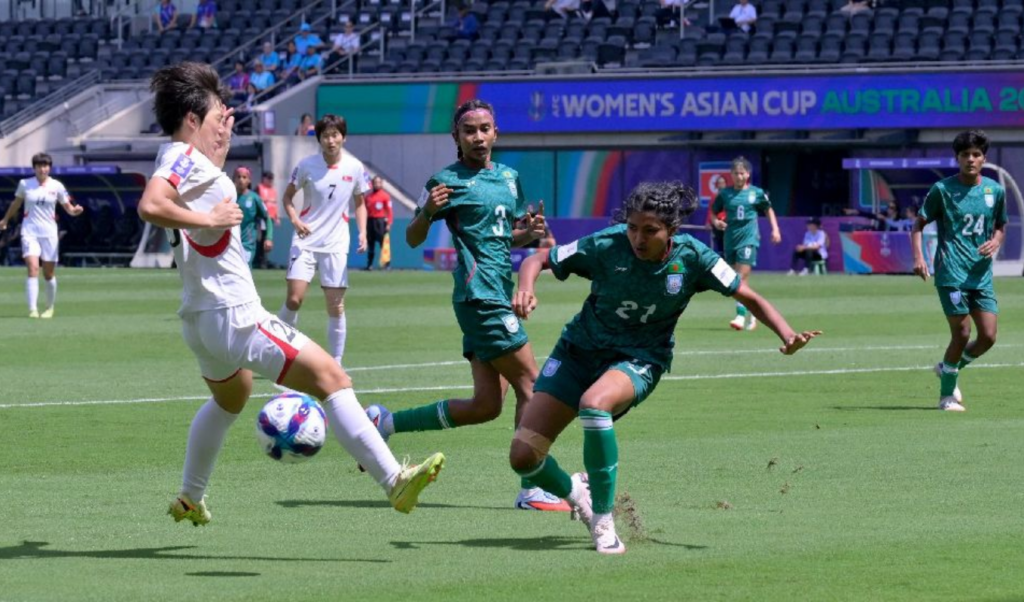
The Bangladesh women’s football team endured a crushing 5-0 defeat against North Korea in their latest group-stage match, leaving their hopes of progressing in the tournament in jeopardy. The match, held in Sydney, saw the Red and Green side unable to withstand North Korea’s relentless offensive play.
Match Summary
Despite a valiant performance against China in their previous match, Bangladesh could not replicate the same spark against a highly organised North Korean side. The North Koreans dominated proceedings from the outset, combining tactical discipline with lethal finishing.
North Korea’s Kim Kyong-yong emerged as the star of the match, scoring two goals and securing her status as the decisive player. Her teammates Miyong Yu-jong, Chae Un-yong, and Kim Hye-yong each contributed a goal, cementing the 5-0 scoreline and delivering a sobering defeat for Bangladesh.
| Aspect | Details |
|---|---|
| Match | Bangladesh Women vs North Korea Women |
| Date & Venue | 7 March 2026, Sydney, Australia |
| Result | North Korea 5 – 0 Bangladesh |
| Bangladesh Goals | 0 |
| North Korea Goals | Kim Kyong-yong (2), Miyong Yu-jong, Chae Un-yong, Kim Hye-yong |
| Ball Possession | North Korea 65.3%, Bangladesh 34.7% |
| North Korea Shots | 31 total, 11 on target |
| Key Bangladesh Player | Milli Akter (goalkeeper, multiple crucial saves) |
Defensive Heroics by Bangladesh
Despite the heavy loss, goalkeeper Milli Akter stood out as a beacon of resilience. Positioned under relentless pressure, she made at least five critical saves that prevented the defeat from being even more severe. Bangladesh’s defensive unit also contributed by absorbing wave after wave of North Korean attacks, but ultimately, the strength and precision of the opposition proved too overwhelming.
Tactical Analysis
Bangladesh struggled to assert themselves in both midfield and attack. Players such as Rituparna and Mariara repeatedly lost control of the ball, failing to mount any sustained offensive pressure. The team’s lack of possession—just 34.7% compared with North Korea’s 65.3%—meant that defensive lines were under continuous strain.
This disparity in ball control, combined with the inability to build attacking momentum, led to the concession of five goals over the full 90 minutes. Analysts noted that while the defensive efforts, particularly Milli’s heroics, offered a small positive takeaway, the overall performance highlighted the gap in tactical execution and finishing ability between the two sides.
Implications for Tournament Progress
With consecutive defeats—0-2 against China and 0-5 against North Korea—Bangladesh now faces a critical final group-stage match against Uzbekistan on 9 March in Perth. The team must secure at least a victory or a favourable result to maintain any chance of advancing.
Fans and commentators are hopeful that the Red and Green side will address the errors evident in their first two matches and deliver a stronger, more disciplined performance against Uzbekistan. Achieving a win in the final match would not only salvage pride but also demonstrate the team’s resilience and potential for future competitions.
Looking Ahead
The Bangladesh women’s team must focus on improving ball retention, midfield control, and attacking cohesion if they are to challenge stronger sides in the tournament. While the losses to China and North Korea underline the challenges ahead, the upcoming match presents a critical opportunity to gain experience, restore confidence, and potentially claim a first victory in this competitive setting.