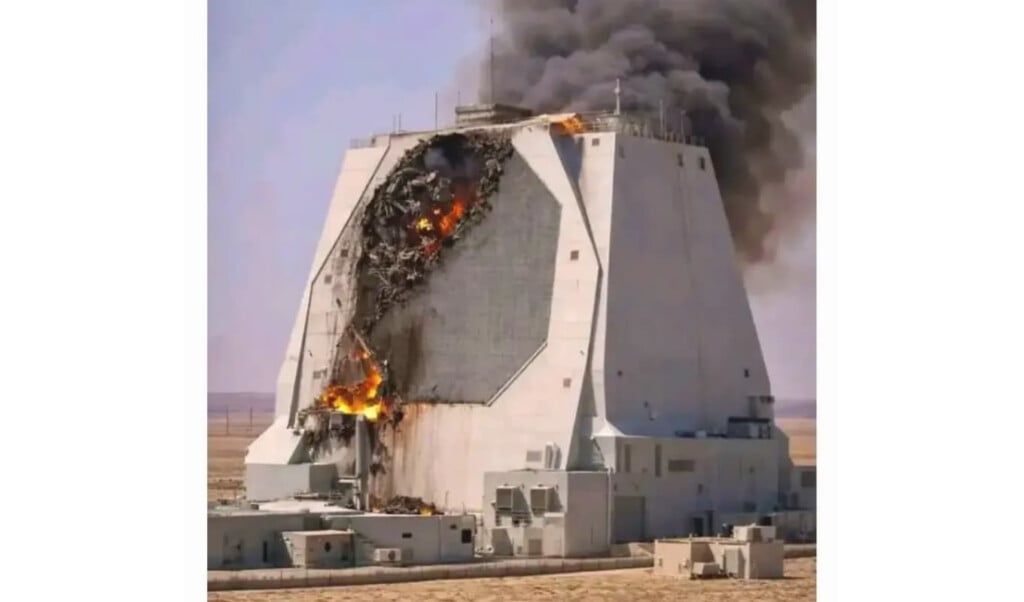
A precision Iranian military strike has completely destroyed a critical U.S. defence radar in the Gulf region, raising serious concerns about American missile defence capabilities in the area. The radar, valued at approximately 300 million dollars, played a pivotal role in the Terminal High Altitude Area Defense (THAAD) system, which is designed to intercept ballistic missiles at high altitudes.
U.S. military sources confirmed that the attack occurred at Jordan’s Muwaffaq Salti Air Base during the early days of the ongoing conflict. Satellite imagery shows that the AN/TPY-2 radar and associated support equipment, manufactured by RTX Corporation, were entirely obliterated. One American official later confirmed the radar’s destruction, highlighting the strategic blow to the THAAD battery.
The Foundation for Defence of Democracies reported that Iran carried out two strikes on Jordanian territory, the first on 28 February and the second on 3 March. While both attacks were partially intercepted, the loss of the THAAD radar has alarmed military experts. Ryan Brobst, deputy director of the Foundation’s Center on Military and Political Power, stated, “Had the attack been fully successful, it would have marked Iran’s most effective strike against THAAD to date.”
THAAD systems are capable of destroying ballistic missiles at high altitudes, offering protection beyond the reach of short-range Patriot missile systems. With the AN/TPY-2 radar gone, the THAAD battery’s operational capacity is significantly diminished, shifting defence responsibilities largely to Patriot systems. Analysts warn that the Patriot PAC-3 interceptor stockpile could be rapidly depleted under sustained threats.
The United States maintains a total of eight THAAD batteries globally, including deployments in South Korea and Guam. Each battery is valued at roughly one billion dollars, with the radar component alone accounting for approximately 300 million dollars.
THAAD Battery Components and Capabilities
| Component | Quantity | Description |
|---|---|---|
| Personnel | 90 | Operators assigned to the battery |
| Truck-mounted Launchers | 6 | Each launcher carries 8 interceptors; total 48 interceptors |
| AN/TPY-2 Radar | 1 | Detects and tracks targets at high altitude |
| Fire Control & Communications Unit | 1 | Coordinates and manages the system |
Each interceptor missile, manufactured by Lockheed Martin, costs roughly 13 million dollars. Another radar stationed in Qatar, the AN/FPS-132, was also damaged early in the conflict; it is primarily used for long-range threat detection rather than direct interception.
The Gulf region’s U.S. defence network is under pressure from a combination of Iranian drones and ballistic missile threats. On Friday, the White House convened an urgent meeting with representatives from Lockheed Martin and RTX Corporation to discuss accelerated production of replacement systems. Analysts warn that the strikes could have long-term consequences for U.S. defence readiness and regional security.