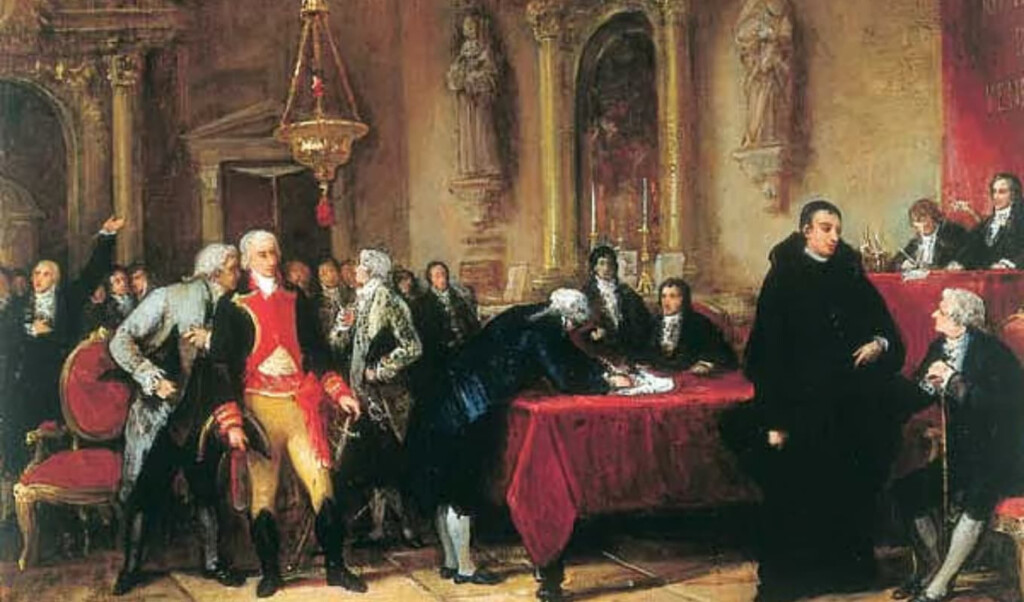
The declaration of independence issued by Venezuela in the early nineteenth century stands as one of the most significant political documents in the history of Latin America. Adopted on 5 July 1811, it marked a decisive step away from Spanish colonial authority and towards the creation of a sovereign republican state. More than a simple act of rebellion, the declaration reflected a carefully considered political philosophy shaped by the intellectual and geopolitical currents of the Atlantic world.
At the time, Europe was undergoing profound upheaval. In 1808, the French emperor Napoleon Bonaparte invaded Spain, forcing King Ferdinand VII from the throne and installing his brother Joseph Bonaparte as ruler. This intervention plunged the Spanish Empire into a crisis of legitimacy. As news reached Spain’s American colonies, a profound political vacuum emerged. Local elites began to question whether they should continue to recognise the authority of a distant monarchy weakened by foreign domination.
In Venezuela, the first response was cautious. The Creole elite—people of Spanish descent born in the Americas—initially sought to maintain loyalty to the Spanish crown while protecting their local interests. However, events soon overtook this cautious stance. On 19 April 1810, leaders in Caracas established a governing council, or junta, effectively creating a local administration that operated independently of Madrid. This development laid the institutional groundwork for the independence movement that followed.
Intellectual Foundations of Independence
The Venezuelan declaration drew heavily on the ideas of the European Enlightenment. Concepts such as popular sovereignty, the social contract, and natural rights formed the philosophical backbone of the document. These principles, widely debated in eighteenth-century Europe and the Americas, had already influenced earlier political transformations, including the American Declaration of Independence (1776) and the French Revolution (1789).
Thinkers such as Jean-Jacques Rousseau, John Locke, and Montesquieu had argued that legitimate political authority derived not from divine right but from the consent of the governed. Venezuelan leaders embraced this argument, asserting that the people possessed the ultimate authority to determine their own political destiny.
Why Independence Became Inevitable
The declaration presented a series of arguments explaining why separation from Spain had become unavoidable. One of the most powerful was the sheer geographical and administrative distance between the colony and the imperial centre. Venezuelan leaders argued that it was both impractical and unjust for a small European peninsula to govern a vast territory thousands of miles away.
They also criticised Spain’s economic restrictions, including tight controls on trade and the monopolisation of colonial markets. Such policies limited local economic development while enriching the imperial administration. Venezuelan revolutionaries contended that independence would allow the country to establish its own commercial networks and political institutions.
Key Milestones in Venezuela’s Independence Struggle
| Year | Event | Significance |
|---|---|---|
| 1808 | Napoleon invades Spain | Creates crisis of legitimacy in Spanish Empire |
| 19 April 1810 | Caracas junta established | Beginning of self-government in Venezuela |
| 5 July 1811 | Declaration of independence | Formation of the First Venezuelan Republic |
| 1811–1821 | War of independence | Prolonged conflict between royalists and republicans |
| 1821 | Battle of Carabobo | Decisive victory securing independence |
A New National Identity
The declaration did more than sever political ties with Spain; it also helped forge a new sense of national identity. People who had long been considered subjects of the Spanish Empire began to identify themselves as Venezuelans. This transformation represented not only political liberation but also a profound psychological shift, laying the foundation for a distinct national culture and political vision.
The Cost of Freedom
Despite the symbolic power of the declaration, independence was not immediately secured. The years that followed were marked by intense and often brutal warfare between royalist forces, loyal to Spain, and republican revolutionaries seeking independence. Prominent leaders such as Simón Bolívar and Francisco de Miranda emerged as central figures in the struggle.
The conflict lasted more than a decade, bringing devastation to much of the region. Only after a series of decisive battles—culminating in the Battle of Carabobo in 1821—was Venezuelan independence firmly established.
International recognition also proved difficult. Major powers such as Britain and the United States initially hesitated to recognise the new republic, wary of provoking tensions with Spain and disrupting the fragile balance of European politics.
Enduring Legacy
The declaration concluded with a solemn pledge by its signatories, who vowed to defend their new nation with their lives, property, and honour. This commitment underscored the seriousness of their undertaking and the risks they were willing to accept in pursuit of liberty.
Today, Venezuela’s declaration of independence remains a powerful reminder that political freedom rarely emerges overnight. It requires not only courage and sacrifice but also a clear philosophical vision and a firm commitment to the principles of sovereignty and self-determination. In the broader history of Latin America, the document helped inspire similar movements across the continent, transforming the political landscape and reshaping the modern world.