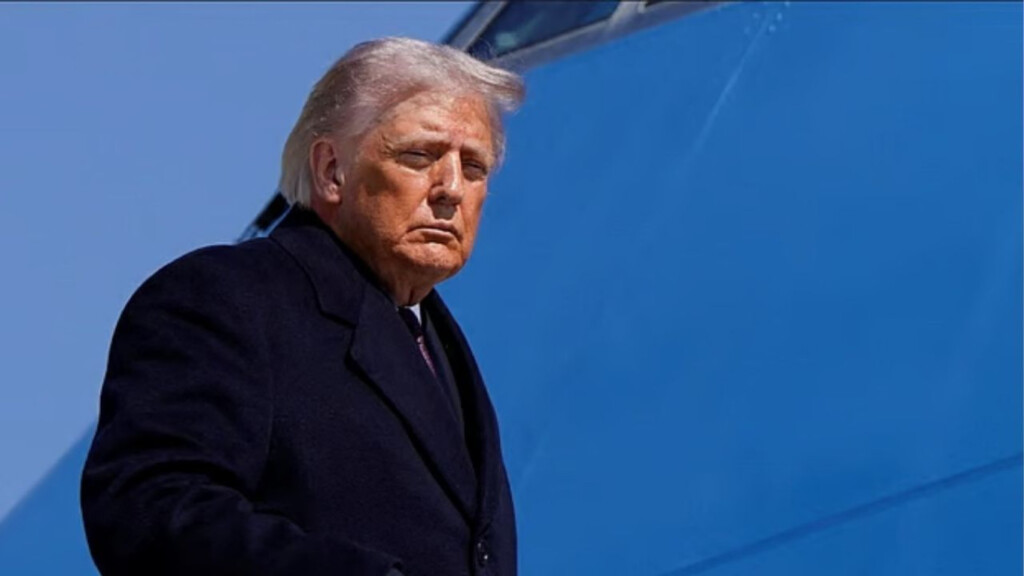
On a Friday afternoon in early 2026, while cruising at thirty thousand feet aboard Air Force One, President Donald Trump issued the order that would dismantle his hard-won reputation as the “Anti-Interventionist President.” Bound for Corpus Christi, Texas, to deliver a lecture on “American Energy Dominance,” the President spent the three-hour flight huddled with hawkish Republican senators, including Ted Cruz and John Cornyn, debating the final parameters of Operation Epic Fury—a full-scale military campaign against Iran.
A Cinematic Transfer of Power
The atmosphere on the flight was surreal, blending high-stakes geopolitics with Hollywood flair. Joining the political entourage was veteran actor Dennis Quaid, who had recently portrayed Ronald Reagan in a 2024 biopic. In a moment captured on video by Senator Cruz, Quaid sat beside Trump and reprised his role as the “Gipper,” stating, “Donald Trump is as strong as I am.”
This symbolic passing of the torch from the icon of 1980s conservatism to the modern MAGA leader masked a deeper, more troubling historical parallel. Ironically, Quaid had also once played a satirical version of George W. Bush—a leader depicted as being led into the Iraq War by oil-hungry advisers. Despite the White House’s denials, the shadows of the 2003 invasion loomed large over the current escalation.
The Shift in Strategy: From Nobel Prize to “Regime Change”
Trump’s 2024 campaign was built on the promise of ending “eternal wars” in Afghanistan and Iraq. Throughout 2025, his administration actively lobbied for a Nobel Peace Prize, positioning him as a global mediator. However, several factors triggered a hawkish pivot:
The Venezuela Precedent: The successful abduction of Nicolás Maduro by U.S. Special Forces in January 2026 emboldened Trump, proving that high-risk, high-reward operations could distract from domestic scandals—specifically the ongoing pressure regarding the release of the Jeffrey Epstein documents.
Technological Supremacy: While Trump remained opposed to massive ground troop deployments, he became enamoured with “push-button warfare”—using air superiority and Tomahawk missiles to crush adversaries without American casualties.
Regional Influence: Pressure from Israeli Prime Minister Benjamin Netanyahu and private calls from Saudi Crown Prince Mohammed bin Salman urged a definitive strike against Tehran’s nuclear and missile infrastructure.
Timeline of the Escalation to Operation Epic Fury
| Date | Event | Outcome |
|---|---|---|
| 3 January 2026 | Extraction of Nicolás Maduro | Increased Trump’s appetite for military “spectacles.” |
| 11 February 2026 | Netanyahu White House Visit | Joint planning for Iranian regime change finalised. |
| 26 February 2026 | Geneva Diplomatic Talks | Failed due to Trump’s demand for permanent enrichment bans. |
| 6 March 2026 | Air Force One Order | Operation Epic Fury officially authorised at 3:38 PM. |
| 7 March 2026 | Initial Strike | 100+ aircraft and Tomahawk missiles hit Tehran. |
The “War-a-Lago” Reality
The command centre for this new conflict was not the White House Situation Room, but a temporary tactical suite at Mar-a-Lago. As donors at a charity gala danced outside, Trump entered the “observation room” to witness the opening salvos. Even Vice President J.D. Vance and Tulsi Gabbard—noted critics of foreign intervention—were present, signalling a unified front for a war aimed at toppling the 47-year-old Islamic Republic.
Ultimately, the “Peace President” has embraced the very cycle he once vowed to break. Claiming an “infinite arsenal,” Trump has committed the United States to a conflict whose beginning he dictated, but whose end now rests in the hands of a defiant Iranian leadership.