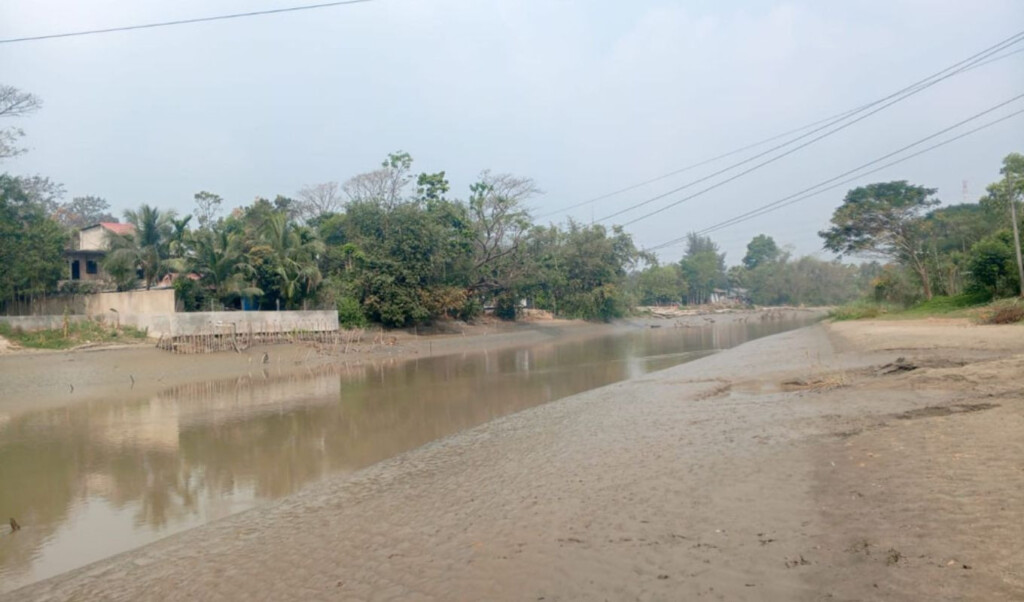
Once a vibrant waterway, the Small Feni River in the southern districts of Bangladesh has now become a source of deep concern for riverside farmers. Reduced freshwater flow from upstream and the encroachment of saline seawater have severely disrupted agricultural activities across extensive tracts of farmland.
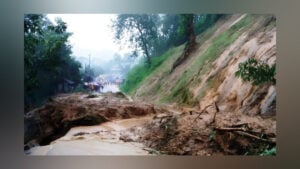
Local farmers rely heavily on the river for irrigation, cultivating rice, vegetables, and other seasonal crops throughout the year. However, the onset of the dry season has coincided with an abnormal rise in salinity levels. During the last flood, the Musapur closure in Noakhali’s Companyganj Upazila was damaged, allowing saline water from the Bay of Bengal to enter the river unhindered.
Previously, farmers would irrigate boro rice and winter vegetables with river water without adverse effects. Today, even small amounts of this water burn seedlings, turning crops red and causing them to wither within days. Deep tube wells are now the only alternative, yet these are insufficient and significantly increase production costs.
Farmers warn that salinity levels are several times higher than the tolerable threshold, degrading soil fertility and threatening the long-term viability of the region’s agriculture-based economy. Moreover, heavy sediment deposits carried by tidal inflows have silted the riverbed, reducing navigability and water retention capacity. Crops such as watermelon, cucumber, pumpkin, and chilli—vital to the coastal economy—remain largely uncultivated due to water quality issues.
Farmer Testimonies
| Farmer | Location | Concern |
|---|---|---|
| Mohammad Ismail Hossain | Adarsha Village, Sonagazi | “River water used to sustain both Aman and Boro rice. Now even a sip burns the tongue. Seedlings die within two days of irrigation.” |
| Sheikh Farid Amin | Baligaon Union, Feni Sadar | “Previously, we could irrigate cheaply using the river. Saline, sandy water now makes cultivation impossible. Many farmers did not even sow crops this season.” |
| Nur Hossain | Feni Sadar | “Small Feni supports millions. Salinity has left hundreds of acres fallow, and feed for livestock is now scarce due to dying grasses.” |
Experts and local agricultural officers emphasise urgent remedial measures, including:
Rapid reconstruction of the Musapur closure.
Modernisation and proper management of sluice gates.
Regular dredging to restore river depth and retain freshwater.
Distribution of salt-tolerant crop varieties to farmers.
Government-supported rainwater harvesting through pond and canal renovation.
Feni’s Daganbhunja Upazila Agricultural Officer, Kamruzzaman, noted that while farmers are accessing alternative water sources, the region’s dependency on the river remains critical. Meanwhile, Feni Water Development Board Executive Engineer Monirul Islam confirmed that the Musapur closure project is under consideration by the Planning Commission. Once implemented, it is expected to stabilise the river, mitigate saline intrusion, and protect livelihoods.
Without immediate and effective action, the Small Feni River’s water crisis could push the coastal region towards permanent soil degradation, posing a severe threat to both agriculture and the local farming community.