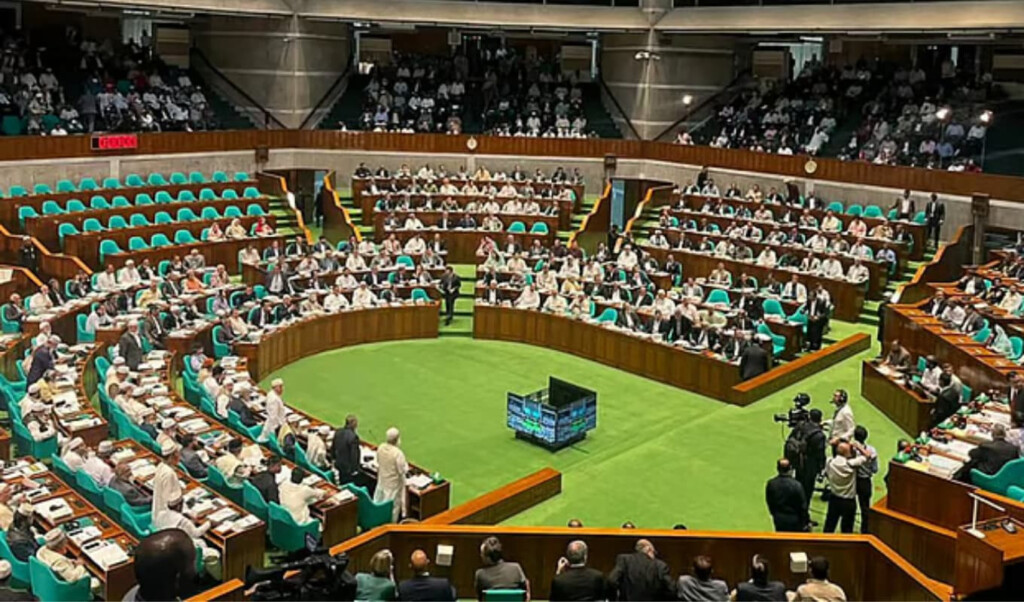
Bangladesh’s 13th National Parliament has come under intense criticism following the adoption of a condolence motion in the names of individuals convicted of war crimes during the 1971 Liberation War. The decision has been widely denounced by political parties, cultural organisations, and civil society for undermining the memory of the nation’s martyrs.
The Communist Party of Bangladesh (CPB) described the parliamentary motion as “an act of profound betrayal against the 3 million martyrs and countless women who suffered atrocities during the Liberation War.” CPB President Kazi Sajjad Zahir Chandan and General Secretary Abdullah Kafi Ratan issued a statement on Friday condemning the inclusion of figures linked to the Jamaat-e-Islami party and their affiliates. They stated, “To honour convicted perpetrators in the first session of the 13th Parliament is inexcusable, and the people of Bangladesh will never forget this affront.”
The Socialist Party of Bangladesh (BASAD) also protested the motion and demanded the immediate removal of the names of war criminals. BASAD Central Committee General Secretary Bazlur Rashid Firoz criticised the parliamentary process, noting that the government’s Chief Whip proposed the motion in the names of convicted Razakars and war criminals, which was subsequently approved by the Speaker. Firoz called this “a disgraceful precedent that tramples on the collective consciousness of the nation forged through decades of struggle and sacrifice.”
Cultural organisation Bangladesh Udichi added its condemnation, highlighting the broader disrespect shown to national symbols. Acting President Mahmud Selim and General Secretary Amit Ranjan De accused opposition MPs of failing to stand during the national anthem, describing this behaviour as “an insult to the values of independence, the Liberation War, and the sacrifices of our martyrs.” They emphasised that the inclusion of convicted war criminals in a parliamentary tribute distorts history and sends a misleading message to younger generations.
In addition, 41 prominent citizens, including poets, writers, journalists, researchers, and development workers, publicly demanded the withdrawal of the motion from the parliamentary record. Their statement urged vigilance to prevent similar controversial decisions in the future, calling the parliamentary tribute “a violation of historical truth and national conscience.”
Summary of Reactions
| Group / Organisation | Reaction | Remarks |
|---|---|---|
| Communist Party of Bangladesh (CPB) | Strong condemnation | “Betrayal of Liberation War martyrs” |
| Socialist Party of Bangladesh (BASAD) | Calls for withdrawal | “Disgraceful precedent undermining collective memory” |
| Bangladesh Udichi | Condemnation and protest | Highlights disrespect to national anthem and symbols |
| 41 Prominent Citizens | Demands removal | Urges prevention of future controversial acts |
The backlash underscores the enduring sensitivity surrounding the legacy of the 1971 Liberation War and reflects broad public insistence that state institutions uphold the honour of national history and the memory of those who sacrificed their lives for Bangladesh’s independence.