Despite near-universal enrolment in primary education, a substantial number of students drop out before completing their studies, compelled by the need to contribute to family income. As a result, the rate of child labour in the country has risen sharply, increasing by approximately 2.4 percentage points in recent years. Economic pressures and social realities are driving many children out of school and into the workforce.
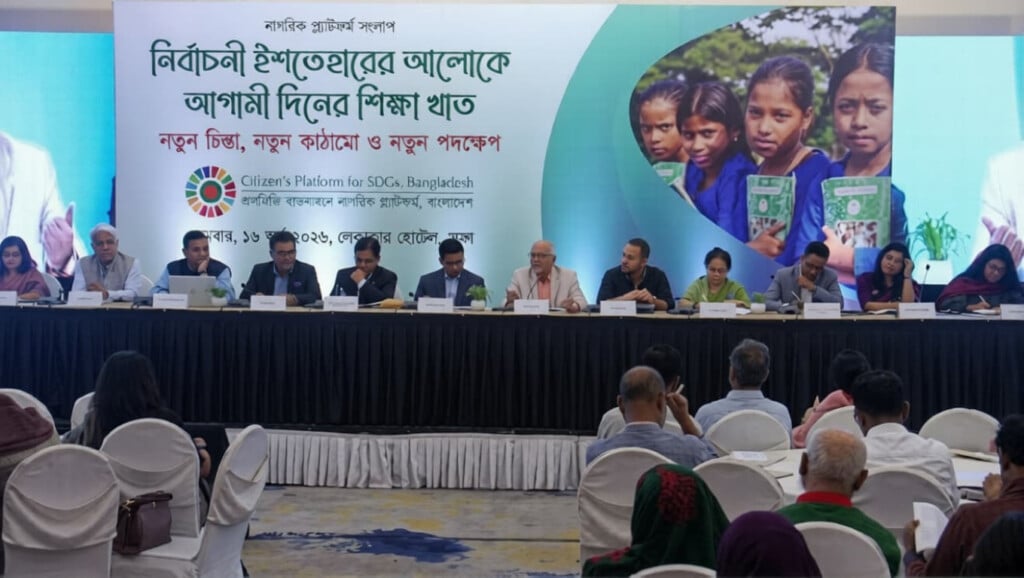
These findings were presented on Monday at a dialogue titled “Future of Education in Light of Election Manifestos: New Ideas, New Structures, and New Measures”, organised by the Citizen Platform at a hotel in the capital. The session featured a keynote presentation by Dr. Toufiqul Islam Khan, Additional Research Director at the Centre for Policy Dialogue (CPD). The event was moderated by Dr. Debapriya Bhattacharya, Convener of the Citizen Platform and Honourable Fellow of CPD. Special guests included Babi Hajjaj, State Minister for Primary and Mass Education, and Mahdi Amin, the Prime Minister’s Education Adviser. CPD Fellows Professor Mostafizur Rahman and educationist Rasheda K. Chowdhury also attended.
Dr. Khan highlighted that while enrolment in primary education has reached near-universal levels, retaining students beyond the primary stage remains a major challenge. Male enrolment, once nearly 98%, fell to approximately 91% in 2024. Transition rates from primary to secondary education are similarly unsatisfactory, with many students unable to progress or leaving school mid-course. Children from impoverished households, rural areas, or vulnerable social situations are often compelled to enter the workforce at an early age. According to CPD research, the child labour rate, which was around 6.8% in 2019, rose to nearly 9.2% in 2025.
Child Labour and Education Statistics
| Indicator | 2019 | 2024 | 2025 |
|---|---|---|---|
| Male primary enrolment (%) | 97.8 | 91.3 | – |
| Child labour rate (%) | 6.8 | – | 9.2 |
| Transition to secondary education (%) | 85 | 78 | – |
CPD studies further indicate that significant inequalities exist in education costs and access. More than half of all educational expenses are borne by families directly, making education difficult for low-income households. Although textbooks are provided free of charge, families must regularly spend on guides, coaching, and additional learning materials. Limited technological facilities and inadequate infrastructure for students with disabilities further exacerbate disparities. In addition, insufficient sanitation and safety measures for girls impede educational continuity.
The research also noted that unemployment among highly educated youth has reached approximately 13.5%, highlighting a mismatch between academic qualifications and labour market requirements. Graduates often lack the practical and cognitive skills demanded by modern workplaces, leaving many unable to compete effectively. Experts warn that unless the education system transitions from degree-centric learning to skills-based education, reducing educated unemployment and creating a skilled workforce essential for national development will remain a formidable challenge.