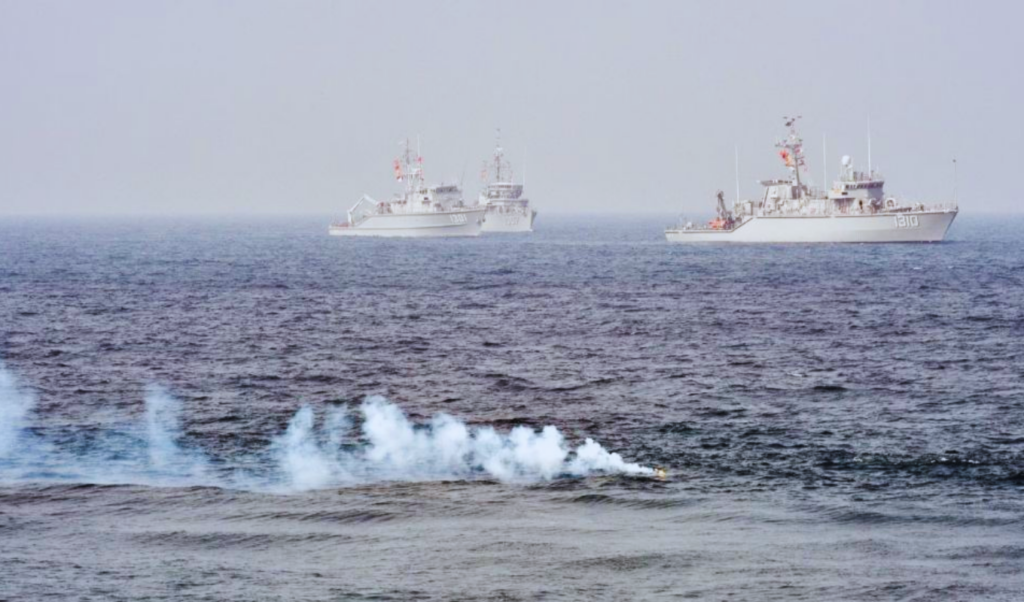
Tensions have escalated in the Strait of Hormuz, a critical maritime chokepoint in the Middle East, after reports emerged that Iran has deployed naval mines in the waterway. The move has sparked international concern due to its potential impact on global trade and the oil market.
According to reports from CBS News, the Iranian Islamic Revolutionary Guard Corps (IRGC) has laid at least a dozen naval mines, including advanced Maham-3 and Maham-7 types. These modern mines are capable of detecting nearby vessels and detonating automatically, posing a serious hazard to commercial shipping.
Several U.S. media outlets have noted that the mines were reportedly deployed on 23 March, before the expiry of a two-day ultimatum issued by then-President Donald Trump. While the precise number of mines remains unconfirmed, analysts warn that even a limited deployment could have disproportionate consequences.
The Strait of Hormuz is responsible for transporting roughly 20 per cent of the world’s seaborne oil. As a result, even a small number of mines could cause major disruption. Shipping companies have already expressed concerns, and insurance premiums for vessels navigating the strait have begun to rise.
Experts indicate that the mines were not placed haphazardly but at strategic locations. This suggests that Iran retains the capacity to selectively allow or block ship passage, effectively transforming the strait into a controlled maritime corridor rather than closing it entirely. Current intelligence suggests the mines have been laid closer to the Dubai coastline rather than near Iranian territorial waters.
Naval historian John Buckley commented, “Controlling the flow of global oil allows leverage without direct conflict.”
To date, there are no confirmed reports of ships striking the mines. Nevertheless, drone attacks by Iran have already led to reduced vessel traffic, significantly lowering the volume of shipping through the strait.
The United States, along with the United Kingdom and France, is reportedly monitoring the situation closely, with contingency plans to secure safe navigation. Japan has also indicated willingness to provide support if necessary. Retired U.S. General Jack Keane warned, “We are dealing with a government that has a history of deception; extreme caution is required.”
The situation remains fluid. Although the Strait of Hormuz is technically open, it is far less secure than before. Analysts warn that a single incident could trigger a substantial shock in global oil markets.
| Aspect | Details | Implications |
|---|---|---|
| Mine Types | Maham-3, Maham-7 | Automatic detection and detonation |
| Deployment Date | 23 March 2026 (approx.) | Ahead of U.S. ultimatum expiry |
| Global Oil Transit | ~20% via the strait | Potential market disruption |
| Strategic Location | Near Dubai coastline | Allows selective passage control |
| International Response | USA, UK, France, Japan | Monitoring and potential security operations |
In conclusion, the deployment of Iranian naval mines underscores a strategic shift in maritime risk management, where control over crucial waterways can exert global influence without conventional warfare. With oil prices sensitive to even minor disruptions, the international community is on high alert as the situation continues to develop.