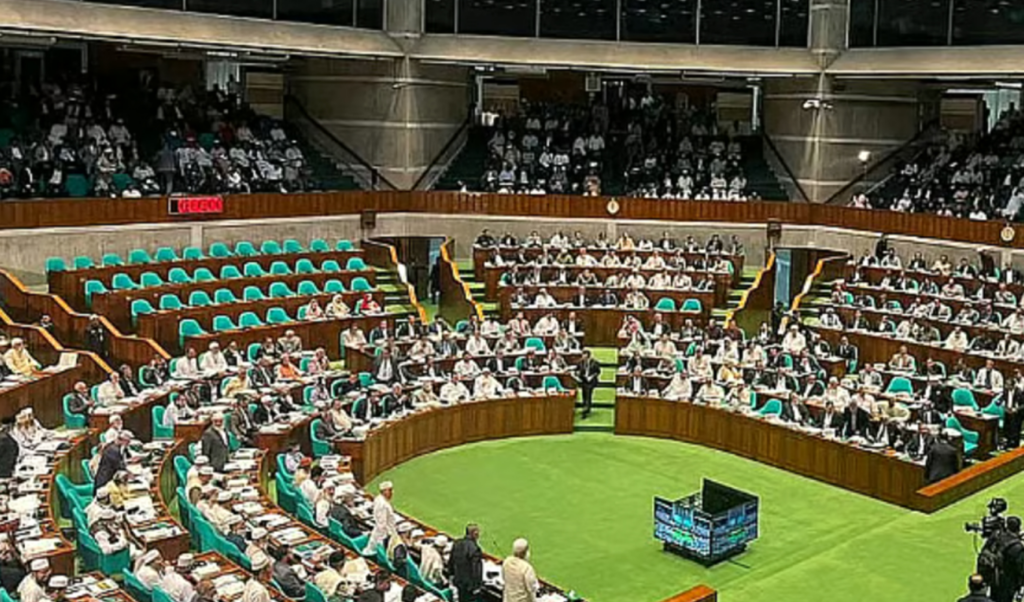
A parliamentary special committee has recommended the full approval of 98 ordinances and the partial revision of 15 others out of a total of 133 ordinances issued by the interim government, while effectively withholding immediate approval for 20 key ordinances, including the proposed referendum legislation.
The report was presented on Thursday (2 April) in Parliament by the chair of the special committee, Jaynul Abedin (Barishal-3). The committee was formed following the submission of the ordinances in the first session of the 13th National Parliament on 12 March, where they were formally tabled in accordance with parliamentary procedure. The 13-member body, comprising representatives from both the government and opposition benches, was tasked with reviewing their legal and constitutional validity.
Overview of Ordinance Review
| Category | Number of ordinances | Outcome |
|---|---|---|
| Fully approved | 98 | Recommended for passage without change |
| To be revised | 15 | To be amended before re-submission |
| Deferred / not approved | 16 | To be reworked and reintroduced later |
| Recommended for repeal | 4 | To be withdrawn via bill |
| Total reviewed | 133 | Interim government ordinances |
According to the committee’s recommendations, the remaining 20 ordinances will not receive immediate parliamentary approval. Of these, 16 are to be withdrawn from current legislative consideration and reworked for future submission, while four have been recommended for outright repeal through formal legislative bills.
The report notes that, under constitutional provisions, an ordinance loses its legal effect if it is not approved by Parliament within 30 days of being laid before the House. As a result, the delayed approval effectively places the 20 ordinances in a state of legislative uncertainty.
Among the 20 ordinances affected are significant legal and institutional reforms, including the proposed Referendum Ordinance, the Anti-Corruption Commission (Amendment) Ordinance, the National Human Rights Commission Ordinance, the Police Commission Ordinance, and the Enforced Disappearance Prevention and Remedy Ordinance.
Ordinances Recommended for Repeal
| Ordinance | Year |
|---|---|
| National Parliament Secretariat (Interim Special Provision) Ordinance | 2024 |
| Supreme Court Judges Appointment Ordinance | 2025 |
| Supreme Court Secretariat Ordinance | 2025 |
| Supreme Court Secretariat (Amendment) Ordinance | 2026 |
The committee further recommended that 16 ordinances be withheld from immediate legislative passage and instead subjected to further review and strengthening before being reintroduced as new bills. These include key areas such as revenue policy reform, microfinance regulation, information rights, and institutional governance.
Some of the notable ordinances in this group include the National Human Rights Commission (Amendment) Ordinance 2024, Revenue Policy and Management Ordinance 2025, Microfinance Bank Ordinance 2026, Information Rights (Amendment) Ordinance 2026, and the Enforced Disappearance Prevention and Remedy Ordinance 2025.
Other legislative instruments in this category include amendments relating to VAT and supplementary duties, customs law, income tax, civil aviation regulation, and travel agency registration and oversight.
The committee also identified a subset of ordinances that faced no objection from the opposition, including amendments related to VAT and supplementary duty, customs, income tax, civil aviation, and travel agency regulation.
Separately, the report recommends full parliamentary approval for a wide range of important legislative instruments, including amendments concerning local government structures, the Bangladesh Bank Act, the Energy Regulatory Commission, the Special Security Force, Grameen Bank, cyber security laws, public service regulations, electoral boundary delimitation, and rehabilitation measures related to the July uprising, among others.
However, opposition members expressed reservations regarding several of the ordinances under review. Three members from Jamaat-e-Islami submitted notes of dissent, objecting to aspects of the committee’s conclusions on the 20 contested ordinances. In total, objections were recorded against 11 of the 16 deferred ordinances.
The committee’s recommendations also include 15 ordinances proposed for revision before being resubmitted to Parliament. While the report did not specify detailed clause-by-clause amendments, it indicated that significant restructuring will be required before they can be reconsidered for legislative approval.
These 15 include amendments relating to the Prevention of Violence against Women and Children, public procurement laws, banking regulation, anti-terrorism legislation, criminal procedure reforms, national data governance, labour law, human organ transplantation, police oversight, tobacco control, human trafficking prevention, land use regulation, telecommunications oversight, and pension and welfare reforms for non-government educational institution staff.
The findings mark a critical stage in the legislative handling of the interim government’s ordinance package, with Parliament now set to decide the fate of dozens of legal instruments spanning governance, security, finance, and institutional reform. The outcome is expected to have significant implications for regulatory continuity and policy direction in the coming months.