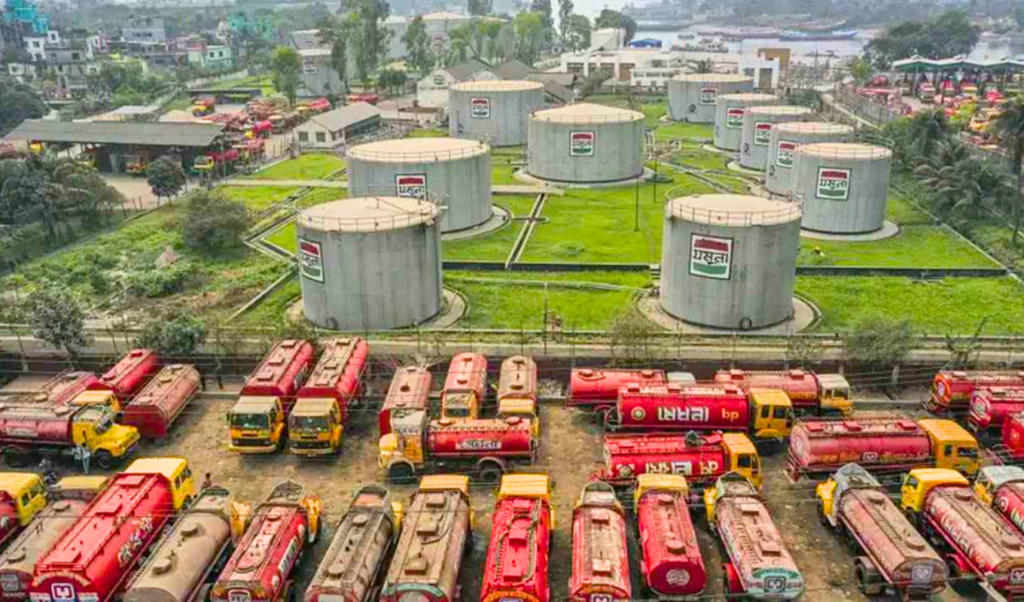
Amid growing global instability triggered by the ongoing conflict involving Iran and heightened tensions between the United States and Israel, concerns over energy security are intensifying in Bangladesh. Disruptions in international supply chains, reduced domestic gas output, and reported irregularities in the market have collectively fuelled fears of a potential nationwide fuel crisis.
According to law enforcement intelligence, these pressures have coincided with a sharp rise in the illegal stockpiling of petroleum products across the country. Authorities have confirmed that evidence of unlawful fuel hoarding has been identified in 22 districts, spread across at least 30 separate locations, marking a significant increase within a short period.
Just one week earlier, such incidents had been reported in 17 districts. The rapid expansion to 22 districts has raised concerns among officials about coordinated stockpiling activities potentially linked to market instability and speculative behaviour.
Districts Affected by Illegal Fuel Stockpiling
| Region | Districts Reported |
|---|---|
| Coastal & Southern Belt | Cox’s Bazar, Barishal, Bhola, Bagerhat, Shariatpur, Madaripur, Narail |
| Northern Region | Gaibandha, Kurigram, Dinajpur, Rajshahi, Chapainawabganj |
| Eastern & Central Belt | Mymensingh, Netrokona, Jamalpur, Gazipur, Narayanganj, Faridpur, Pabna |
| South-Eastern & Chattogram Division | Chattogram, Chattogram Metropolitan, Satkhira |
| Others | Meherpur |
Law enforcement agencies believe that rising global fuel prices and supply uncertainty in the Middle East have created opportunities for unscrupulous traders to engage in hoarding, illegal resale, and smuggling-related activities. In some areas, authorities have also reported isolated incidents of violence linked to fuel distribution disputes.
Police Headquarters data shows that between 17 March and 2 April, a series of intensified operations were carried out across the country targeting irregularities in the petroleum sector. At least 29 separate raids were conducted during this period, resulting in the seizure of more than 40,000 litres of diesel and petrol.
The operations uncovered multiple violations, including illegal fuel storage, manipulation of measurement systems, unlicensed trading, and unauthorised distribution networks. Mobile courts imposed fines amounting to approximately Tk 4.22 lakh, while seized fuel was either deposited into government custody or disposed of following legal procedures.
In a recent operation in the capital, a Rapid Action Battalion (RAB-2) mobile court seized 296 litres of illegally stored fuel from two establishments in the Agargaon area of Sher-e-Bangla Nagar. Officials stated that the crackdown is part of a broader effort to stabilise supply and prevent artificial shortages.
National Fuel Supply Overview
| Indicator | Estimate |
|---|---|
| Annual fuel import | 65–68 lakh tonnes |
| Crude oil import from Middle East | ~15 lakh tonnes |
| Refining facility | Eastern Refinery Limited |
| Regulatory authority | Bangladesh Petroleum Corporation (BPC) |
Officials from the Bangladesh Petroleum Corporation (BPC) have acknowledged that the international situation has placed some pressure on fuel reserves. However, they stressed that supply remains under control and that contingency measures are in place to ensure market stability.
A senior BPC official, speaking on condition of anonymity, noted that while temporary strain on reserves is evident due to global developments, panic buying by consumers is also contributing to perceived shortages. He urged the public not to purchase fuel in excess of actual requirements, warning that such behaviour can exacerbate distribution imbalances.
At a press briefing held at the Secretariat, Monir Hossain Chowdhury, spokesperson of the Ministry of Power, Energy and Mineral Resources, stated that the government has issued strict directives against stockpiling and artificial shortages. He confirmed that coordinated operations by law enforcement agencies are ongoing and that legal action is being taken against those found guilty of violating regulations.
Expert Concerns Over Market Manipulation
Energy analysts argue that the current situation cannot be explained solely by global instability. They suggest that domestic syndicates and market manipulation may also be contributing to the perceived shortage of petrol and octane.
Energy expert Ejaz Hossain stated that production sources such as refineries and condensate imports must be examined closely to determine whether supply levels are being accurately reported. He noted that such shortages have not been typical in previous years and called for a thorough investigation into private import channels and possible cartel activity.
Security and crime analyst Professor Dr Mohammad Omar Faruque of Mawlana Bhashani Science and Technology University warned that hoarding is a recurring issue in Bangladesh’s commodity markets. He argued that coordinated syndicates often exploit crises to manipulate supply, resulting in artificial shortages even when stocks are available.
He further emphasised that occasional enforcement drives are insufficient to resolve the issue. Instead, he called for continuous monitoring of fuel stations, strengthened field-level supervision, and coordinated action by local administrations and magistrates to ensure transparency in fuel distribution.
Dr Faruque also highlighted that repeated claims of “fuel unavailability” at petrol stations, despite actual stock availability, are significantly disrupting public life and damaging institutional credibility.
Enforcement Strategy and Outlook
Authorities from multiple agencies, including police, RAB, Border Guard Bangladesh (BGB), and the Coast Guard, are continuing joint operations to prevent illegal fuel storage and cross-border smuggling. Officials say arrests have already been made in several cases, with further investigations underway.
Despite these efforts, experts and officials alike agree that sustained monitoring, stricter enforcement of licensing laws, and decisive action against syndicates will be essential to prevent the escalation of artificial shortages.
The government maintains that it is closely monitoring the situation and remains committed to ensuring stable fuel supply across the country, even as global uncertainty continues to pose challenges to energy security.