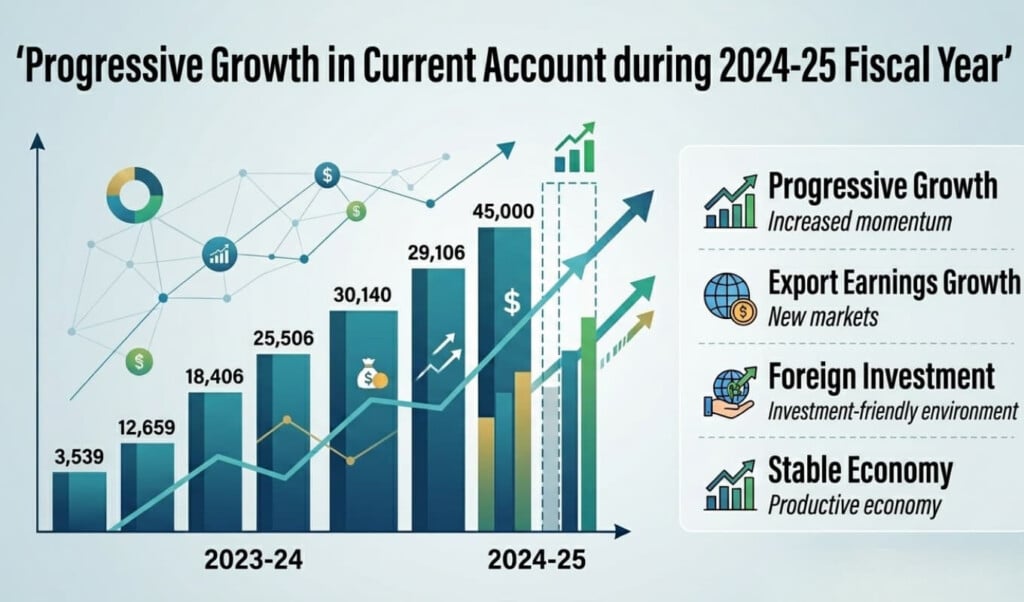
Bangladesh’s current account balance recorded a sharp improvement in the 2024-25 fiscal year, reflecting robust export performance and surging remittance inflows. Nevertheless, the country continues to face challenges from a sizeable trade deficit, which limits overall external stability.
According to the latest data from the Bangladesh Bank, the current account balance rose to Tk 15.1 billion, nearly doubling the previous year’s level. This increase was largely driven by a 38.1 per cent growth in net workers’ remittances and a 17.1 per cent rise in export earnings on a free-on-board (f.o.b.) basis.
Despite these gains, the trade deficit remained high at Tk 2.47 trillion, slightly lower than the Tk 2.49 trillion recorded in FY24. Economists note that while export growth has outpaced import expansion, the country’s dependence on imported goods and industrial inputs continues to maintain pressure on the external account.
Bangladesh External Sector Snapshot (FY24–FY25)
| Indicator | FY24 | FY25 | Year-on-Year Change |
|---|---|---|---|
| Current Account Balance | Tk 7.6 bn | Tk 15.1 bn | +98% |
| Trade Deficit | Tk 2.49 tn | Tk 2.47 tn | -0.8% |
| Export Earnings (f.o.b.) | Tk 4.54 tn | Tk 5.31 tn | +17.1% |
| Import Payments | Tk 7.56 tn | Tk 7.78 tn | +2.9% |
| Net Remittances | Tk 2.72 tn | Tk 3.75 tn | +38.1% |
| Services Outflows | Tk 645.2 bn | Tk 688.1 bn | +6.6% |
| Primary Income Outflows | Tk 578.4 bn | Tk 609.8 bn | +5.5% |
Export earnings reached Tk 5.31 trillion during the year, maintaining a long-term upward trend despite periodic fluctuations. Imports increased to Tk 7.78 trillion, reflecting Bangladesh’s growing reliance on foreign raw materials and consumer goods. Net remittance inflows of Tk 3.75 trillion provided a crucial buffer against external imbalances.
However, significant outflows in services (Tk 688.1 billion) and primary income (Tk 609.8 billion) partially offset these gains, keeping the current account slightly in deficit. Historically, Bangladesh’s trade deficit has widened since the mid-2010s, peaking between FY21 and FY23 alongside elevated current account shortfalls.
Economists describe the latest figures as a mixed signal. While export resilience and strong remittances support external stability, structural challenges remain. “The improvement is encouraging but fragile,” said Dr Zahid Hussain, an independent economist. “Without greater export diversification and better management of imports, pressures on the external account will continue.”
Geopolitical risks, including the Iran–US–Israel conflict, could further complicate the outlook for FY26. Policymakers face the dual challenge of sustaining growth while containing external vulnerabilities in a volatile global environment.