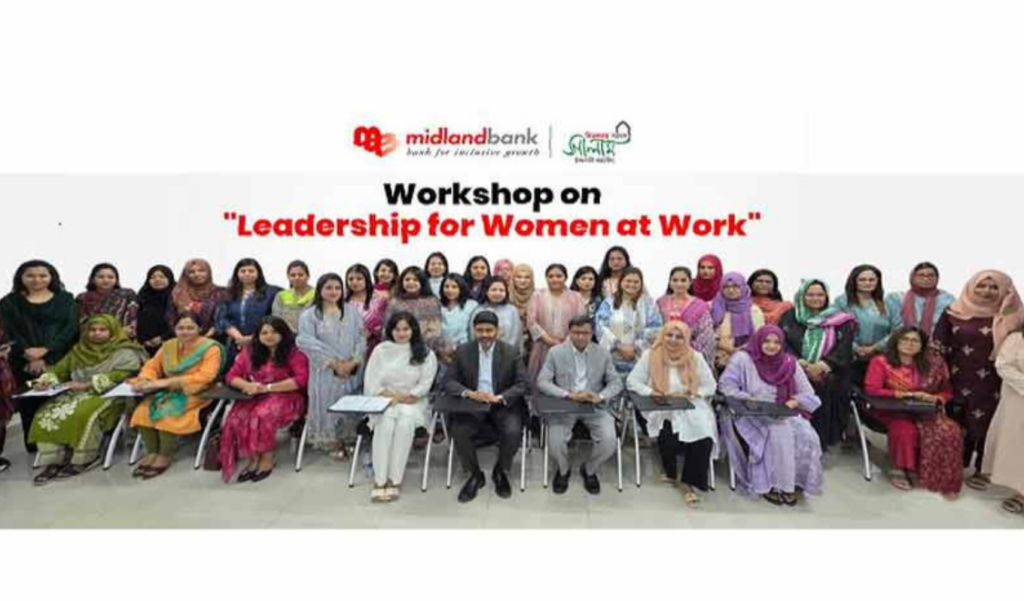
Midland Bank Limited has taken a significant step towards strengthening gender inclusion and leadership capacity by a specialised workshop titled “Leadership for Women in the Workplace.” The initiative, held at the bank’s training institute, reflects a growing commitment within Bangladesh’s financial sector to promote women into leadership roles and enhance their professional capabilities.
The workshop brought together 41 female officers from various branches and departments, offering a structured platform for learning, networking, and leadership development. The programme was formally inaugurated by Zubaed Ur Rahman, who underscored the importance of investing in female talent to build a resilient and forward-looking organisation.
In his opening remarks, Rahman emphasised that empowering women in leadership positions is no longer optional but a strategic necessity. He noted that diverse leadership teams contribute to better decision-making, stronger organisational culture, and improved financial performance—factors increasingly recognised in modern banking.
Expert Insights on Leadership and Professional Growth
The workshop featured a distinguished panel of resource persons, including Dr Mohammad Tajul Islam from the Bangladesh Institute of Bank Management (BIBM), Md Mazharul Islam of Janata Bank Limited, and Sushanta Shekhar Dev.
Through a series of interactive sessions, the speakers addressed key themes such as leadership effectiveness, strategic decision-making, career progression, and the evolving role of women in the workplace. Participants were encouraged to develop confidence, adaptability, and critical thinking skills—attributes essential for leadership in today’s rapidly changing financial environment.
Dr Islam highlighted the importance of continuous learning and professional certification, particularly in a competitive banking landscape shaped by digital transformation and regulatory change. Meanwhile, Mazharul Islam shared practical insights from his experience in public sector banking, focusing on ethical leadership and accountability. Dev, representing Midland Bank’s senior management, stressed the need for women to actively pursue leadership opportunities and contribute to strategic initiatives within their organisations.
Women’s Growing Influence in Banking
Speakers collectively observed that women in Bangladesh’s banking sector are increasingly moving beyond traditional roles to assume positions of influence in leadership, innovation, and policy formulation. This shift reflects broader global trends where financial institutions are recognising the value of diversity in driving innovation and sustainable growth.
They further noted that inclusive workplaces—where both men and women participate equally—are essential for building institutions that are not only competitive but also socially responsible. Gender-balanced leadership, they argued, enhances organisational resilience and aligns with international best practices in corporate governance.
Midland Bank’s Ongoing Commitment
Midland Bank reaffirmed its commitment to supporting female employees through continuous training, mentorship, and career development initiatives. The bank indicated that similar programmes will be expanded in the future to ensure that women are equipped with the skills and confidence required to excel in senior roles.
Such initiatives are particularly important in Bangladesh, where increasing female workforce participation remains a national priority. By investing in leadership development, financial institutions like Midland Bank are contributing to broader economic empowerment and inclusive growth.