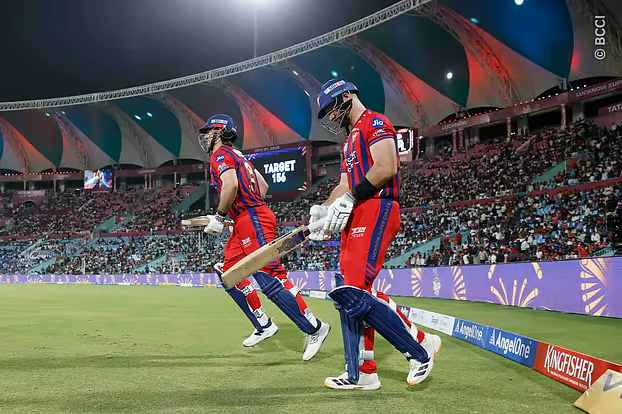
The inherent appeal of Twenty20 (T20) cricket has historically been rooted in its brevity and fast-paced nature compared to Test and One Day International (ODI) formats. However, the current season of the Indian Premier League (IPL) is facing significant criticism as match durations continue to exceed stipulated timeframes. Observers note that almost no matches are concluding within the expected three-and-a-half-hour window. A prominent example cited is a fixture between Mumbai and Bengaluru, which lasted four hours and twenty-two minutes, despite the absence of a Super Over or any extraordinary interruptions.
Legendary Indian cricketer Sunil Gavaskar has expressed stern concerns regarding this persistent issue. Writing in his column for Mid-Day, Gavaskar argued that existing financial penalties for slow over-rates are insufficient. He suggested that because modern players earn substantial incomes, monetary fines do not serve as an effective deterrent. Instead, he advocated for penalties that directly impact the match outcome, such as run deductions or points penalties.
Professionalism and Field Access
Gavaskar characterized the current trend as a sign of “laxity” and “unprofessionalism” within the tournament. He specifically highlighted the unnecessary influx of personnel onto the field of play during matches. He noted that reserve players frequently enter the ground to deliver water bottles outside of designated breaks, which disrupts the flow of the game.
Quoting the late legendary commentator Richie Benaud, Gavaskar reminded stakeholders that the field is strictly for players and umpires. He recommended that during Strategic Timeouts, only the coaching staff and designated drink carriers should be permitted on the field to maintain discipline and pace.
Proposed Regulatory Changes
To address these delays, the 1983 World Cup winner proposed a revision of the “wicket-timer” rules. Under current ICC and IPL regulations, a new batsman is generally allowed two minutes to arrive at the crease following a dismissal. Gavaskar argued that since dugouts are now located immediately adjacent to the boundary ropes, this allowance should be reduced to one minute.
Furthermore, Gavaskar emphasized the psychological impact of on-field penalties. He pointed to the current rule where a team failing to complete their overs on time must bring an extra fielder inside the 30-yard circle for the final overs. Gavaskar noted the visible “panic” this causes because it can tangibly alter the result of the game. He maintains that only “result-altering” penalties will ensure teams adhere to the clock.
Comparative Analysis of Over-Rate Issues and Proposals
| Category | Current Status/Regulation | Gavaskar’s Proposal |
| Average Match Duration | Often exceeding 4 hours | Strictly capped near 3 hours 15 mins |
| New Batsman Entry | 2-minute allowance | 1-minute allowance |
| Primary Penalty | Financial fines for captains/players | Run penalties or point deductions |
| Field Access | Frequent entry by reserve players | Restricted access to essential staff only |
| In-Game Penalty | One fewer fielder outside the circle | Direct run additions to the opposition |
Conclusion
The debate surrounding over-rates in the IPL highlights a growing tension between the commercial requirements of the league and the technical integrity of the sport. Gavaskar’s critique underscores a necessity for the IPL governing body to reconsider how time is managed on the field. Without the implementation of stricter, performance-based penalties, the strategic “dead time” between overs and during wickets may continue to extend the duration of what is intended to be cricket’s most concise professional format.