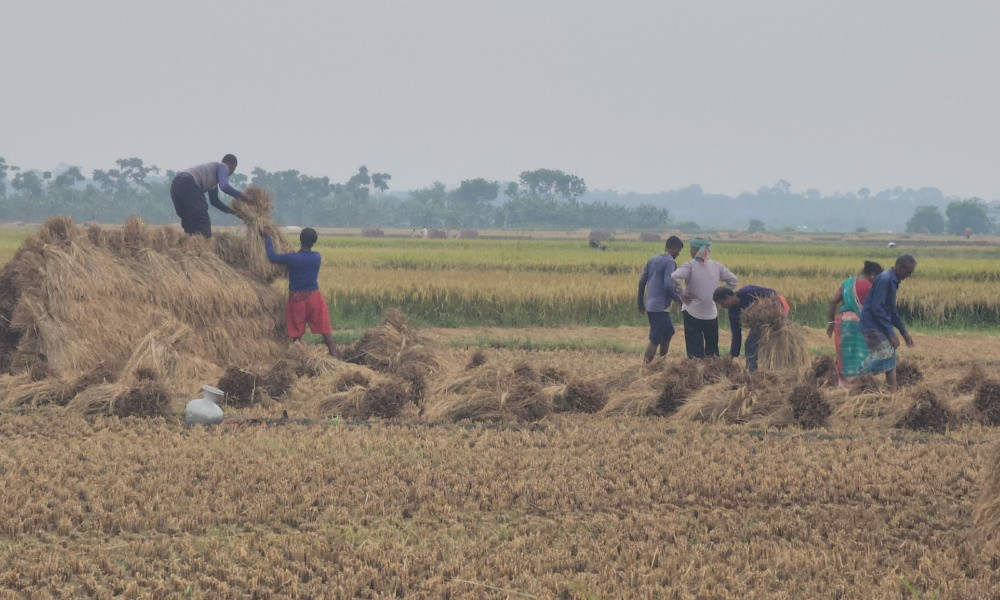
Farmers in Narail’s Sadar upazila have expressed deep concern over rising production costs, low paddy prices, and increasing financial pressure during the ongoing Boro harvest season. Many say that despite a good harvest, profitability remains out of reach due to higher input costs and limited market support.
“We are facing serious difficulties in continuing cultivation. How will we produce crops if we cannot even afford inputs? The situation is becoming harder for farmers to survive,” said farmer Prolad Biswas from Koyragram village under Mulia Union. He added that the current market price of paddy ranges between BDT 1,000 and BDT 1,900 per maund, while labour costs have risen significantly.
According to local farmers, labour wages have increased to around BDT 1,200 per worker per day, while diesel prices have gone up by approximately BDT 15 per litre. Farmers also reported difficulties in accessing diesel locally, often having to travel to the district town, adding transport costs of BDT 30–40 per trip.
Farmer Sachindra Nath Biswas, who cultivated Boro paddy on four bighas of land in Koyragram field, said harvesting has become increasingly costly. “We hired eight labourers at BDT 1,200 each and must also provide three meals a day. After harvesting, the field needs irrigation, ploughing, and replanting. Diesel shortages and queues make it extremely difficult,” he said.
He further noted frequent electricity disruptions affecting rest and post-harvest work. Farmers also reported that combine harvesters were largely unavailable this season, forcing manual harvesting.
Production Cost Comparison
| Category | Last Year | This Year |
|---|---|---|
| Cost per bigha | BDT 12,500 | BDT 18,000 |
| Labour wage (per worker/day) | Lower by ~BDT 300 | BDT 1,200 |
| Diesel price change | Baseline | +BDT 15/litre |
| Paddy selling price (per maund) | Lower range | BDT 1,000–1,900 |
| Transport cost (diesel procurement) | Minimal | BDT 30–40 |
Farmers say many have taken loans or informal credit to finance cultivation, forcing them to sell paddy immediately after harvest to repay debts, even at low prices.
Several farmers, including Anand Biswas and his wife Mitali, who cultivate leased land, reported working as daily labourers alongside farming to sustain their household. “We are cutting paddy ourselves because harvest machines are not available and labour costs are high,” they said.
Concerns have also been raised over the limited availability of government-supported combine harvesters. Officials previously distributed subsidised machines, but farmers allege that operational use has been minimal.
Meanwhile, the government procurement programme has yet to begin, contributing to weak market prices. Farmers say they are unable to access the state procurement system, which could have ensured fairer returns.
District food office officials confirmed that paddy procurement has not yet started, while agricultural authorities stated that around 5,297 hectares have been cultivated this season in Narail, with an estimated production target of 345,623 metric tonnes. They also noted that procurement lists of genuine farmers have been sent to relevant departments.