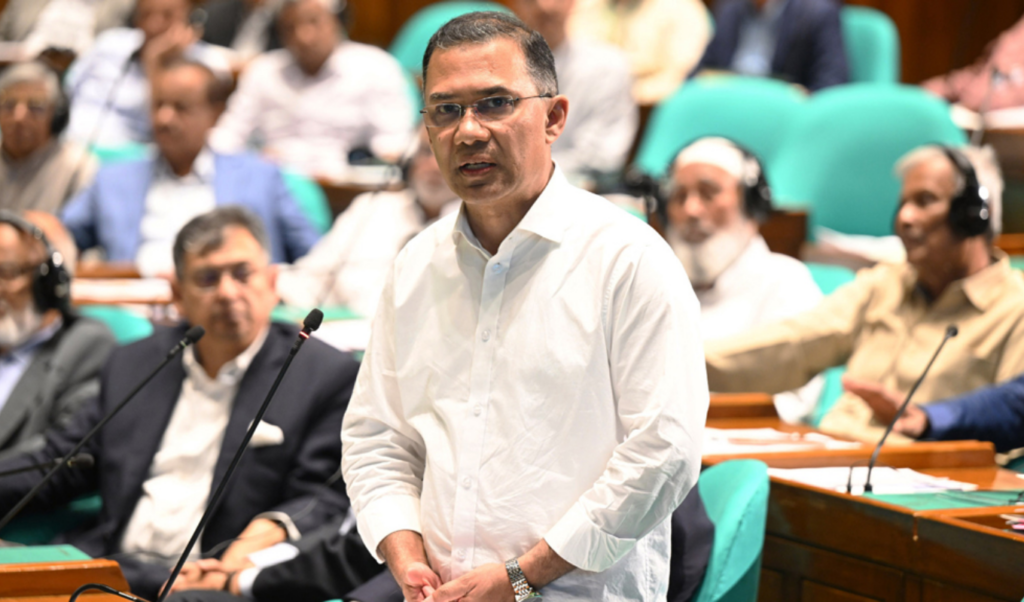
During the concluding session of the inaugural sitting of the Thirteenth National Parliament on Thursday, 30 April 2026, Prime Minister and Leader of the House Tarek Rahman offered a rare personal reflection on his experiences within the Bangladeshi education system. Addressing the House, the Prime Minister recalled the volatile atmosphere of the 1990s and expressed his administration’s commitment to fundamentally transforming the nation’s academic environment.
The Prime Minister’s remarks followed a speech by the Leader of the Opposition, Dr Shafiqur Rahman, who had raised significant concerns regarding the current climate and safety within educational institutions. Acknowledging these observations, the Prime Minister noted that the desire for a peaceful and productive learning environment was a sentiment shared across the political aisle.
Recollections of Political Unrest and Personal Risk
Reflecting on his own years as a student during the anti-autocracy movement of the 1990s, the Prime Minister detailed the physical risks often associated with campus life during periods of intense political transition. He stated:
“I have also studied in the educational institutions of this country. During the political turmoil of the 1990s anti-autocracy movement, I found myself entangled in campus disturbances on several occasions. Once or twice, I fell into quite serious and life-threatening situations.”
By citing these personal anecdotes, the Leader of the House illustrated a historical precedent for the “unstable environments” that have historically plagued Bangladeshi campuses. He emphasised that his government remains determined to ensure that the current generation of students does not have to endure the same levels of insecurity or systemic disruption that defined previous decades.
Comparative Observations from the United Kingdom
The Prime Minister drew a comparison between the domestic education system and international standards, specifically referencing his time spent in the United Kingdom. Addressing the Leader of the Opposition—whose son resides in Britain—the Prime Minister noted that his own prolonged stay in the UK for political reasons allowed him to observe their primary and secondary schooling models closely.
“I have seen what the schools in that country are like,” the Prime Minister remarked. “When I observed the school environments and the children there, it was only natural for me, as a citizen of Bangladesh involved in politics, to wonder: why can’t the schools in my own country be like this?”
He articulated a vision where the aesthetic and functional standards of Bangladeshi schools are elevated to match those of developed nations, arguing that the psychological well-being of students is deeply linked to the physical and social environment of their institutions.
A Vision for Institutional Reform
The Prime Minister asserted that the status quo of educational institutions must undergo a definitive change. He reiterated that the administration is working towards a paradigm shift where schools and universities are viewed strictly as centres of excellence, free from the threat of violence or coercive political influence.
“We certainly do not wish for the current state of our educational institutions or the condition of our students to remain as they are,” he affirmed. “It must undoubtedly be changed.”
The Prime Minister’s address signals a policy priority focused on “educational diplomacy” and the adoption of modern pedagogical environments. He concluded by assuring the House that the government is open to constructive dialogue with the opposition to implement reforms that prioritise student welfare and academic integrity. This commitment to reform is seen by analysts as a cornerstone of the Thirteenth Parliament’s legislative agenda, aiming to de-politicise campuses and foster a global standard of education within Bangladesh.