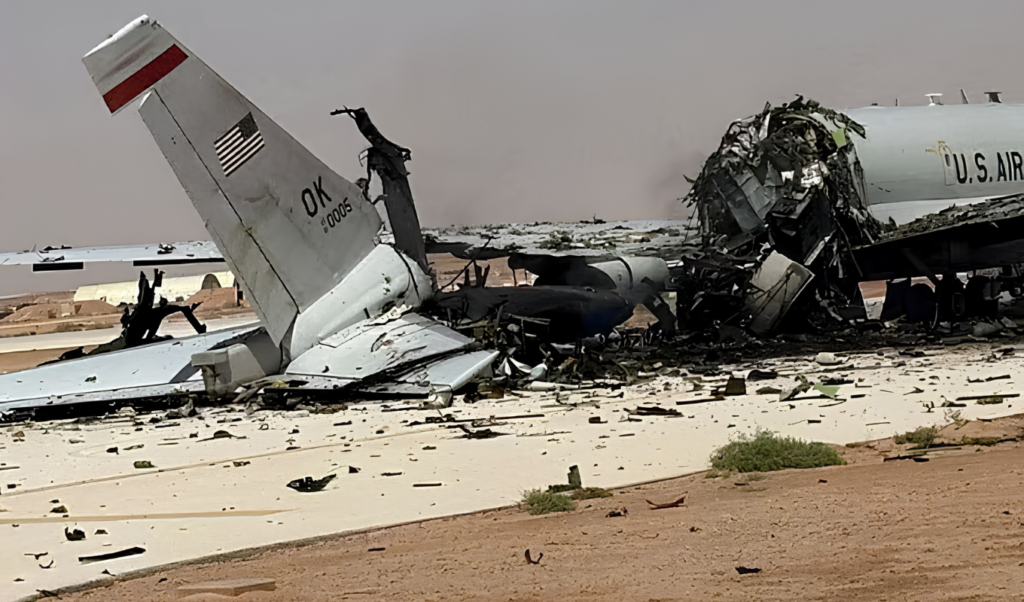
At least 42 aircraft belonging to the United States military—including fighter jets, drones, surveillance planes, and aerial refuelling tankers—have been destroyed or damaged during the conflict with Iran. This data was disclosed in a recent report by the Congressional Research Service (CRS), a public policy research institute that provides policy and legal analysis to the United States Congress.
According to the representative report, the current figure represents a conservative estimate. The total volume of losses is expected to rise due to several compounding variables, including data classification restrictions, fluid battlefield conditions, and the ongoing administrative processes required to officially determine the precise causes of aircraft damage or destruction.
Conflict Timeline and Financial Expenditure
The joint military campaign against Iran was initiated by the United States and Israel on 28 February, with the US military designating the intervention as “Operation Epic Fury”. Following 40 days of intense aerial and ground engagements, a temporary ceasefire was brokered between Washington and Tehran on 8 April, mediated by Pakistan.
The Pentagon recently disclosed that the total financial cost of the military campaign under Operation Epic Fury has reached approximately $29 billion (£22.3 billion). During a congressional hearing on 12 May, Jules Hurst, the financial chief of the Pentagon, provided an explanation for the escalating expenditure. Hurst stated:
“The primary reason for the increased cost is that we now have a precise accounting of the actual funds required to repair or replace the weaponry and equipment broken or destroyed on the battlefield. Consequently, the total expenditure has surpassed our initial projections.”
Inventory of Destroyed and Damaged Aircraft
The Pentagon has not yet published a comprehensive, formal assessment of the material losses incurred during the conflict. The CRS clarified that its inventory was compiled independently by monitoring, cross-referencing, and analysing official statements, press releases, and briefings issued by the Department of Defense and United States Central Command (CENTCOM), alongside verified media despatches.
The current distribution of verified US military aircraft losses comprises the following assets:
| Aircraft Model & Type | Primary Operational Role | Quantity Damaged/Destroyed |
| F-15E Strike Eagle | Strike Fighter | 4 |
| F-35A Lightning II | Stealth Multi-role Fighter | 1 |
| A-10 Thunderbolt II | Ground-Attack Aircraft | 1 |
| KC-135 Stratotanker | Aerial Refuelling Tanker | 7 |
| E-3 Sentry (AWACS) | Airborne Early Warning & Control | 1 |
| MC-130J Commando II | Special Operations Transport | 2 |
| HH-60W Jolly Green II | Combat Search and Rescue Helicopter | 1 |
| MQ-9 Reaper | Medium-Altitude Long-Endurance UAV | 24 |
| MQ-4C Triton | High-Altitude Long-Endurance UAV | 1 |
| Total Losses | 42 |
Diplomatic and Military Response from Iran
Following the publication of the CRS findings, the Iranian Foreign Minister, Abbas Araghchi, shared the report publicly via the social media platform X (formerly Twitter). Araghchi remarked that the document serves as an official American acknowledgment of the operational intelligence gained by Iran during the hostilities preceding the April ceasefire.
Araghchi issued a formal warning regarding future engagement, stating that if Donald Trump initiates further military campaigns against the Islamic Republic, Tehran will deploy its newly acquired combat insights to present the United States military with “many more surprises”.
The Foreign Minister further asserted that the admission by the US Congress, coming months after the outbreak of hostilities, confirms the destruction of high-value hardware. He concluded by stating that it is now verified that Iran’s armed forces were responsible for the historic first downing of the widely discussed F-35 stealth fighter jet.