The proposed national budget for the 2026–27 financial year exhibits significant disparity within the personal income tax framework, according to the Centre for Policy Dialogue (CPD). The non-governmental research organisation stated that the newly introduced tax architecture disproportionately increases the fiscal burden on lower-income segments. Conversely, the growth rate of tax liability for high-earning individuals with an annual income exceeding Tk 30 lakh remains comparatively minimal.
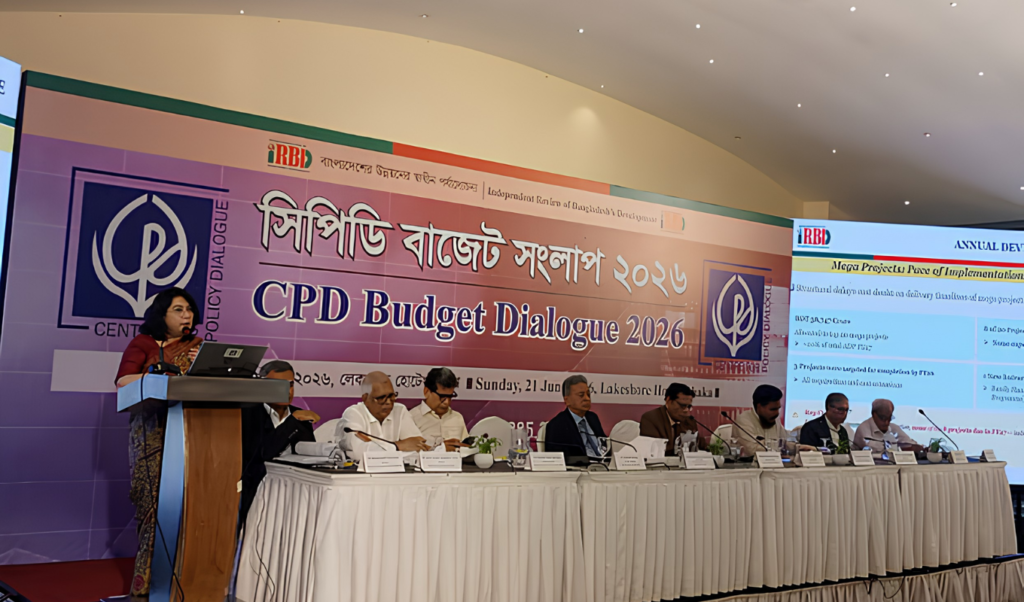
This assessment was disclosed on Sunday during a budget review dialogue organised at the Lakeshore Hotel in Gulshan, Dhaka. Amir Khosru Mahmud Chowdhury, the Minister for Finance and Planning, attended the event as the chief guest. The keynote essay was presented by Dr Fahmida Khatun, the Executive Director of the CPD. Presided over by CPD Distinguished Fellow Mustafizur Rahman, the dialogue was also attended by the Minister of State for Planning, Zonaed Abdur Rahim Saki (Zonayed Saki), as the special guest, alongside Akhhtar Hossain, a Member of Parliament elected from the National Citizen Party (NCP), who attended as an honoured guest.
The event featured extensive discussions led by prominent economists, sector specialists, and industry leaders, including Hossain Zillur Rahman, Executive Chairman of the Power and Participation Research Centre (PPRC); M. A. Razzaque, Chairman of Research and Policy Integration for Development (RAPID); Anwar-Ul-Alam Chowdhury Parvez, President of the Bangladesh Chamber of Industries; Inamul Haq Khan, Senior Vice President of the BGMEA; and Montu Ghosh, President of the Garment Workers’ Trade Union Centre.
Analysis of the Increased Tax Burden
In her keynote presentation, Dr Fahmida Khatun analysed the escalation of the tax burden relative to the income growth of taxpayers. The findings indicate that individuals with an annual taxable income between Tk 6 lakh and Tk 15 lakh will see their tax liability rise by 12.5 per cent to 16.7 per cent under the new budget. In sharp contrast, individuals earning above Tk 30 lakh will experience a tax liability increase of just 7.6 per cent. Dr Khatun noted that this distribution directly contradicts the principles of social equality and justice.
The following table outlines the proportional increase in tax liability across different annual taxable income thresholds as specified in the budget proposal:
| Annual Taxable Income Range | Growth Rate of Tax Liability | Impact Category |
| Tk 6 Lakh to Tk 15 Lakh | 12.5% to 16.7% | High Increase |
| Above Tk 30 Lakh | 7.6% | Low Increase |
Employment Directives and Macroeconomic Concerns
The CPD highlighted that the proposed budget lacks a definitive strategy to fulfil the government’s electoral manifesto commitment of generating 10 million new jobs within 18 months. Dr Khatun observed that the budgetary allocations for the four key ministries responsible for employment generation—namely the Ministry of Labour and Employment, the Ministry of Expatriates’ Welfare and Overseas Employment, the Ministry of Industries, and the Ministry of Commerce—have either decreased or stagnated relative to total public expenditure. Furthermore, major employment-focused projects, such as the Patuakhali EPZ and the Jamdani Village, have remained stalled for years. Without a structured national employment programme and requisite structural reforms, the target faces the risk of remaining merely a political aspiration.
Regarding inflation, the government aims to reduce the rate to 7.5 per cent in the upcoming fiscal year. However, the average inflation rate up to May of the outgoing financial year stood at 8.63 per cent. The CPD emphasized that achieving the targeted reduction is unfeasible without a prudent monetary policy and a guaranteed supply of food and fuel. While the CPD commended the Finance Minister’s objective for economic recovery under the new administration, it cautioned that the macroeconomic indicators remain overly optimistic. The organization welcomed the enhanced allocations for human resource development sectors, specifically education and healthcare, but expressed serious concerns regarding the efficient execution and implementation of these funds.