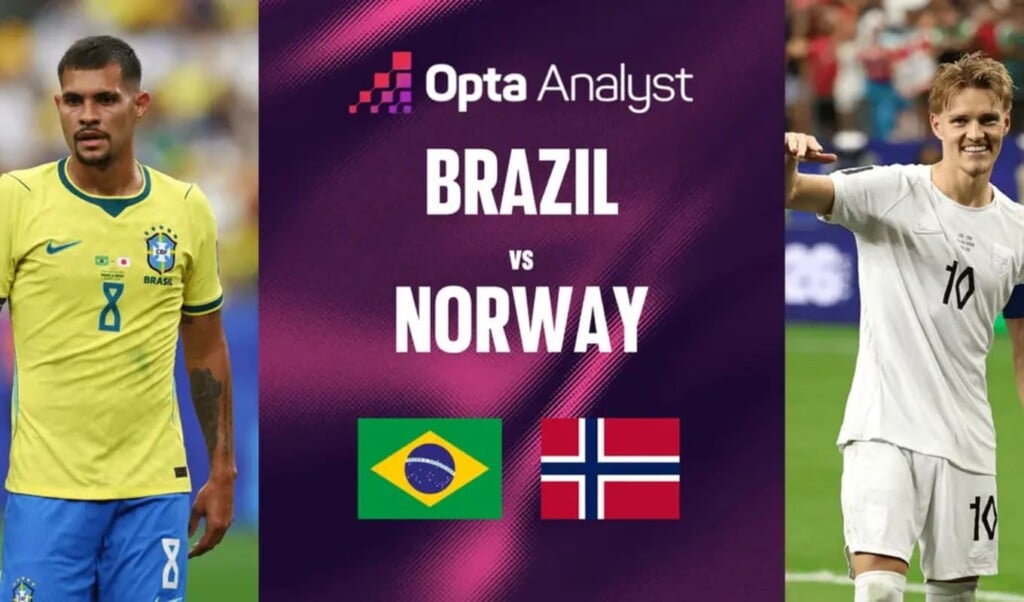
An intriguing tactical battle awaits in the World Cup Round of 16 as five-time champions Brazil prepare to square off against a resilient Norway side led by the clinical Erling Haaland. Although traditional head-to-head statistics lean heavily in favour of the Scandinavian nation, advanced data analysis from the prominent football analytics platform Opta Analyst suggests a different outcome entirely, heavily backing the South American giants to progress to the quarter-finals.
Brazil booked their place in the knockout phase following a hard-fought comeback against Japan in their final group fixture. After conceding an early goal to Kaishu Sano in Houston, Carlo Ancelotti’s side demonstrated immense composure. Veteran midfielder Casemiro levelled the scoreline before Gabriel Martinelli converted a late chance to secure a 2-1 victory. The winning goal was orchestrated by Bruno Guimarães, who registered his fourth assist of the tournament. This feat places him in esteemed company; within Brazilian football history, only Pelé has recorded more assists in a single World Cup iteration, setting the benchmark with six during the legendary 1970 campaign.
Despite their progression, Ancelotti faces tactical dilemmas regarding his forward line. Brazil’s attackers have lacked their customary efficiency, registering 60 shots across their opening four matches. This represents their second-lowest shot-conversion efficiency in a single World Cup tournament since 1998, a year they averaged 14.4 shots per match. Nonetheless, the Seleção remain in buoyant form, carrying a four-match winning streak into the knockout stage. This marks their most consistent run of consecutive victories since their historic 11-match winning streak spanning the 2002 and 2006 tournaments.
Historically, the Round of 16 has been a safe haven for Brazil, who have suffered just one defeat in their last ten matches at this particular stage—a narrow 1-0 loss to neighbours Argentina in 1990. Conversely, Norway arrive at this fixture on the back of an impressive run. They edged past the Ivory Coast with a 2-1 victory in the Round of 32, sealed by an 86th-minute strike from Manchester City forward Erling Haaland. This victory marked Norway’s first-ever win in a World Cup knockout match, having previously exited the tournament at the first knockout hurdle against Italy in both 1938 and 1998.
Haaland represents the single greatest threat to Brazil’s quarter-final ambitions. The talismanic forward has scored in 13 consecutive international appearances, accumulating 25 goals in the process. A goal against the five-time world champions would see him become only the eighth European player in footballing history to find the net in each of his first four World Cup appearances.
Remarkably, past encounters offer a psychological edge to the underdogs. In their four previous meetings on the international stage, Brazil have failed to record a single victory over Norway, with the Europeans winning twice and drawing twice. Furthermore, Brazil have struggled significantly against European opposition in the knockout rounds, failing to win a single knockout tie against a European nation since their iconic 2-0 victory over Germany in the 2002 World Cup final.
Despite history heavily favouring Norway, the Opta supercomputer offers a contrasting prediction. Through rigorous statistical simulations, the supercomputer projects a 53.6 per cent probability of a Brazilian victory within regular time, compared to a modest 22.4 per cent chance for Norway. The probability of the match remaining level after 90 minutes and heading into extra time is calculated at 24 per cent.
In terms of outright progression, the algorithm gives Brazil a comfortable 65.6 per cent chance of reaching the last eight, whilst Norway hold a 34.5 per cent chance of causing an upset. The winner of this highly anticipated fixture will advance to face either England or Mexico in the quarter-finals.