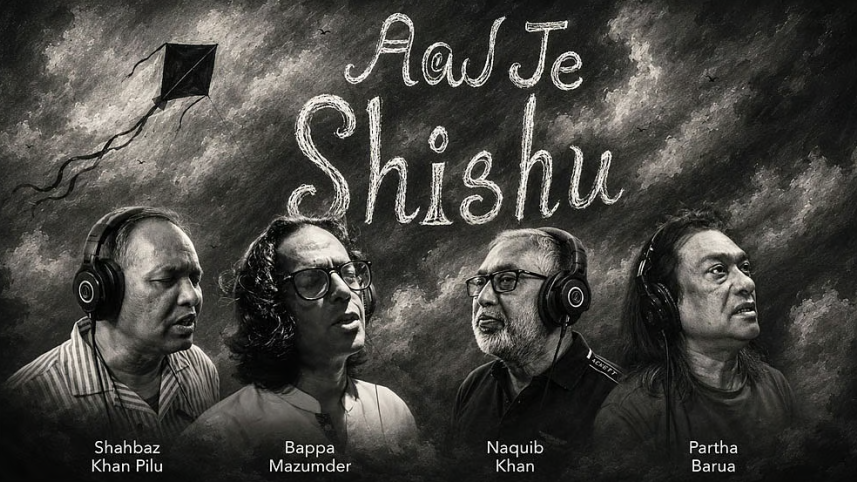
More than three decades after its original release, the iconic Renaissance song “Aj Je Shishu” has returned in a renewed form, bringing together four prominent figures in Bangladesh’s music scene for a contemporary reimagining of the classic track.
The refreshed rendition features original vocalist Pilu Khan, joined by Naquib Khan, Partha Barua and Bappa Mazumder. The arrangement has been newly crafted by Partha Barua, and the track has been released through the Partha Barua & Souls YouTube channel, becoming available to listeners from 29 June.
“Aj Je Shishu” was originally written by Shahid Mahmud Jangi and composed by Pilu Khan. It first appeared on Renaissance’s second studio album, “Tritiyo Bishwo”, released in 1993. Long regarded as one of the band’s most memorable works, the song was penned prior to the album’s release and has since maintained a lasting presence in Bangladesh’s modern music heritage.
The new version arrives at a time when reinterpretations of classic South Asian songs have become increasingly common, often serving both artistic and social purposes. In this case, the collaborators emphasise that the project was not intended for commercial gain, but to draw attention to issues surrounding children’s rights and social responsibility.
Naquib Khan described the initiative as a purposeful revival rather than a routine remake. He noted that while revisiting older compositions is not unusual in contemporary music culture, this rendition was conceived with a clear social message at its core. According to him, the enduring relevance of the lyrics made the song particularly suitable for renewed attention, even decades after its original release.
Bappa Mazumder also reflected on the track’s lasting appeal, pointing to its lyrical depth and melodic strength. He said he accepted the invitation without hesitation, joining the collaborative effort alongside Naquib Khan, Partha Barua and Pilu Khan. In his view, the song continues to resonate across generations because it blends emotional simplicity with a powerful underlying message.
The reimagined arrangement preserves the essence of the original composition while introducing a more contemporary soundscape, shaped by Partha Barua’s updated musical direction. The intention, according to the artists involved, is to reconnect the song with younger audiences while retaining the emotional weight that made it significant in the first place.
Nearly thirty years on from its debut, “Aj Je Shishu” returns not merely as a nostalgic revival, but as a renewed reminder of its central theme and continuing social relevance.