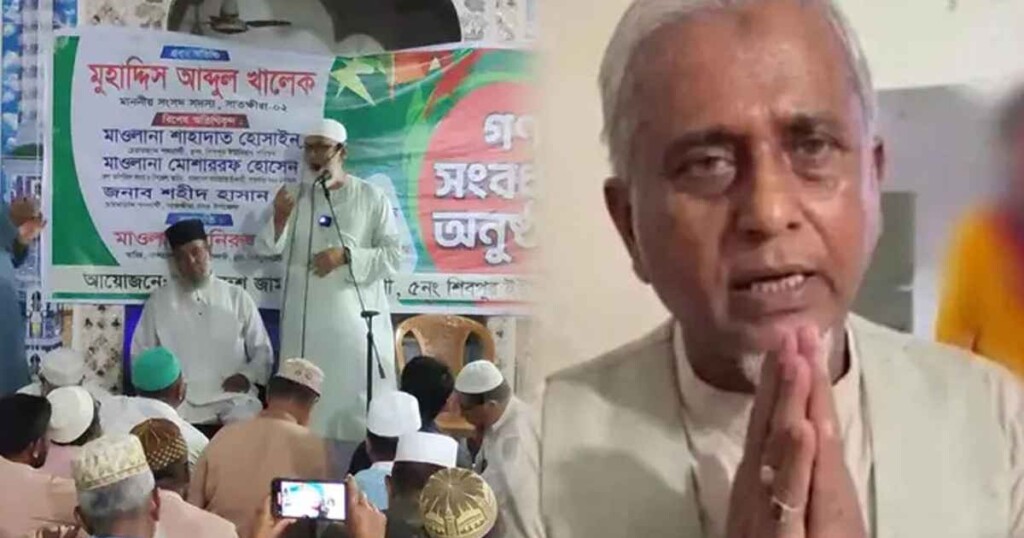
A lawmaker from Bangladesh Jamaat-e-Islami has defended Satkhira-4 MP Gazi Nazrul Islam over a marriage that has sparked public debate, saying the young woman involved had herself expressed a desire to remain with him and care for him for the rest of her life.
Satkhira-2 MP Muhaddis Abdul Khaleque made the remarks while speaking as the chief guest at a public reception held at Gotaghata Mosque in Shibpur Union of Satkhira Sadar Upazila at around 7pm on Thursday, 23 July.
The reception was organised by local residents and religious scholars under the banner of the general public and local ulema of Shibpur Union. Several local political and community figures attended the event.
Speaking about the controversy surrounding Gazi Nazrul Islam, Khaleque said that the matter had been discussed in the presence of the MP’s first wife and other family members. According to him, the young woman had made it clear that she did not want to marry anyone else and wished to remain with Gazi Nazrul Islam and serve him for the rest of her life.
Khaleque claimed that, faced with what he described as the woman’s firm decision, her parents eventually arranged the marriage at their own home.
The Jamaat MP sought to distinguish between what he described as an act that was socially unacceptable and one that was morally or ethically wrong. “The act was socially unacceptable, but it was not unethical,” he said, while acknowledging that the incident had generated considerable controversy.
He also said the political consequences had been severe because of the public reaction and the position held by Gazi Nazrul Islam. According to Khaleque, Jamaat-e-Islami had expelled him from the organisation following the controversy, and steps were also being taken towards the cancellation of his parliamentary membership.
Khaleque stressed that Jamaat-e-Islami could not overlook conduct that created serious social controversy, particularly when it involved someone holding a prominent public position. He said the organisation did not compromise on matters it considered socially or morally objectionable.
Drawing an analogy with the conduct expected of a mosque imam, Khaleque argued that the same mistake could carry different consequences depending on the status and responsibilities of the person involved. He said that if an ordinary individual made such a mistake, society might view it differently, whereas the actions of a religious leader or public representative would inevitably attract greater scrutiny.
“An imam’s mistake carries greater significance,” he said, arguing that a person occupying a prominent position should be held to a higher standard of conduct. He maintained that, given Gazi Nazrul Islam’s standing, the incident could not be treated as an ordinary mistake.
The comments come amid wider public discussion over the personal conduct of elected representatives and the standards expected of public figures. In Bangladesh, controversies involving MPs often attract heightened attention because their private actions can become subjects of political debate, particularly when they intersect with questions of social values, religious expectations and party discipline.
Khaleque reiterated that Gazi Nazrul Islam’s expulsion from the organisation was a consequence of the controversy and maintained that his parliamentary position would also not remain.
The reception was chaired by Maulana Moniruzzaman, president of Jamaat-e-Islami’s Shibpur Union unit. Among those attending as special guests were Maulana Shahadat Hossain, a candidate for chairman of Shibpur Union Parishad; Maulana Mosharraf Hossain, a district executive council member and upazila shura member; and Shahid Hasan, a candidate for chairman of Satkhira Sadar Upazila, along with other local leaders.