A shortage of compressed natural gas (CNG) continued to disrupt fuel supplies at stations across Dhaka on Saturday, leaving large numbers of drivers stranded in queues and adding to pressure on the capital’s already congested roads.
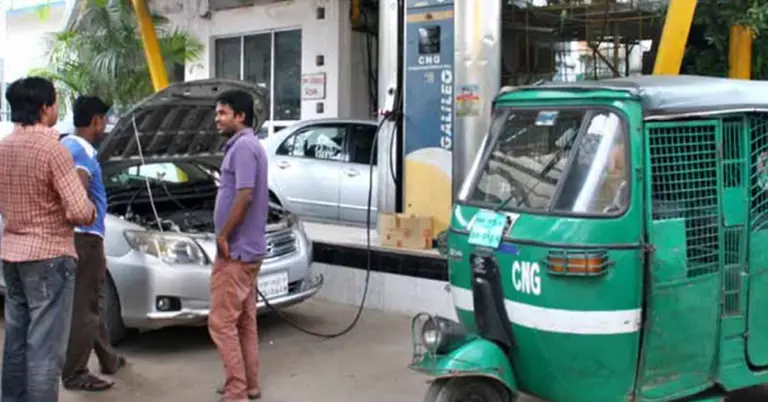
At many CNG stations, signs reading ‘No Gas’ were displayed as supplies ran out. At others, gas was available but the pressure was too low to allow vehicles to refuel at a normal rate. Drivers were consequently forced to spend hours waiting, while long queues formed outside several stations.
The situation was observed on Saturday (25 July) at a number of CNG stations in the capital’s Moghbazar, Tejgaon and Banglamotor areas. Vehicles were seen lining up for fuel, with drivers waiting for supplies to resume or for pressure to improve. In some locations, the slow refuelling process further extended waiting times.
Drivers said many had already travelled from one station to another after finding no gas at their usual outlets, only to encounter similar conditions elsewhere. Some stations had no gas at all, while others were operating with insufficient pressure. As a result, a significant portion of the working day was being spent simply searching for and collecting fuel rather than carrying passengers.
The disruption is particularly damaging for CNG and ride-sharing drivers, whose daily earnings depend heavily on the number of hours they can keep their vehicles on the road. Under normal circumstances, drivers can complete several passenger trips from morning until evening or late at night. Long delays at fuel stations, however, reduce the number of trips they can make and, in turn, cut their daily income.
The financial pressure is especially significant for drivers who have fixed expenses to meet regardless of how much they earn. These may include payments to vehicle owners, loan instalments, maintenance costs and household expenses. When several hours are lost at a fuel station, such costs remain unchanged even as earnings fall.
The shortage is also creating wider difficulties for passengers and the city’s transport system. When CNG-powered vehicles remain stuck at fuel stations for extended periods, fewer vehicles are available to carry passengers. During busy hours, commuters may have to wait longer or seek alternative modes of transport.
Long queues at fuel stations can also contribute to local traffic congestion. Vehicles waiting for fuel may occupy road space around stations, creating additional pressure on already busy streets, particularly in densely populated commercial and residential areas.
Fuel station operators have also expressed concern over the irregular supply. According to them, some stations are having to remain operational for around five to six hours while waiting for adequate gas supplies or sufficient pressure. When pressure remains low, stations cannot provide the expected volume of gas within the usual timeframe, slowing down the entire refuelling process.
The operators said the shortage does not necessarily reduce demand. Instead, drivers continue to wait in the hope that supplies will improve, resulting in longer queues and increased congestion around stations. The slower process then creates a cycle in which vehicles remain at the stations for extended periods, further delaying other drivers.
For CNG and ride-sharing drivers, the problem is therefore not limited to the inconvenience of refuelling. Every hour spent waiting represents lost time on the road and fewer opportunities to earn. For passengers, meanwhile, reduced vehicle availability can mean longer waiting times and greater difficulty finding transport.
Both drivers and station operators have called for urgent measures to restore a stable gas supply. They believe that normalising supplies and maintaining adequate pressure would help reduce queues, enable drivers to complete their regular trips and ease disruption to passenger transport.
CNG-powered vehicles play a significant role in Dhaka’s daily transport network, serving commuters across many parts of the capital. A prolonged disruption in fuel supplies could therefore have consequences extending beyond individual drivers and station operators, affecting passenger mobility and adding further strain to the city’s overall transport system.
With the shortage continuing on Saturday, those affected are now looking for a swift resolution and a return to reliable gas supplies at CNG stations across the capital.