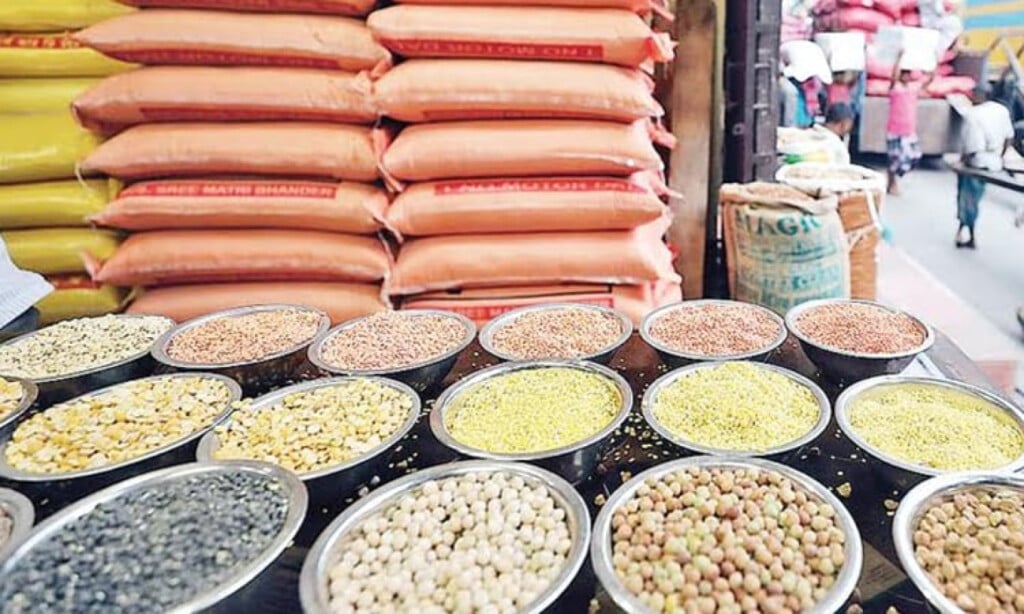
The commodity markets in Chattogram are witnessing a surge in supply of essential Ramadan goods, leading to a significant drop in prices.
Traders and importers attribute this trend to the Interim Government’s proactive measures, including tax reductions and policy support, which have facilitated larger imports and disrupted unethical trade syndicates.
Khatunganj-Chaktai, the country’s largest commodity hub, along with Reazuddin Bazar and ‘Falmondi’ at Station Road, are bustling with supplies of edible oil, chickpeas, sugar, onions, potatoes, and dates.

Market insiders note that this year’s price stability is an exception compared to previous years, when prices would rise sharply ahead of Ramadan. Traders are now struggling to manage their inventories due to high stock levels and slower retail demand, leading to lower prices than last year.
To ensure a steady supply of consumer goods, the interim government relaxed the LC opening margin for 11 essential items, including rice, wheat, onion, pulses, sugar, eggs, and spices. As a result, imports have increased significantly. Between October 2024 and February 2025, Chattogram Port recorded 1.95 million tons of imported consumer goods—12% more than the same period last year.
In January alone, 97,181 tons of chickpeas were unloaded at the port, with more shipments awaiting clearance. Wholesale prices of high-quality chickpeas have dropped to TK 92.5 per kg, while medium-quality varieties are selling at TK 90 per kg, lower than last year’s pre-Ramadan price of TK 95-100.
Other essentials have also seen price drops. Locally produced onions are now selling at TK 32-38 per kg, while Indian onions are priced at TK 50-55. Ginger prices have fallen by TK 10 per kg in the past two weeks, now standing at TK 65-70 per kg. Garlic has also seen a decline, currently selling at TK 195-200 per kg.
Traders in Khatunganj highlight that the increased supply of local and imported onions, as well as spices like ginger and garlic, has kept prices in check. Unlike previous years, when the administration had to intervene against price hikes, this time the market is stabilizing naturally due to high imports.
The surge in date imports has also contributed to lower prices. A five-kg packet of Medjool dates is now TK 4,100, Ajoa TK 4,500, Safabi TK 3,200, and Maryam TK 7,700. Last year, similar quality dates were sold at TK 4,000 per 5 kg, but this year they are available for TK 3,300-3,400 due to reduced import duties.
Md. Mohiuddin, General Secretary of the Chaktai Khatunganj Aratdar General Traders Welfare Association, noted that traders imported more than the estimated demand, leading to visible price impacts in the market.
Sugar imports in December and January stood at 2.53 lakh tons, covering 85% of the estimated demand of three lakh tons for Ramadan. Similarly, edible oil imports surpassed expectations, with 3.89 lakh tons of soybean and palm oil arriving in January alone.
Despite sufficient edible oil imports, its price remains unchanged, unlike other commodities, which have become more affordable. Traders in Khatunganj anticipate further stability in prices as Ramadan approaches.