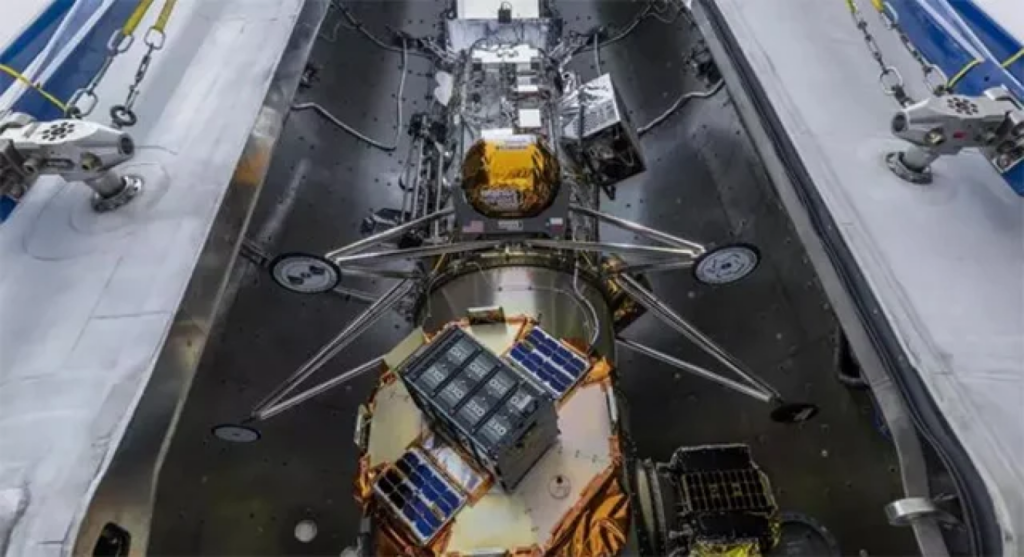
WASHINGTON, Feb 26, 2025 (BSS/AFP) – After making history as the first private company to land a robot on the Moon, albeit with a less-than-perfect touchdown, Intuitive Machines is preparing for another attempt—this time aiming for a flawless landing.
The Houston-based company’s new lunar lander, Athena, is scheduled for launch aboard a SpaceX Falcon 9 rocket. The launch window opens at 7:02 pm (0002 GMT) Wednesday from the Kennedy Space Center in Florida, as per official spaceflight advisories. If all goes according to plan, Athena will land on the Moon around March 6, targeting Mons Mouton plateau, a location closer to the lunar south pole than any previous mission.
A Mission with Advanced Capabilities
Athena is equipped with cutting-edge scientific instruments, including a drill designed to search for ice beneath the lunar surface. A highlight of the mission is Grace, a unique hopping drone named after the renowned computer scientist Grace Hopper. This drone is engineered to navigate the Moon’s rugged terrain, including steep inclines and boulder-filled areas—critical for supporting future human missions.
Additionally, the lander will carry a small rover, which will test a lunar cellular network developed by Nokia Bell Labs. This network will enable communication between the lander, rover, and drone, laying the groundwork for future lunar operations requiring reliable connectivity.
A New Era of Commercial Lunar Missions
Until recently, successful soft landings on the Moon were achieved only by major national space agencies. However, the United States is now fostering a new era of private space exploration through NASA’s Commercial Lunar Payload Services (CLPS) program. This initiative enables private companies to deliver NASA hardware to the Moon at a significantly lower cost than traditional government-led missions. The program is an essential component of NASA’s Artemis project, which aims to return astronauts to the Moon and develop technologies for future Mars exploration.
“This is a really sophisticated mission enabled by partnerships between the government and US industry,” said Joel Kearns, NASA’s deputy associate administrator for exploration.
The Challenge of Lunar Landing
The biggest challenge for Intuitive Machines remains executing a precise and controlled landing. The company’s first lander, Odysseus, successfully reached the Moon in February 2024, but tipped over due to a landing miscalculation, reducing its solar power intake and limiting its ability to conduct NASA experiments. That mission, conducted under a $118 million contract, fell short of its full potential.
For this second attempt, NASA is providing $62.5 million, and Intuitive Machines has made several crucial upgrades. These include improvements to the laser altimeter, which measures altitude and velocity for safer landings, and better coordination with NASA’s Deep Space Network (DSN) for more accurate navigation.
“Landing on the Moon is very challenging,” Kearns explained. “Unlike Earth, where we have air, wings, and parachutes, lunar landings rely solely on thrusters for controlled descent.”
A New Wave of Lunar Exploration
Athena’s landing will be preceded by another private US mission—Firefly Aerospace’s Blue Ghost—which is expected to arrive on March 2. This lander, launched in January, is traveling on a longer trajectory, sharing its journey with Tokyo-based ispace’s Resilience lander.
Also onboard this rocket is NASA’s Lunar Trailblazer probe, which will enter orbit after a four-month journey. This probe is set to conduct a two-year mission analyzing different forms of water on the Moon, furthering scientific understanding of the lunar environment.
These private sector-driven efforts come at a pivotal moment for NASA, as speculation grows about potential shifts in its space exploration priorities. Some reports suggest that NASA may scale back its Moon program in favor of focusing on Mars—a long-standing ambition of both former President Donald Trump and his close associate Elon Musk.
Regardless of the broader strategic direction, missions like Athena’s demonstrate that private companies are playing an increasingly vital role in lunar exploration—bringing the Moon within closer reach for science, industry, and, eventually, human settlement.