GOMA, DR Congo, 28 February 2025 (BSS/AFP) – Goma, which fell to M23 fighters and the Rwandan military in late January, has become a stark symbol of the ongoing conflict that has ravaged eastern Democratic Republic of Congo for over three decades.
In early January, an offensive on North Kivu’s capital—home to thousands of UN and humanitarian workers—seemed unlikely. However, the situation quickly deteriorated as clashes escalated in the surrounding areas.
Initially, M23 fighters and Rwandan troops seized Minova, a strategic port on Lake Kivu to the southwest, tightening the noose around Goma. The city, housing around a million residents alongside nearly as many displaced people, faced an increasing threat.
By 23 January, the front line still held on the plain near Sake, the last major defensive barrier northwest of Goma. Congolese army helicopters launched rocket barrages, and reinforcements departed from Goma to the cheers of displaced civilians. Explosions echoed in the distance as the military, assisted by local militias, UN peacekeepers, and southern African forces, attempted to repel the advance.
Despite these efforts, the Congolese army had been gradually losing ground since 2021 due to M23’s steady advances and Rwanda’s well-trained, well-equipped forces. Eventually pushed back to Goma, the defenders were left with nowhere to retreat, trapped between the enemy and the waters of Lake Kivu.
The Breaking Point
On the morning of 23 January, Rwandan military units overwhelmed thousands of Congolese troops and militias near Sake. The military governor of North Kivu was killed on the front lines. A counter-offensive near Sake proved futile, and two days later, the fall of Goma seemed inevitable.
In response, NGOs and the UN evacuated non-essential personnel from the city. The road leading to the front became a relentless conveyor of wounded soldiers and damaged equipment. The charred remains of a UN armoured vehicle lay abandoned, destroyed by a direct hit.
UN and southern African forces suffered significant losses, with at least 19 soldiers killed. Meanwhile, the Congolese army, plagued by corruption and weak leadership, struggled to resist. M23 fighters identified a vulnerability on the poorly secured northern front and made their decisive move.
The Fall of Goma
On 26 January, Goma awoke to the thunderous sound of shelling as Rwandan forces crossed the border, taking the Congolese military and Romanian paramilitary forces by surprise. Intense fighting erupted in impoverished, densely populated neighbourhoods, forcing civilians to shelter in their homes.
As the Congolese army retreated toward central Goma, UN peacekeepers, recognising the collapse of the defence, shifted their priority to protecting civilians. That night, the streets lay eerily silent as anxious residents huddled indoors, cut off from communication due to an internet and phone blackout.
On the morning of 27 January, chaos erupted at Goma prison near the airport, where prisoners rioted, setting fires. Many inmates perished in the flames, while only a handful of women detainees managed to escape.
The few Congolese army units still holding their positions soon realised they had been abandoned—most senior officers had already fled by boat across Lake Kivu, leaving ordinary soldiers stranded.
Unlike in 2012, when M23 briefly occupied Goma but left a retreat route open, this time, no escape was allowed. Trapped Congolese soldiers aimlessly roamed the city, searching for an escape route.
The Takeover
Some Congolese troops attempted an assault on Gisenyi, a Rwandan border town, provoking retaliatory fire. Fighting spread to areas previously untouched by conflict, even well-to-do neighbourhoods.
By the afternoon, after relentless bombardment, Congolese soldiers were forced out of key positions near the port and military headquarters. Those trying to flee by boat came under heavy fire, with many diving into Lake Kivu in desperation.
By 28 January, resistance had largely crumbled, although isolated skirmishes persisted, particularly around the airport. M23 fighters and Rwandan troops methodically secured the city, eliminating the last pockets of opposition.
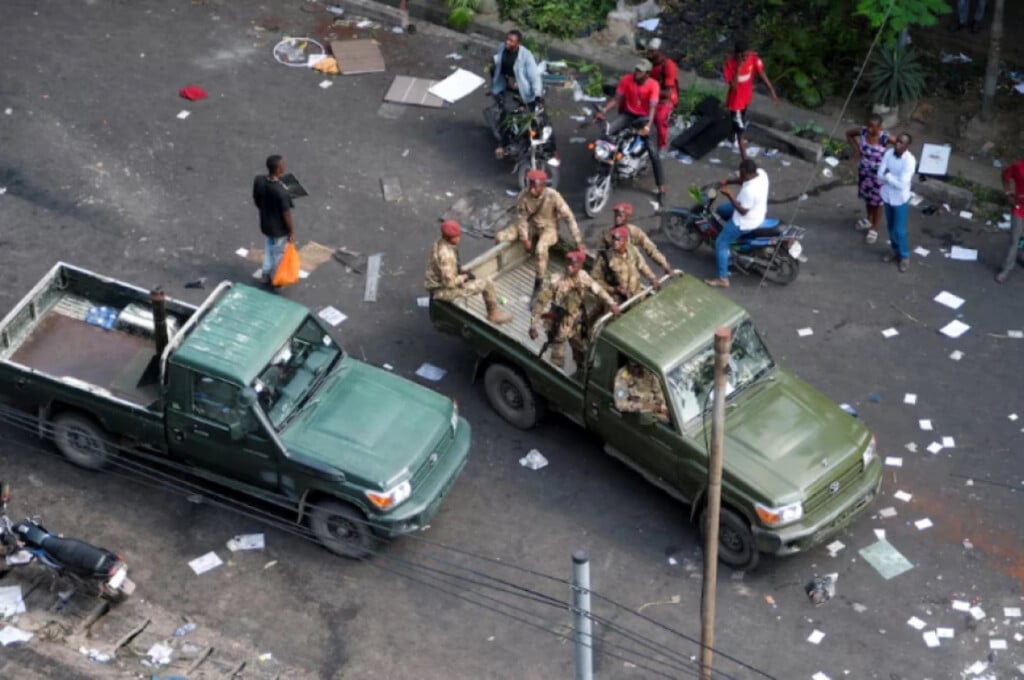
Thousands of Congolese soldiers and Romanian paramilitary personnel fled to the UN peacekeeping base, abandoning weapons, uniforms, and vehicles. Meanwhile, looters—militiamen, bandits, and even civilians—seized weapons and supplies, anticipating further unrest.
Aftermath
On the morning of 29 January, civilians took advantage of the lawlessness, looting shops and humanitarian warehouses. Hospitals overflowed with wounded fighters and civilians, while bodies littered the streets. Mortuaries quickly ran out of space.
As dawn broke, Goma’s residents were left in shock. The Congolese military and its allied militias had vanished. In their place, M23 fighters and Rwandan troops marched in disciplined formation through the grey, battle-scarred streets. Some wary civilians clapped tentatively as they passed, uncertain of what the future held.
A Region in Crisis
The fall of Goma underscores the fragility of the DRC’s eastern region, where decades of conflict have led to repeated humanitarian disasters. The involvement of foreign forces, coupled with the internal weaknesses of the Congolese army, has prolonged instability, leaving civilians trapped in an endless cycle of violence and displacement.
International observers warn that without a durable political solution, the conflict will only continue to devastate the region, displacing millions and fuelling further unrest.