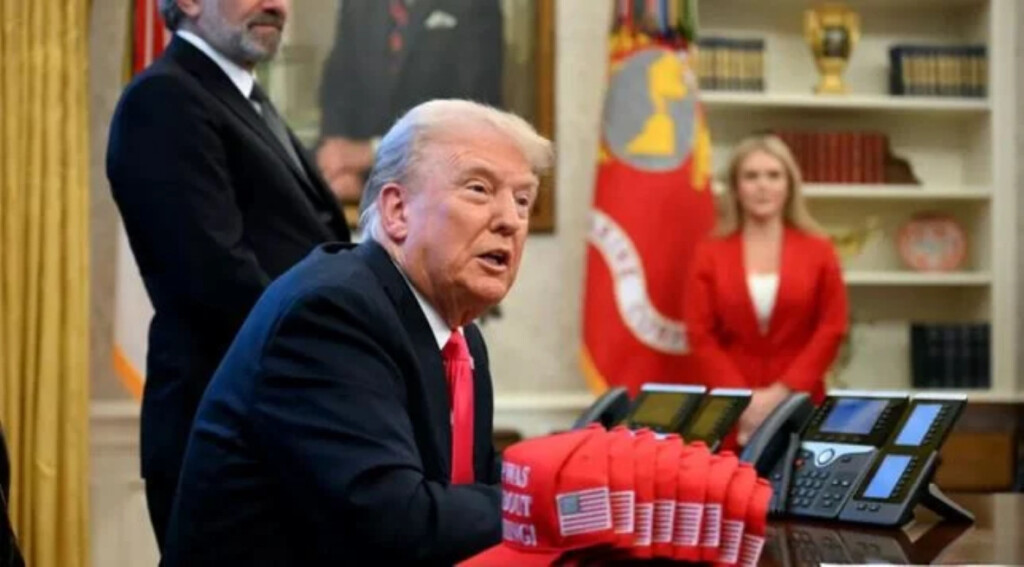
WASHINGTON, 3 March 2025 (BSS/AFP) – United States President Donald Trump has intensified tariffs on Canada, Mexico, and China, citing insufficient progress in combating fentanyl trafficking. However, analysts suggest that the fentanyl crisis is not the sole motivation behind his trade policy, but rather part of a broader political strategy.
“He needs a legal justification for these tariffs,” remarked Joshua Meltzer, a senior fellow at the Brookings Institution. While trade measures usually require lengthy investigations, declaring a drug-related emergency allows Trump to impose tariffs swiftly.
According to Meltzer, fentanyl also holds significant political weight for Trump. “People, especially in poorer and rural communities, tend to be sceptical or opposed to trade,” he explained. “Framing trade restrictions around a tangible threat, such as fentanyl, resonates with his voter base.”
In early February, Trump announced sweeping tariffs on Canada and Mexico before temporarily pausing them. That pause is set to expire on Tuesday, with additional tariffs on China expected to follow. Trump has defended his stance, insisting that narcotics are entering the United States at “unacceptable levels.”
However, Canadian Prime Minister Justin Trudeau has refuted these claims, asserting that less than one per cent of fentanyl and undocumented migrants entering the US originate from Canada. Trump dismissed these figures last Thursday, countering that Canada was “only apprehending one per cent” and should be doing far more.
The US has recorded tens of thousands of opioid-related deaths annually, though figures from 2023 indicate a decline compared to the previous year.
A Shift in Trade and Diplomacy
Traditionally, Washington has separated diplomatic relationships from trade matters, but Trump appears to take a more holistic approach, according to Kimberly Breier, a former senior US diplomat during his first term.
She pointed out that in 2018, Trump’s steel and aluminium tariffs became leverage in negotiations over the United States-Mexico-Canada Agreement (USMCA). Any new tariffs introduced this time are likely to feature in upcoming USMCA discussions, she noted.
Breier further suggested that Trump’s stance on trade has become more assertive. “He used tariff threats over immigration in his first term, but now he appears even less constrained,” she added.
Annie Pforzheimer, a former US career diplomat, noted that past administrations have largely supported free trade, preferring not to mix economic policies with other issues. “This administration, however, is far more protectionist and willing to sacrifice trade relations,” she said.
Strong Support from Anti-Drug Activists
Despite concerns from economic and diplomatic experts, Trump’s tough stance on fentanyl has been welcomed by anti-drug campaigners.
Andrea Thomas, 57, whose daughter died from a counterfeit pill laced with fentanyl, expressed her support. “This is what we, as affected families, have been calling for – a whole-of-government response,” said Thomas, the executive director of Facing Fentanyl, a network advocating against the drug.
For Thomas, viewing fentanyl policy through an economic lens is a novel but necessary approach. Last year, she led a petition urging the US to impose trade penalties on China for its alleged involvement in fentanyl production. She believes that the 10 per cent tariff on Chinese goods, which took effect in February, is “just the beginning.”
Washington has long accused Beijing of failing to curb fentanyl trafficking, a claim China denies.
The Effectiveness of Tariffs in Combating Fentanyl
Despite the administration’s stance, some experts question whether tariffs are an effective tool against drug trafficking.
A recent article in The Lancet Regional Health – Americas warned that trade restrictions would do little to disrupt international drug networks. Epidemiologists suggested that imposing tariffs on neighbouring countries might even damage diplomatic efforts essential for combating trafficking.
However, Breier pointed out that Trump’s previous tariff threats had influenced Mexico’s policies. “His approach led to a shift in Mexico’s behaviour, making the country take the issue more seriously,” she said.
As evidence, she cited Mexico’s recent handover of 29 alleged drug lords, including one accused of ordering the killing of a US agent. She described the development as “a turning point that could mark the beginning of a new era in bilateral cooperation.”
Context and Implications
The ongoing fentanyl crisis in the United States has been a significant political and public health issue. The synthetic opioid, largely produced using precursor chemicals from China and trafficked through Mexico, has been responsible for a surge in overdose deaths in recent years. The Biden administration had previously sought to address the crisis through diplomatic pressure on China and financial sanctions against traffickers.
Trump’s aggressive trade policy marks a departure from diplomatic approaches, instead using economic penalties as a deterrent. His move also aligns with his broader protectionist trade agenda, which has seen tariffs deployed as leverage in negotiations beyond drug policy.
The political landscape in the US remains deeply divided on trade and drug policy. While Trump’s supporters view his tough stance as necessary, critics warn that escalating trade tensions could have unintended economic consequences, potentially affecting American businesses and consumers.
As the situation unfolds, the effectiveness of Trump’s fentanyl-focused tariffs remains uncertain, but their political impact is already shaping the discourse ahead of the 2025 presidential race.