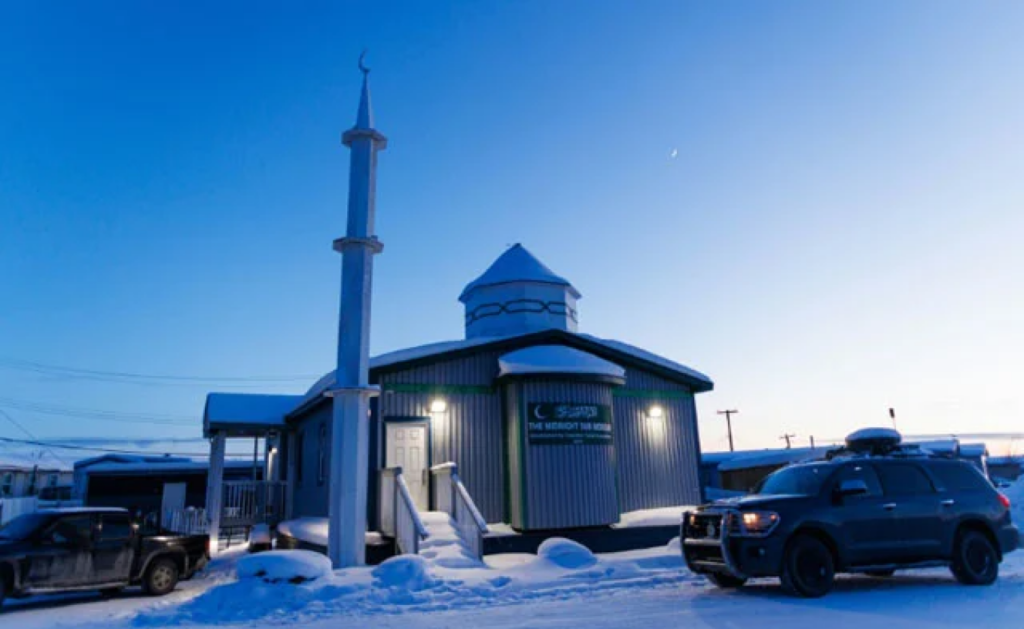
INUVIK, Canada, 4 March 2025 (BSS/AFP) – Muslims gathered at the Midnight Sun Mosque in the Canadian Arctic this week to break their Ramadan fast, enjoying home-cooked Sudanese dishes in a serene setting surrounded by breathtaking landscapes.
However, not everyone finds life in the remote northern town ideal.
“I’m stuck. Every year, I say, ‘This is my last year in Inuvik,'” laughed Abadallah El-Bekai, a Lebanese-born Palestinian, who has lived in the Northwest Territories community for 25 years.
“God didn’t agree for me to go. Maybe I made mistakes in my life, and God sent me here!” the 75-year-old joked.
Widely known as the “Little Mosque on the Tundra,” the Midnight Sun Mosque opened its doors in August 2010 to accommodate the growing Muslim population migrating north for work opportunities.
The mosque was originally constructed in Winnipeg, Manitoba, before being transported 4,000 kilometres (2,485 miles) north by truck. Today, it holds the distinction of being the northernmost mosque in the Western Hemisphere.
Imam Saleh Hasabelnabi, who has lived in Inuvik for 16 years, explained that while the congregation is no longer expanding, it remains steady at around 100 to 120 members.
Muslims residing near the Arctic Circle face unique challenges in practising their faith, particularly regarding prayer schedules that are traditionally dictated by the sun’s position.
Inuvik experiences 24-hour daylight for over 50 consecutive days each year, while its polar nights—where the sun does not rise at all—last approximately 30 days.
“The first time was a shock. I couldn’t believe it. I prayed five times a day, and the sun was still up,” Hasabelnabi recalled of his first summer in the town.
To manage this challenge, the community follows the local time in Mecca, Islam’s holiest city, for their religious observances.
Mohamed Asad Behrawar, an accountant who recently moved to Inuvik, said adjusting to the endless daylight was not too difficult, as he had previously lived in Edmonton, Alberta, which also experiences extended summer days.
“But it’s still hard to adjust to this environment. It’s quite harsh,” the 36-year-old admitted.
Despite the frigid temperatures, members of the mosque gathered on Sunday to break their fast on the third day of Ramadan. They brought an assortment of chicken dishes, rice, and other home-cooked meals, sitting together to share the experience.
El-Bekai, though often contemplating leaving, happily engaged in conversations while enjoying his meal.
With a population of approximately 3,400, Inuvik’s Muslim community consists of individuals who initially arrived in Canada as refugees and later moved north in search of better job prospects. Many of them work as taxi drivers in the town, which sits just south of the tree line.
Abdul Wahab Saleem, a 37-year-old Islamic scholar visiting from Edmonton, described the Muslim community in Inuvik as a “visible minority.”
“You walk around outside, and you’ll see Muslims all the time. Every time you take a cab, chances are it’s driven by a Muslim,” he observed.
A Unique Ramadan Experience
Observing Ramadan in the Arctic is an extraordinary experience, blending deep faith with resilience against extreme conditions. While many long for the comforts of larger communities, others embrace the solitude, tight-knit connections, and the mosque’s warm communal spirit in one of the most remote Muslim congregations in the world.