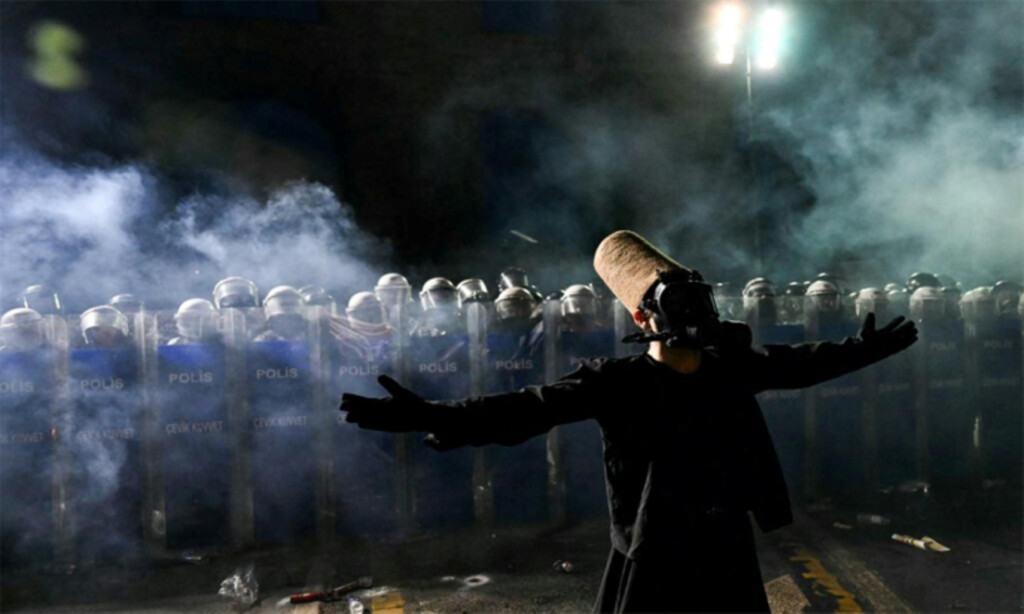
ISTANBUL, 25 March 2025 (BSS/AFP) – Large crowds of students flooded the streets of Istanbul on Monday in the latest wave of protests following the arrest and imprisonment of the city’s opposition mayor, an event that has triggered Turkey’s most significant unrest in years.
The demonstrations erupted after the 19 March detention of Ekrem Imamoglu and have since expanded to at least 55 of Turkey’s 81 provinces, leading to violent clashes with riot police and attracting widespread international condemnation.
The interior minister reported that more than 1,130 individuals have been arrested over the past six days, including 43 on Monday night. Among the detainees are journalists, including a photographer from AFP.
Imamoglu, 53, a prominent member of the opposition Republican People’s Party (CHP), is widely regarded as the only political figure with the capacity to challenge President Recep Tayyip Erdogan in an election.
In the span of just four days, Imamoglu went from serving as Istanbul’s mayor—a role that had once been instrumental in launching Erdogan’s political career—to being arrested, interrogated, jailed, and stripped of his office following a controversial graft and terrorism investigation.
Students Lead the Charge for Democracy
On Monday, students in both Istanbul and Ankara began assembling early in the afternoon, having declared a boycott of lectures at the leading universities in both cities.
In Istanbul, throngs of students waving flags and chanting slogans made their way towards Besiktas, a port on the Bosphorus, while local residents signalled their support by clapping and banging saucepans from their balconies, according to AFP correspondents.
“Your Palaces, Our Streets”
Following a rally at the port, demonstrators commenced a march along the coastline towards the historic peninsula, seeking to converge with the nightly protest outside City Hall.
“This is not just a demonstration; this is an act of defiance against fascism!” CHP leader Ozgur Ozel declared to the vast assembly of protesters, many of whom brandished banners aimed at Erdogan, including one that read, “Your palaces are yours; the streets are ours.”
Ozel also urged a boycott of pro-government television channels that have refused to broadcast images of the protests, along with businesses closely affiliated with the ruling administration, including a well-known chain of cafés.
Following a cabinet meeting on Monday, Erdogan accused the opposition of inciting unrest. “Stop playing with the nation’s nerves,” he stated, while also seeking to reassure the public that Turkey’s economic situation was stable, claiming the government had “successfully managed the latest market fluctuations.”
The controversy surrounding Imamoglu’s arrest has severely impacted the Turkish lira and unsettled financial markets. The benchmark BIST 100 stock index plummeted by nearly 8.0 percent on Friday, although it saw a partial recovery on Monday, closing around 3.0 percent higher.
International Condemnation
On Sunday, Imamoglu was overwhelmingly selected as the CHP’s presidential candidate for the 2028 election—a decision that many observers believe prompted the crackdown against him.
His imprisonment has provoked strong reactions from abroad. Germany labelled the move “totally unacceptable,” while neighbouring Greece stated that actions undermining civil liberties “cannot be tolerated.” Meanwhile, the European Union cautioned Ankara to uphold “a clear commitment to democratic norms.” France’s foreign ministry echoed these concerns, describing Imamoglu’s arrest as a “serious attack on democracy.”
Press Freedom Under Threat
In a further escalation, police detained ten Turkish journalists before dawn on Monday, including an AFP photographer, allegedly for covering the protests, according to the MLSA human rights group.
The move was strongly criticised by the Journalists’ Union of Turkey, the Turkish Journalists Association, and several other media organisations.
“Stop targeting journalists!” they demanded in a joint statement, highlighting that many reporters had faced police violence, tear gas, and plastic bullets while covering the unrest.
Reporters Without Borders (RSF) also called for the immediate release of detained journalists, with RSF’s Turkey representative, Erol Onderoglu, condemning the arrests.
Imamoglu’s wife, Dilek Kaya Imamoglu, also spoke out against the suppression of the press. “What is being done to members of the media is a matter of freedom. None of us can remain silent about this,” she posted on X (formerly Twitter).
Defiant from Behind Bars
Imamoglu, who has described his imprisonment as a political “execution without trial,” issued a resolute message from jail via his lawyers.
“I wear a white shirt that you cannot stain. I have a strong arm that you cannot twist. I will not budge an inch. I will win this war,” he declared.
Historical Context and Additional Information
Turkey has a long history of political crackdowns, with previous opposition figures, journalists, and activists facing similar fates under Erdogan’s rule. The arrest of Imamoglu mirrors past moves against prominent figures such as Selahattin Demirtas, the leader of the pro-Kurdish HDP, who has been imprisoned since 2016.
The country’s democratic backsliding has been a subject of international concern, particularly in the wake of a failed coup attempt in 2016, which led to a massive purge of government critics.
For many in Turkey, Imamoglu’s imprisonment is not just about one politician—it is a broader struggle for democracy, justice, and press freedom in an increasingly authoritarian landscape.