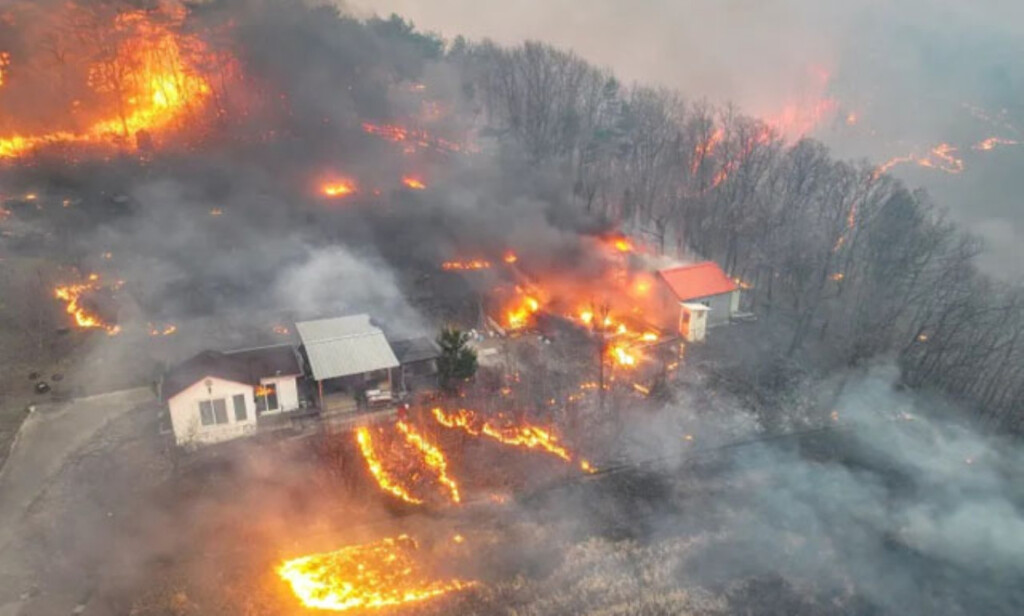
UISEONG, SOUTH KOREA, 26 March 2025 (AFP) – At least 18 people have lost their lives in one of South Korea’s most severe wildfire outbreaks, with multiple blazes causing what the acting president has described as “unprecedented damage.”
The fires, which ignited over the weekend, have swept through rural villages and even destroyed a historic temple, forcing the government to declare a full-scale national emergency response. The crisis alert has been raised to its highest level as authorities struggle to contain the destruction.
“Eighteen people have died in the wildfires,” a Ministry of Safety official confirmed to AFP. “Additionally, six people are in serious condition, and 13 others have sustained minor injuries.”
Government Declares National Emergency
Efforts to control the blazes have been severely hindered by dry, windy conditions, with authorities taking the extraordinary measure of evacuating thousands of prisoners from detention centres in the affected areas.
On Tuesday, an emergency alert was issued for Hahoe Folk Village, a UNESCO World Heritage Site and popular tourist destination, as fires edged dangerously close.
“Wildfires burning for a fifth consecutive day in Ulsan and the Gyeongsang region are causing damage on an unprecedented scale,” acting president Han Duck-soo stated. He warned that the situation had exceeded previous fire prediction models and had developed in a manner far more severe than initially expected.
Thousands of people have been evacuated, but officials lamented that despite their efforts, loss of life had been unavoidable.
Winds and Dry Weather Complicate Firefighting Efforts
As night fell, entire regions were left without power or communication, and several roads became impassable. Han revealed that “strong winds reaching speeds of 25 metres per second persisted from yesterday afternoon through the night, forcing the suspension of helicopter and drone operations.”
“Constantly shifting wind directions and ongoing dry weather advisories have exposed the limitations of conventional firefighting methods,” he added.
Firefighters have worked tirelessly to battle the flames, but local residents describe the terrifying speed at which the fires have spread.
‘The Fire Came From the Mountain’
Survivors sheltering in the gymnasium of Sinsung Elementary School recounted their harrowing escapes.
“The wind was so strong,” said Kwon So-han, a 79-year-old resident of Andong. “As soon as the evacuation order was given, I fled. The fire came from the mountain and engulfed my house. I couldn’t take anything with me – just my body.”
The South Korean government has promised immediate relief efforts, including financial aid and emergency support for those displaced by the disaster. More people are being moved to temporary shelters, with authorities working around the clock to ensure their safety.
Hope for Rain
Meteorologists have forecast rain for late Wednesday, and authorities hope even a small amount of precipitation will aid in extinguishing the flames.
While wildfires can be caused by multiple factors, including weather conditions and human activities, scientists have increasingly linked the intensity and frequency of such disasters to climate change. Rising global temperatures and prolonged dry spells contribute to an environment where fires can spread rapidly.
Initial reports suggest that the fire in Uiseong was sparked accidentally by an individual tending to a family grave site. This incident has highlighted the ongoing risks posed by human activities in fire-prone areas.
A Growing Concern
South Korea has experienced a rise in wildfires in recent years, with authorities warning that such disasters could become more frequent due to climate shifts. The government is now reviewing stricter fire prevention measures, including enhanced surveillance, better early-warning systems, and improved emergency response infrastructure.
For now, residents of the affected regions can only wait and hope that nature provides relief in the form of much-needed rainfall.