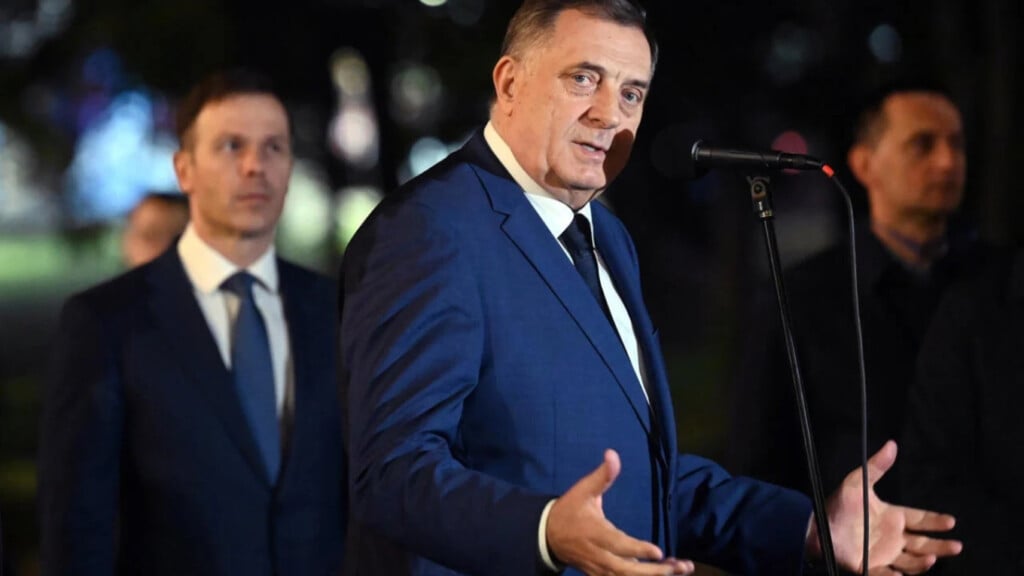
BELGRADE, 10 April 2025 (BSS/AFP) – Milorad Dodik, the President of Bosnia’s Serb-dominated entity, Republika Srpska (RS), has expressed a conditional willingness to engage in dialogue and temporarily freeze controversial “secessionist” legislation. However, he insists this will only occur if Christian Schmidt, the international envoy supervising Bosnia’s post-war peace accord, withdraws the measures he has imposed.
Context: Bosnia’s Fragile Power-Sharing System
Following the devastating war in the 1990s, Bosnia and Herzegovina was divided into two semi-autonomous entities:
| Entity | Dominant Groups | Capital |
|---|---|---|
| Republika Srpska (RS) | Serbs | Banja Luka |
| Federation of Bosnia and Herzegovina | Bosniaks and Croats | Sarajevo |
This complex arrangement is overseen by an international envoy, currently Christian Schmidt, tasked with safeguarding the Dayton Peace Agreement, signed in 1995.
Dodik’s Challenge to Federal Authority
Dodik, 66, has long opposed Schmidt’s role, arguing it undermines the autonomy of Republika Srpska. Earlier this year, he defied the envoy by enacting laws that effectively bar federal judicial and law enforcement agencies from operating within RS.
These laws have been labelled “secessionist” by international observers, raising concerns about constitutional integrity.
As a result:
Dodik was convicted of defying Schmidt’s authority.
He received a one-year prison sentence and a six-year ban from holding public office.
Dodik refused to appear in court and has been issued with a federal arrest warrant.
Statement on Social Media
In a post on the social platform X (formerly Twitter), Dodik stated:
“The only solution is annulling Christian Schmidt’s voluntarism and all the decisions he has imposed. In that case, Republika Srpska is ready to temporarily freeze the laws recently adopted by the National Assembly.”
His conditional offer suggests a momentary de-escalation, but critics remain wary of his intentions.
International Responses
The situation has drawn significant international attention. This week:
French President Emmanuel Macron met with Serbian President Aleksandar Vučić in Paris.
EU Foreign Policy Chief Kaja Kallas visited Sarajevo, emphasising EU commitment to Bosnia’s unity and future.
| International Position | Statement |
|---|---|
| European Union | “The EU will not accept any threats to Bosnia’s future as a country.” |
| President Macron | “Everyone’s responsibility is to uphold the constitutional order.” |
| Kaja Kallas | “Bosnia’s constitution is the cornerstone of peace and must be respected.” |
Dodik responded by welcoming some of these messages, but also added a pointed critique:
“If Kallas believes that the constitutional order is what Schmidt has imposed, then we clearly don’t understand each other.”
Regional Tensions and Political Fallout
Dodik’s stance has further strained relations within Bosnia’s already fragile political framework. The arrest of such a high-profile Serb leader risks igniting unrest in Republika Srpska, potentially destabilising the delicate ethnic balance.
Furthermore:
Germany and Austria imposed travel bans on Dodik and two other senior RS officials last week.
Dodik also holds a Serbian passport, raising questions about potential political support from Belgrade.
Bosnia remains a candidate country for EU membership, and the EU has made it clear that any threats to constitutional unity could jeopardise that status.