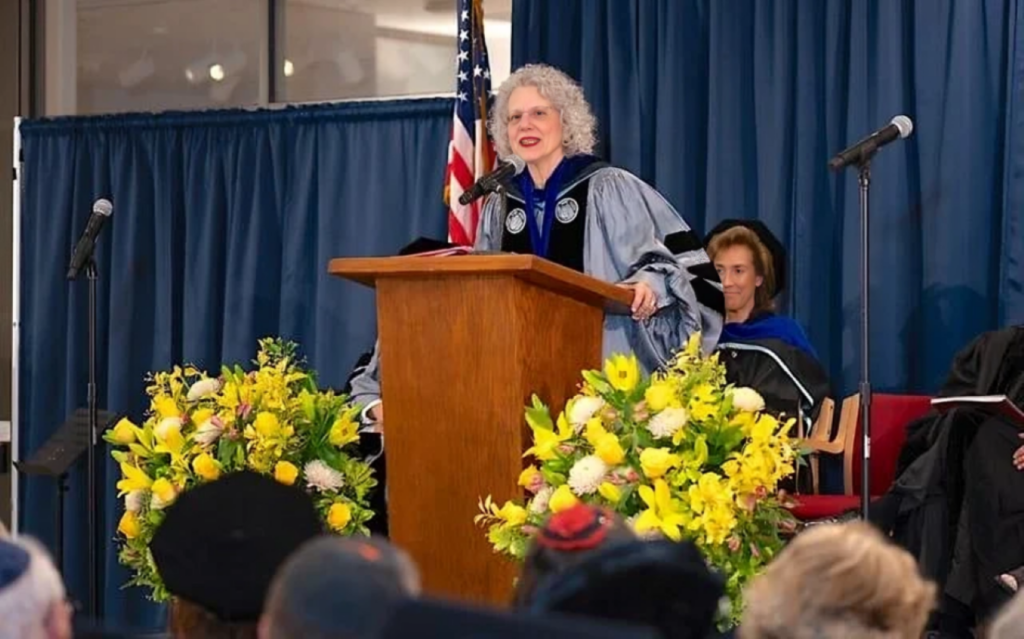
New York – Shuly Rubin Schwartz, the first woman to serve as Chancellor of the Jewish Theological Seminary (JTS), has announced she will step down at the end of the 2025–2026 academic year. Appointed in 2020, she has led the Conservative movement’s flagship academic and rabbinical institution during a period marked by significant global and institutional challenges.
Schwartz shared her decision during a meeting of the JTS Board of Trustees, later explaining to the Jewish Telegraphic Agency that she had never intended a lengthy tenure. “I’ve been here for 34 years,” she said. “After a sabbatical, I will return to the faculty — it is a decision made with love and excitement for what we’ve achieved.”
Legacy of Leadership
Schwartz joined JTS in 1991 and has served in numerous academic leadership roles, including Dean of the Albert A. List College of Jewish Studies, Dean of the Gershon Kekst Graduate School, and Provost. She made history as the third non-rabbi Chancellor, following religion scholar Arnold Eisen and Cyrus Adler (1924–1940).
In a statement, Board Chair Alan Levine praised her tenure:
“Chancellor Schwartz has guided JTS with clarity, nuance, and compassion through turbulent times — from the COVID-19 pandemic to rising antisemitism and the tragic events of 7 October. She has left the institution stronger and better equipped for the future.”
An executive search firm has been appointed to assist in identifying the next Chancellor — the ninth in JTS’s 139-year history.
Achievements and New Initiatives
During her time in office, Schwartz introduced several key initiatives, including:
- A transition to virtual learning amid the pandemic.
- The establishment of the Division of Lifelong and Professional Studies.
- Launch of a creative writing MFA, to be led by renowned Israeli author Etgar Keret.
- Appointment of four new faculty members, including historian Sandra Fox as the inaugural Rifkind Chair in Jewish History.
“Since that is my field, I am particularly thrilled about that hire — it was my last one,” Schwartz noted.
Addressing Challenges in Jewish Leadership
JTS remains a central institution for training Conservative rabbis and cantors. However, in recent years, its rabbinical and cantorial schools have faced declining enrolment. To counter this trend, Schwartz implemented a number of programmes to strengthen the leadership pipeline:
- The Emerging Leaders fellowship.
- A low-residency preparatory programme for aspiring rabbis.
In 2024, JTS ordained nine rabbinical students and three cantorial students — an increase compared to previous years. The coming autumn intake includes 17 rabbinical and four cantorial students.
“Not enough young people see themselves as being called to serve the Jewish people,” she said. “We had to rebuild the muscle of identifying young talent and encouraging them to consider becoming rabbis.”
Despite shrinking numbers of Conservative congregations, Schwartz said that demand for JTS-trained rabbis remains high across the United States.
A Family Legacy and Personal Commitment
Schwartz has deep familial ties to JTS: her grandfather and mother, Gilla Pearlstein Rubin, were graduates of its Teachers’ Institute, while her father, Rabbi Mordecai Rubin, was ordained at JTS. She herself grew up in Wantagh, Long Island, and resides on the Upper West Side of Manhattan.
Her leadership style has been defined by what she terms “principled centrism” — balancing tradition with contemporary relevance.
“In a world that’s increasingly polarised, Conservative Judaism offers full engagement with the world alongside a deep commitment to Hebrew prayer, tradition, and love for Israel,” she said.
Zionism and Institutional Integrity
JTS, under Schwartz’s leadership, has maintained its strong Zionist stance. “That is one of the matters we probe during the application process,” she noted, distinguishing JTS from other non-Orthodox seminaries now accepting non- or anti-Zionist candidates.
Context of Broader Institutional Change
Schwartz’s announcement comes amid other leadership transitions within Conservative Judaism:
- Rabbi Matt Berkowitz will soon succeed Rabbi David Golinkin as President of The Schechter Institutes in Jerusalem.
- Sarah Schwartz, a scholar of the Bible, has been appointed as the new Dean of The Schechter Institute of Jewish Studies.
These changes represent what Berkowitz described as a “liminal moment” for the movement, as it navigates evolving religious, cultural, and political dynamics.
Looking to the Future
Reflecting on the unforeseen challenges of her term — including the COVID-19 pandemic and the trauma of the 7 October 2023 Hamas attacks — Schwartz emphasised the importance of resilient, visionary leadership for the future.
“We’re preparing leaders for a future we cannot yet imagine,” she said. “We need someone who understands the complexity of the world we live in and the unique role JTS plays in helping people find meaning.”