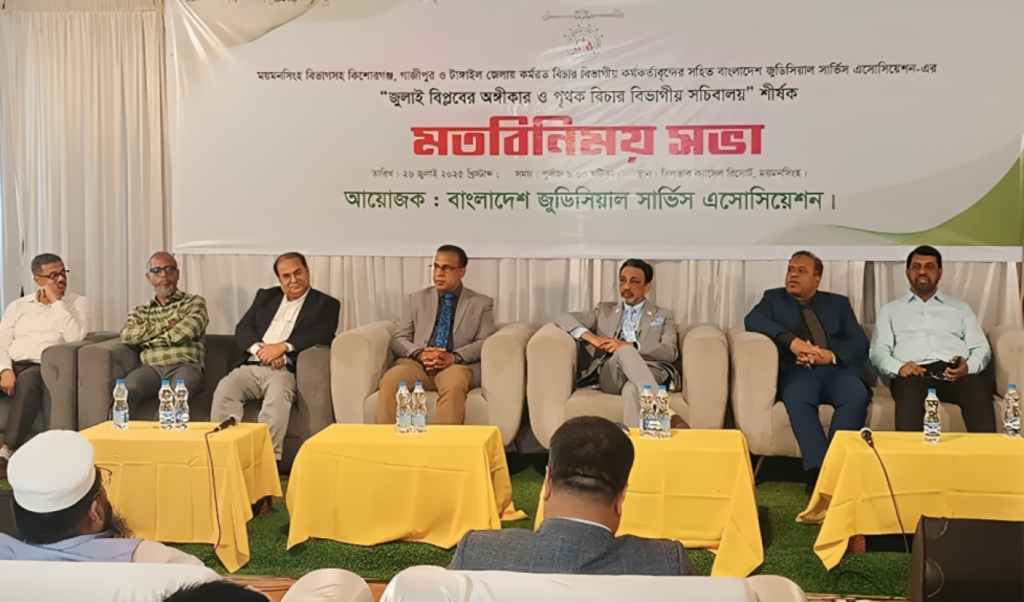
The Bangladesh Judicial Service Association (BJSA) has raised serious concerns over the state of judicial independence in the country, pointing to political interference, recruitment and promotion disparities, budget constraints, and continued reliance on the executive branch. The association has strongly urged for the complete separation of the judiciary from the executive and the establishment of a fully independent judicial secretariat under the Supreme Court.
These demands were made during a discussion session titled “Commitment of the July Uprising and the Need for an Independent Judicial Secretariat”, held on Saturday, 26 July at Silver Castle Resort, Mymensingh. Organised by BJSA, the event saw the participation of judicial officials from four districts of Mymensingh Division, as well as from Kishoreganj, Tangail, and Gazipur.
Demands and Areas of Concern
| Issue | Details |
| Judicial Independence | Judiciary still largely dependent on the executive branch |
| Judicial Secretariat | Call for a separate, fully independent judicial secretariat under the Supreme Court |
| Appointments & Promotions | Demand for seniority, merit, and equality-based appointments from district to higher courts |
| Budget Constraints | Severe financial shortfall hindering infrastructure and operations |
| Constitutional Conflicts | Article 116 places judicial control under the President, executed on advice of the executive |
| Unimplemented Court Orders | Only 1 of 12 directives from 2007’s separation ruling has been fully implemented |
Speakers’ Concerns
At the outset, judges paid tribute to the martyrs and wounded of the July Mass Uprising, recognising their sacrifices as symbols of a new dawn for democracy and civil rights in Bangladesh.
Speakers emphasised that:
“Though the judiciary was declared separate from the executive on 1 November 2007, most key directives from the Supreme Court’s verdict in the Masdar Hossain case remain unimplemented. The judiciary continues to rely on the executive for postings, transfers, promotions, and disciplinary matters — a clear contradiction to judicial independence.”
Need for Structural Reform
The association criticised the stagnant state of judicial benefits, highlighting that the judicial allowance has remained frozen since 2009, and called for the formation of a separate and independent pay commission for judicial officers.
They argued that financial independence is a cornerstone of true judicial freedom. Presently, the judiciary lacks control over:
- Budget allocation
- Infrastructure development
- Human resource management
“A separate budgetary framework and financial authority for the judiciary are essential. Judicial dignity and economic incentives should reflect the constitutional importance of judges’ responsibilities,” stated one speaker.
Constitutional Articles in Focus
| Article | Provision | Issue |
| Article 109 | Empowers the High Court to supervise subordinate courts and tribunals | Endorses judicial independence |
| Article 116 | Vests control of judges in the President (exercised via the executive branch) | Undermines independence by allowing executive oversight |
| Article 116A | Mentions independence of the judiciary | Undermined in practice due to lack of proper enforcement |
BJSA members demanded amendment of Article 116, proposing that all disciplinary, posting, and promotion powers be transferred to the Supreme Court.
Legislative and Executive Developments
- Judges referenced the Supreme Court Judge Appointment Ordinance 2025, already drafted.
- The Chief Justice has submitted a full proposal to the Ministry of Law, advocating for a separate judicial secretariat, modelled after the Election Commission and Parliament Secretariats.
- The interim government led by Dr Muhammad Yunus has also pledged support for the establishment of the Supreme Court Secretariat, with hopes for imminent governmental action.
Quotes and Notable Remarks
“The judiciary cannot fulfil its constitutional duties without full administrative and financial autonomy. We must act now to uphold the rule of law and public confidence.”
“Without full implementation of the Masdar Hossain verdict, judicial reforms remain incomplete and ineffective.”
Participants
| Name | Position |
| Md Zakir Hossain | Senior District & Sessions Judge, Mymensingh (Chief Guest) |
| Md Amirul Islam | BJSA President & Judge, Women & Children Repression Prevention Tribunal, Khulna (Chair) |
| Senior Judges Present | From Sherpur, Netrokona, Jamalpur, Kishoreganj, and Metropolitan Gazipur |
The session closed with a unified call to action:
There is no alternative to a separate, independent judicial secretariat under the Supreme Court, if Bangladesh is to fulfil its constitutional promise of an impartial, empowered, and independent judiciary.