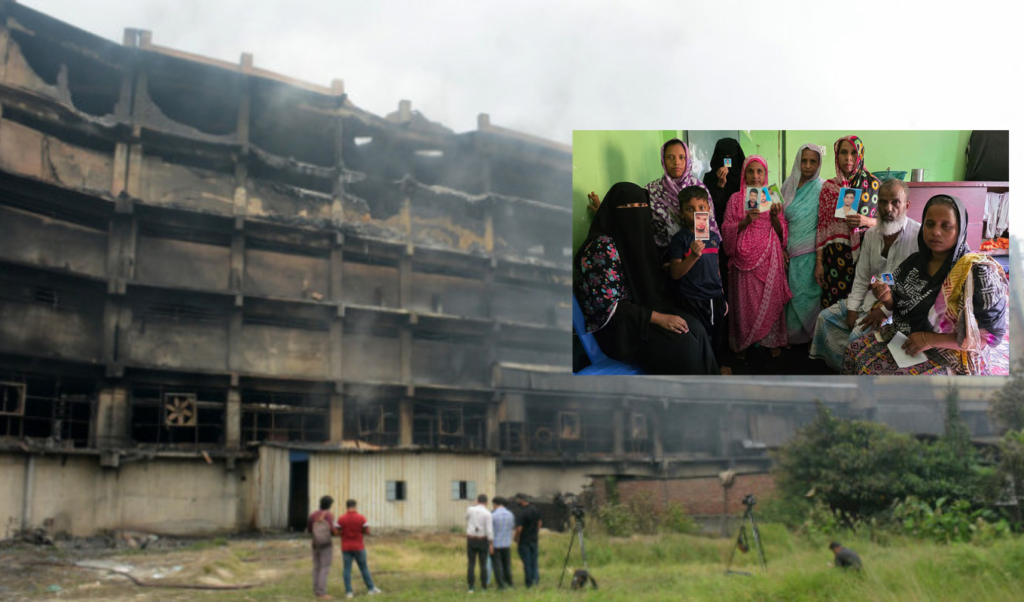
Two years after a catastrophic fire gutted the Gazi Tyres factory following political unrest, the families of 182 missing individuals remain trapped in an agonizing administrative limbo. Despite repeated appeals to police stations, government departments, local lawmakers, and political leaders, relatives have received little more than empty assurances. Without official declarations of death or death certificates, dozens of impoverished families are unable to secure inheritance documentation, claim widow pensions, or even register the births of children born after the tragedy.
The disaster unfolded in August 2024 at the massive manufacturing facility located along the Dhaka-Sylhet Highway in Rupganj Upazila. Owned by Golam Dastagir Gazi, a former Awami League minister and member of parliament, the factory became a target for widespread looting and arson following the fall of the Awami League administration on 5 August 2024.
A subsequent investigation by the district administration revealed that the factory suffered two distinct waves of violence. The first occurred between 5 August and 8 August 2024, leading to initial structural fires and the eventual disconnection of the site’s electricity and gas supplies. The second, far more deadly incident erupted on the night of 25 August, hours after Golam Dastagir Gazi was arrested in Dhaka.
As news of the owner’s arrest spread, large crowds entered the complex to loot valuable copper components and industrial chemicals. According to the eight-member official inquiry committee headed by former Additional District Magistrate Hamidur Rahman, intruders plundering the upper floors set fire to the ground-floor exit gates before fleeing, trapping hundreds of people inside. Fueled by highly flammable rubber stock and raw chemicals, infernos quickly consumed the six-storey structure. Firefighters required 22 hours to bring the blazes under control, while internal fires burned for five days.
Because the high temperatures rendered the building structurally unsafe, comprehensive search and rescue operations were never conducted inside the main tower. A preliminary sweep of the basement yielded no casualties, after which official search efforts were permanently abandoned.
By 26 August 2024, hundreds of distraught locals gathered outside the gates searching for family members who had entered the complex during the chaos and failed to return. Local authorities registered their details, establishing an official list of 182 missing persons.
During a public hearing organized by the district administration on 1 September 2024, desperate family members breached safety barriers to enter the ruins themselves, recovering 15 fragments of human bones from the debris. The remains were handed over to the police for forensic analysis by the Criminal Investigation Department (CID). However, Tareq Al Mehdi, Additional Superintendent of Police (Crime) for Narayanganj District, recently revealed that no DNA testing has been performed on the bone fragments due to a lack of directives from higher authorities.
For the families left behind, the absence of legal closure has caused severe economic hardship. Shahadat Sikdar, 30, an electrician from Maikuli village, disappeared in the blaze alongside his 26-year-old brother Sabbir Sikdar and their brother-in-law Jamir Ali, 36. Shahadat’s son, Abdullah, was born three months after the fire. Seventeen months later, the family remains unable to obtain a birth certificate for the child because the father’s death cannot be officially verified.
“We know in our hearts that they are not alive,” said Cynthia Akhtar, Shahadat’s sister, who recently took a job at a local soap factory to support her family. “Because we do not have death certificates, we cannot obtain birth registrations or inheritance documents. My brother had outstanding microfinance loans, but lenders refuse to waive the debt without proof of death. Loan collectors come to our home every day to harass us.”
Similar hardship has fallen upon Farzana, the 27-year-old widow of textile worker Mohammad Arif. Unable to afford rent after her husband disappeared, Farzana was forced to move into her mother’s home and pull her eldest son out of kindergarten to enroll him in an overcrowded government school.
For elderly mothers like Rashida Begum, whose son Aman Ullah, a battery factory worker, went missing at the site, the loss is deeply emotional. “If they would just give me a piece of his bones, I could press it to my chest and find peace,” she wept. “We didn’t even get his burnt ashes.”
Administrative inertia has further compounded the plight of relatives. While Gazi Tyres management filed two criminal cases focused exclusively on vandalism and property destruction, neither case addressed the missing persons. Senior Assistant Superintendent of Police (Rupganj-Araihazar Circle) Mehdi Islam stated that while police missed the opportunity to file a missing-persons case at the time, an official status report confirming that none of the 182 listed individuals could be traced has been submitted to the District Magistrate through the District Police Superintendent.
Family members revealed they initially refrained from filing police complaints out of fear, as local rumors suggested anyone entering the factory would be branded a looter. Several relatives later lodged General Diaries (GDs) once the situation stabilized.
Narayanganj District Commissioner Md Rayhan Kabir acknowledged the ongoing distress of the affected families, assuring that local authorities are working with police to resolve the administrative gridlock and assist relatives in securing necessary legal documentation.