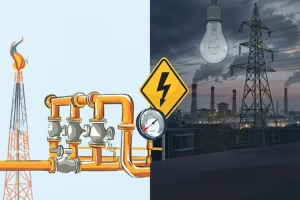
A severe and persistent energy crisis involving gas shortages and frequent power cuts has pushed Bangladesh’s light engineering sector into deep financial distress. Small and medium enterprises (SMEs) across the country report plummeting production volumes, soaring operational overheads, and widespread job losses.
Faisal Polymer Industries, a manufacturing unit based in Dhaka’s Jatrabari area that has produced water taps for over a decade, illustrates the gravity of the situation. Managing Director Md Solayman Parsi explains that melting brass to cast taps requires continuous furnace operation, heavily dependent on steady gas supplies. However, low pressure over the past four to five months has effectively choked production. The factory now operates for barely three or four hours a day, causing output to drop by more than 60 percent.
Daily fixed operational costs of eighteen thousand taka must be met regardless of output, requiring a daily production value of seven to eight lakh taka to break even. Current output languishes at just three to four lakh taka, forcing severe losses. Consequently, the workforce at the factory has shrunk from thirty employees a year ago to a mere twelve.
The Jatrabari cluster alone hosts roughly 350 large and small tap-manufacturing units, nearly all experiencing similar disruption. Across Bangladesh, the Bangladesh Engineering Industry Owners Association estimates that fifty thousand light engineering workshops support approximately 650,000 jobs. Yet, key industrial hubs in Keraniganj, Narayanganj, Bogura, Pabna, and Gazipur report daily power outages lasting six to eight hours alongside critically low gas pressure. Essential industrial processes like metal casting and heat treatment have ground to a halt.
Makers of agricultural equipment and industrial machinery face identical hurdles. Agro Machinery Industries Limited in Gazipur’s Shalna cluster reports that production has halved due to frequent load-shedding lasting up to an hour per outage, leaving the firm struggling to meet client orders. Meanwhile, manufacturing expenses continue to climb despite reduced productivity. Brothers Engineering, a plastic mould maker in Keraniganj, reports a thirty percent spike in electricity bills alongside a forty percent jump in diesel expenditure for backup generators, even as monthly production dropped by thirty percent.
SME Foundation Managing Director Anwar Hossain Chowdhury notes that entrepreneurs frequently report their inability to fulfill existing orders on schedule due to infrastructure bottlenecks. Without swift remediation, vulnerable businesses face mounting defaults on bank loans and the very real prospect of permanent closure.