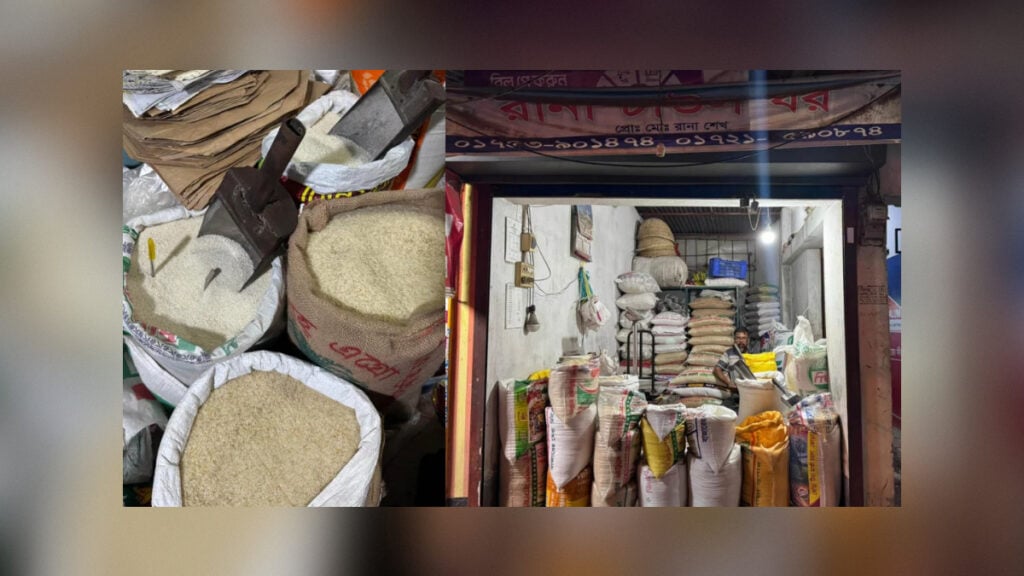
Fragrant rice, traditionally reserved for pulao, biryani, family gatherings and festive occasions, has become significantly more expensive in Rajshahi, putting additional pressure on household budgets. Some varieties have nearly doubled in price within six months, while Chinirgura, one of the most commonly used fragrant rice varieties for pulao, is now selling for as much as Tk230 per kilogram.
Retail prices for Chinirgura currently range between Tk220 and Tk230 per kg, depending on quality and brand. In the wholesale market, fragrant rice is being sold at around Tk180-Tk200 per kg, while retail prices can reach about Tk210 or more.
The increase has been particularly sharp in recent months. Loose Chinirgura rice, which was available for Tk115-Tk120 per kg just three months ago, now costs around Tk170-Tk180. Packaged Chinirgura has risen from Tk135-Tk140 to about Tk230 per kg. Domestic Kalijira rice has increased from Tk120-Tk125 to around Tk160, while Dinajpur’s fragrant Kataribhog rice has risen by roughly Tk15 to Tk95-Tk105 per kg.
For many consumers, the pace of the increase is difficult to absorb.
Export blamed for part of the increase
A section of rice traders attributes the sharp rise in fragrant rice prices to exports, arguing that shipments abroad have reduced supplies in the domestic market.
In the 2025-26 financial year, three leading companies exported a combined 1,530 metric tonnes of rice, according to the information cited by traders. Much of the fragrant rice in question is produced from BRRI-34, commonly known as Chinirgura.
Ashok Prasad, owner of AP Chaul Bhandar-1 in Rajshahi’s Saheb Bazar, said prices began rising after Eid-ul-Adha. According to him, some fragrant rice varieties have increased by almost Tk100 per kg.
He attributed much of the increase to exports and said prices could fall if exports were halted.
Wholesale trader Jasim Uddin of the Kadirganj area expressed a similar view. He said rice that had been selling for around Tk100 per kg six months ago was now approaching Tk200.
Jasim said he was no longer keeping fragrant rice in stock. He also said officials from the Directorate of National Consumer Rights Protection visited his shop about two weeks earlier and questioned him about prices. He was fined Tk10,000 over an allegation that he had sold pulao rice at Tk200 per kg.
According to Jasim, however, traders are themselves purchasing the rice from company warehouses at around Tk200 per kg. Transport costs are added afterwards, while traders generally need to retain a commission of 10 to 20 per cent. He therefore argued that selling below the purchase price was not commercially viable.
He said the bags carried company contact numbers that could be used to verify the purchase price.
Supply constraints add to market pressure
Export demand is not the only factor cited for the price increase. Poor production conditions, reduced availability of paddy and higher processing costs have also contributed to the pressure on the market.
During the previous growing season, severe heat and a lack of rainfall affected fragrant paddy production in parts of northern Bangladesh. Lower-than-expected yields have subsequently affected supplies.
There are also concerns about how paddy is purchased and stored at the beginning of the season. Large rice-processing companies reportedly bought substantial quantities of paddy at relatively high prices early in the season, reducing the amount available to smaller mills and open-market traders.
Fragrant rice also requires specialised processing and polishing. Rising electricity bills, milling costs and transport expenses have increased the overall cost of bringing the product to consumers.
The price of paddy itself has risen sharply in some producing areas. Dinajpur rice wholesaler Atiar Rahman said a 75kg sack of paddy was traded at around Tk4,000 when the crop arrived. The price later rose to Tk6,000 and has now reached about Tk8,500.
Asked about the reasons, he pointed to shortages of paddy in the area. He was less certain about the role of exports.
Consumers cutting back
The higher prices are already changing purchasing patterns in Rajshahi. Fragrant rice is not normally a daily staple for most households, but it is widely used during family celebrations, religious festivals and social gatherings. As prices rise, consumers are reducing the quantities they buy or switching to cheaper varieties.
Mohammad Azad, a salaried worker shopping at Saheb Bazar, said the price had become difficult to justify even for occasional use. He noted that packaged Chinirgura now costs Tk230 per kg, a price he said he had never encountered before.
Another consumer, Jahangir Alam Khan, said he was shocked when he returned to buy pulao rice after five months. He had previously purchased it for Tk140 per kg but had to pay Tk230 this time.
Housewife Selina Parvin was shopping for rice for her daughter’s birthday. She said she had little choice but to buy fragrant rice because relatives would be visiting and pulao was part of the planned meal. Yet even loose Chinirgura was expensive, while the quality available at lower prices was not satisfactory in her view.
The impact is also being felt by restaurants. Mohammad Golap Sardar, who runs a restaurant in the Kumarpara area, said he had bought pulao rice for Tk130 per kg six months ago. He now pays around Tk200 per kg. However, he has not been able to raise the price of prepared pulao by a similar amount because of concerns about customers.
Rice trader Rajib Hossain said higher prices were hurting traders as well as consumers. He said customers who previously bought 5-10kg of fragrant rice at a time were increasingly limiting their purchases to just 1-2kg.
Farmers yet to benefit from higher rice prices
Despite the sharp rise in retail prices, farmers who produced the paddy are not necessarily receiving the same benefit.
Asfakuzzaman Babu, a farmer from Keshabpur in Godagari, said he had cultivated fragrant paddy on two bighas of land but sold his crop six months ago. Had he retained the paddy, he believes he could have received a much higher price now.
He said that if fragrant rice prices remain at current levels, he may consider increasing his cultivation of fragrant paddy in the future.
The situation highlights a significant gap between farm-gate prices and retail prices. While consumers are paying considerably more for processed fragrant rice, the higher retail price does not automatically translate into equivalent returns for farmers who have already sold their harvest.
Dinajpur remains a major production centre
Data from the Department of Agricultural Extension indicate that most BRRI-34, or Chinirgura, paddy is produced in Dinajpur, with some cultivation also taking place in Thakurgaon and Panchagarh.
In Dinajpur, the target for rice cultivation this year has been set at 260,860 hectares. Of that area, Chinirgura has been cultivated on around 95,000 hectares, compared with 94,000 hectares last year.
Mohammad Afzal Hossain, deputy director of the Dinajpur District Department of Agricultural Extension, said several major companies, including Square Food and Beverage, Ispahani Agro and PRAN Agro, package and market fragrant rice produced from Chinirgura paddy.
Jahura Auto Rice Mill in Bochaganj is also involved in local processing and marketing. Around 200 small and large automatic rice mills have developed in the district around fragrant paddy production and processing, according to the department.
Afzal Hossain said, however, that farmers had not received the same prices now being seen in the rice market. The gap between the price received for paddy and the price paid for processed rice remains a concern.
Calls for closer market monitoring
The precise contribution of exports, supply shortages, production costs, stockholding and transportation to the latest price surge remains disputed among traders and other market participants. But the scale of the increase has prompted calls for stronger monitoring of the fragrant rice market.
The sharp rise in retail prices also raises questions about the entire supply chain, from farmers selling paddy to mills processing it and traders distributing the finished rice.
A clearer picture of purchase prices, processing costs, transport expenses, wholesale margins and retail prices could help establish where the largest increases are occurring. For consumers already reducing their purchases because of higher prices, greater transparency and effective market oversight could be crucial to preventing further unjustified increases.