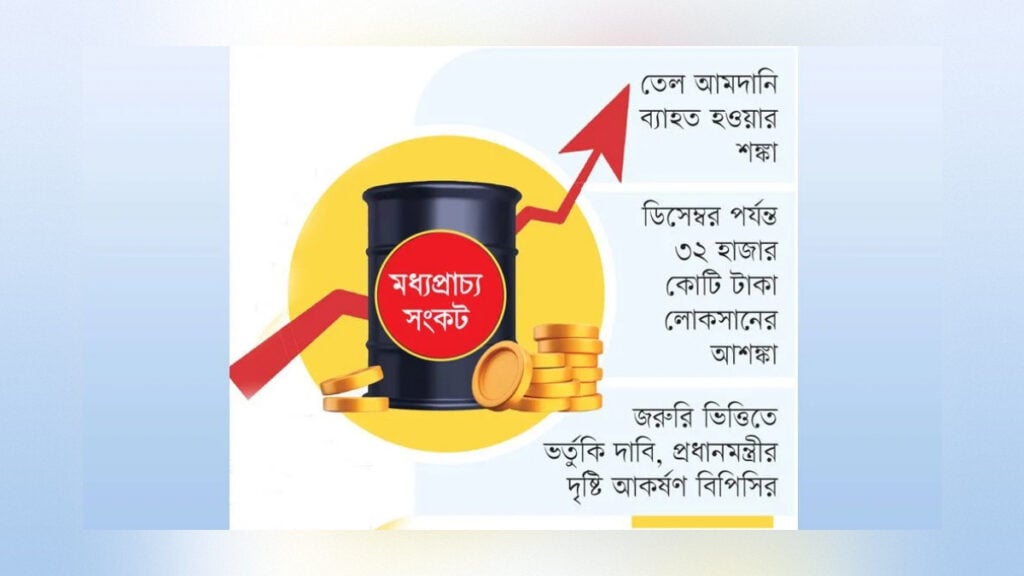
The Bangladesh Petroleum Corporation (BPC) has sought at least Tk20,059.73 crore in government subsidy after suffering substantial losses by purchasing fuel at high international prices and selling it domestically at lower rates.
According to BPC calculations, the state-owned fuel importer incurred the losses over five months from March to July amid heightened tensions in the Middle East and a sharp rise in international oil prices. The corporation has warned that if global prices remain elevated, its losses could increase by another Tk11,000–12,000 crore between August and December.
That would push the government’s potential financial burden to more than Tk32,000 crore for the March-December period.
BPC has informed the Energy Division that it has not received any subsidy from the government since March. Without financial support of at least Tk20,000 crore, the corporation says maintaining fuel imports could become increasingly difficult. Its ability to meet loan obligations to the International Finance Trade Corporation (ITFC) could also come under pressure.
BPC Chairman Md Monzur Alam Pradhan said the corporation had already informed the Energy Division about the extent of its losses and the financial difficulties arising from fuel imports.
Losses surged during the five-month period
BPC said its losses varied considerably from month to month. In March, the corporation lost Tk2,248.37 crore. The figure rose sharply to Tk7,866.03 crore in April before falling to Tk2,621.28 crore in May.
Losses increased again in June, reaching Tk6,198.58 crore, while July recorded a comparatively lower loss of Tk1,125.47 crore.
Taken together, the losses over the five-month period amounted to Tk20,059.73 crore.
The figures reflect the widening gap between international procurement costs and domestic selling prices. When international prices rise sharply while local retail prices remain comparatively low, BPC has to absorb the difference.
One shipment illustrates the scale of the problem.
On 18 April, BPC paid Tk270.32 per litre for a shipment of 33,379 tonnes of diesel carried by the vessel MV Cap Bony. At the time, diesel was being sold in the domestic market for Tk100 per litre.
The difference was more than Tk170 per litre. BPC calculated that the single shipment resulted in a loss of Tk672.65 crore.
Further losses feared through December
The Energy Division and BPC have estimated that the financial pressure could persist if international oil prices do not fall.
Under their preliminary calculations, the average procurement cost could reach Tk172.54 per litre for diesel, Tk146 for octane and Tk142 for petrol through December.
At those prices, diesel alone could require a subsidy of more than Tk57 per litre compared with the domestic selling price. BPC estimates that the subsidy requirement between August and December could exceed Tk11,000 crore.
The Energy Division has reportedly raised the issue with the Finance Ministry on several occasions.
The situation is particularly significant for Bangladesh because the country relies heavily on imported petroleum products. Any sustained rise in global crude prices therefore increases the cost of securing fuel for transport, industry, power generation and other economic activities.
Bill for three months could approach Tk29,000 crore
BPC is also facing a substantial import payment requirement in the coming months.
According to its calculations, the corporation needs to import around 6.65 lakh tonnes of diesel, jet fuel, octane, furnace oil, marine fuel, ALC, Marban and liquefied petroleum gas in September. The estimated cost is Tk8,661 crore.
In October, BPC expects to import around 5.65 lakh tonnes of fuel products at an estimated cost of Tk8,779.32 crore.
The requirement is expected to rise further in November, when around 7.8 lakh tonnes of fuel products may need to be imported. The projected expenditure for that month is more than Tk11,432 crore.
As a result, the total import bill for September, October and November could reach Tk28,873.43 crore.
The scale of these payments has placed additional pressure on BPC’s cash position, particularly as the corporation is already absorbing losses from domestic fuel sales.
BPC’s financial reserves under pressure
BPC said it had previously been able to manage its operations using profits accumulated over several years. The corporation reportedly had between Tk35,000 crore and Tk40,000 crore deposited with different banks.
Of that amount, Tk11,000 crore was taken by the government, while the remaining funds were earmarked partly for development projects, including the Eastern Refinery-2 project.
BPC now says the financial strain caused by higher fuel costs is rapidly consuming those reserves. The corporation is reportedly facing difficulties in arranging letters of credit needed to maintain regular fuel imports.
A BPC official, speaking on condition of anonymity, told Jugantor that returning the Tk11,000 crore previously taken from the corporation would help restore its ability to manage fuel imports and strengthen its financial capacity.
Government revenue from fuel imports has also risen
The increase in international fuel prices has not only affected BPC’s procurement costs; it has also changed the amount of tax and duties collected by the government at the import stage.
According to BPC figures, the government received Tk18.36 in duties and value-added tax for every litre of imported diesel in February. The figure increased to Tk38.64 per litre as prices rose. In April, the amount stood at Tk38.90, while it was Tk29.74 per litre in July.
In April, the Tk38.90 collected per litre comprised Tk8.97 in customs duty, Tk23.77 in value-added tax, Tk3.17 in supplementary duty and Tk2.99 in advance income tax.
The figures highlight the financial imbalance facing BPC: while higher import prices have increased government revenue from duties and taxes, the corporation has simultaneously had to sell fuel domestically at prices substantially below its procurement costs.
Three options proposed to maintain imports
In a letter signed by the BPC chairman, the corporation outlined several measures it believes could help maintain uninterrupted fuel imports.
The first is the provision of Tk20,059 crore in government subsidy to compensate for the losses incurred from March to July.
The second is to retain the previous rates of duties and taxes on imported fuel from March until the end of the Middle East conflict. The third option is to adjust domestic fuel prices in line with international market conditions.
BPC has also requested that the Energy Division brief Prime Minister Tarique Rahman on the corporation’s overall fuel import situation.
The immediate concern for BPC is maintaining the flow of fuel while meeting large import payments and managing accumulated losses. If international prices remain high, the corporation will face continued pressure on its reserves and financing capacity.
For the government, the issue presents a difficult balance between supporting BPC, protecting domestic consumers from higher fuel prices and managing the broader fiscal impact of rising import costs.