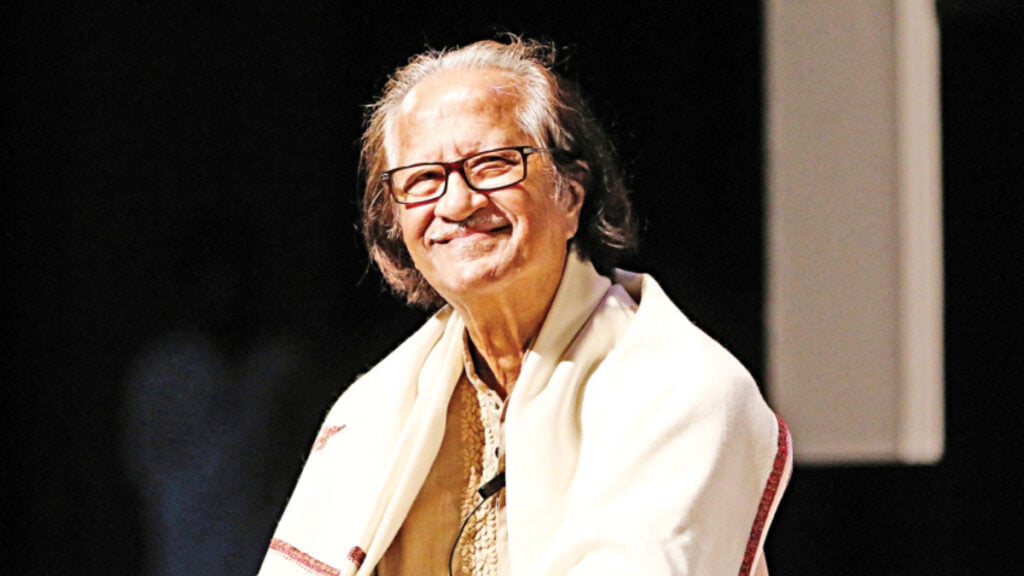
Mustafa Monwar, one of Bangladesh’s most influential artists and pioneers of puppetry, was remembered through music, dance and puppet theatre at a commemorative programme marking his 91st birth anniversary.
Held at the Bangladesh Shilpakala Academy in Dhaka on Thursday evening, the event brought together artists, former colleagues, students and cultural enthusiasts to celebrate Monwar’s extensive contribution to the country’s artistic and cultural life. Titled ‘A Lifelong Pursuit of Colour, Line, Imagination and Aesthetics’, the programme was jointly organised by Multimedia Puppet Theatre and the Bangladesh Shilpakala Academy.
The event was the first formal birth anniversary observance for Monwar since his death on 29 June this year. Coming only a few months after his passing, the programme served as an opportunity for people associated with his long career to revisit his work and reflect on the influence he left across several branches of Bangladesh’s cultural landscape.
Music, dance and puppetry formed the main elements of the evening’s programme. Alongside the performances, former colleagues and students shared memories of working with Monwar, recalling his approach to art and his sustained efforts to encourage creative expression. Their recollections also highlighted his role in expanding the scope of artistic practice in Bangladesh.
Monwar was a major figure in the development of puppetry in the country. Although widely recognised as a painter, his creative career extended well beyond the visual arts. He worked across puppetry, theatre, radio and television, establishing a distinctive identity through his ability to combine artistic expression with storytelling and visual imagination.
His contribution to puppetry was particularly significant. Rather than treating the form solely as entertainment, Monwar explored its potential to communicate social ideas and human values. Through characters, movement, visual design and narrative, he helped demonstrate how puppetry could engage audiences with issues connected to everyday life while remaining accessible and imaginative.
His work also carried a strong connection with children and young audiences. Through television programmes and puppet productions, he introduced generations of children to stories, visual creativity and performance. His approach helped make puppetry a familiar part of children’s cultural experiences while encouraging imagination and creative thinking.
Monwar’s artistic work also assumed a humanitarian dimension during the 1971 Liberation War. He used puppetry in refugee camps with the aim of providing children with moments of relief amid the difficult circumstances of war. The initiative reflected the wider role he believed creative work could play in society, particularly when ordinary forms of life had been disrupted.
After independence, he continued to contribute to the development and wider practice of puppetry in Bangladesh. His efforts helped give the art form greater visibility and encouraged its development beyond traditional entertainment. His work brought together elements of visual art, performance, storytelling and imagination, creating a distinctive approach that influenced subsequent practitioners.
Television became another important platform for his creative work. His programmes and puppet productions for children reached a broad audience and helped establish him as a familiar figure among successive generations of viewers. His contribution to television was part of a wider artistic career that crossed institutional and media boundaries.
Monwar’s achievements were formally recognised when he received the Ekushey Padak in 2004 for his contribution to art and culture. His career as a painter, puppeteer and cultural organiser subsequently became closely associated with the development of Bangladesh’s modern cultural heritage.
The birth anniversary programme therefore served a purpose beyond commemorating an individual artist. By bringing music, dance and puppetry together, the organisers sought to present different aspects of Monwar’s creative legacy to contemporary audiences, particularly younger generations who may encounter his work through new forms and settings.
The memories shared by former colleagues and students repeatedly returned to his commitment to creativity, aesthetics and human values. The performances, meanwhile, offered a living expression of the artistic forms with which he was closely associated.
Monwar’s career remains intertwined with several important chapters in Bangladesh’s cultural history. His work across painting, puppetry, theatre, radio and television gave him a rare breadth of influence. The 91st birth anniversary observance provided an opportunity not only to remember that contribution but also to keep his artistic ideas and creative legacy visible to future generations.