Staff Reporter
While showing an individual arrested in a new case for investigation purposes—commonly known as a “shown arrest”—is a recognized legal procedure, growing concerns have emerged over its potential misuse. Prominent media entrepreneur and Managing Director of Mohona Television, Shahed Ahmed Majumder, remains incarcerated due to successive shown arrests executed just as he secures bail in preceding cases. His family alleges that despite repeatedly obtaining court-ordered bail, he is denied release as law enforcement continually re-arrests him at the prison gates.
According to his family, Shahed Ahmed has been detained for nearly a year in connection with a specific case. Over this period, courts have granted him bail in various cases on at least four occasions. However, on each instance, police officers executed new shown arrests at the prison gates before he could step free, with the most recent re-arrest taking place on 26 August.
Family members recalled that officers from the Counter Terrorism and Transnational Crime (CTTC) unit initially detained Shahed Ahmed from the capital’s Gulshan area last year, subsequently naming him in a case filed with Gulshan Police Station. Despite not being initially listed as an accused in several other matters, police continued to process arrests against him, repeatedly invoking shown arrests in older cases registered under Mirpur Model and Gulshan police stations—actions his family describes as calculated and harassment-driven.
Police Action Persists Despite Ministry Directives
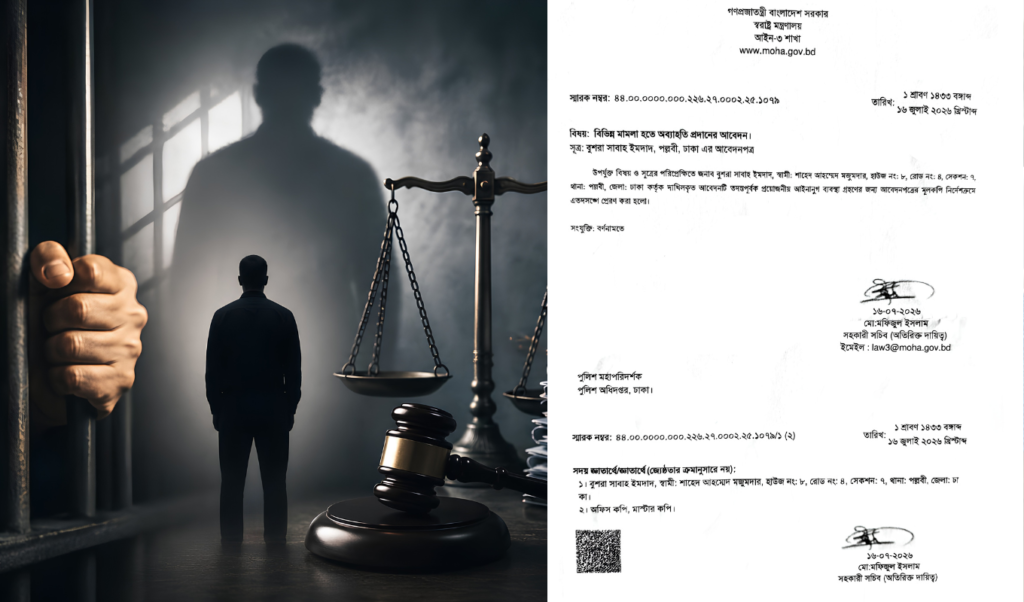
The situation attracted public attention following a humanitarian appeal lodged by Shahed Ahmed’s wife, Bushra Sabah Emdad. On 16 July, the Law-3 branch of the Ministry of Home Affairs issued an administrative instruction to the Inspector General of Police (IGP) regarding his discharge from the relevant proceedings.
However, family members reported that nearly a month after the Home Ministry’s directive, police again executed a shown arrest in a fresh case. The move has raised serious questions regarding compliance with executive instructions within police ranks, with the family arguing that such actions undermine government efforts to establish administrative transparency and accountability.
Legal analysts note that continuous re-arrests effectively neutralize court-granted bail, transforming a procedural investigative tool into a mechanism for indefinite detention. Family members maintain that Shahed Ahmed is a non-political figure with no involvement in the incidents cited in the case files.
Commenting on the practice, human rights activist Advocate Lalon Hossain noted that while shown arrests are standard procedure for high-profile criminal cases or dangerous offenders, applying the measure repeatedly to non-political individuals curtails fundamental rights and undermines public trust in judicial remedies.
Advocate Khondoker Hasan Shahriar, a senior lawyer at the Supreme Court of Bangladesh, described the pattern as a clear misuse of police powers often influenced by extraneous factors. He emphasized that in standard legal systems, individuals are not kept indefinitely detained prior to conviction. He added that if an accused faces multiple warrants or pending cases, investigating officers should account for them jointly rather than waiting for bail orders to take fresh action.
“Executing a shown arrest only after bail is granted raises obvious questions,” Shahriar said, adding that showing an individual arrested in a new case without relevant statements under Section 161 or 164 of the Code of Criminal Procedure constitutes an abuse of statutory power.
Dr Iftekharuzzaman, Executive Director of Transparency International Bangladesh (TIB), stressed that urgent measures are required to eliminate arbitrary arrests, systematic harassment, and the improper application of shown arrests to safeguard constitutional guarantees of personal liberty and equal protection under the law.
Non-Political Background
Shahed Ahmed’s family reiterated that although he grew up in a politically active family, he personally maintained no political affiliations, focusing instead on cultural and creative pursuits such as music and painting. They asserted that he had no involvement in the alleged incidents and was not present at the locations cited in the police reports.
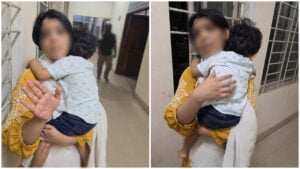
Left to care for their two young daughters alone during his prolonged detention, Bushra Sabah Emdad continues to navigate legal and administrative channels seeking his release. She has called for a prompt and impartial review of the cases to ensure justice for her husband.
Attempts to obtain official statements from Gulshan and Mirpur Model police stations regarding the specific grounds for the shown arrests were unsuccessful, as station officials declined to comment. However, Deputy Commissioner of the Dhaka Metropolitan Police (Media) Md Akhtar Hossain advised consulting senior police management regarding policy-level matters.
Legal Framework Behind ‘Shown Arrest’
The legal mechanics surrounding shown arrests saw legislative adjustments when the interim administration led by Dr Muhammad Yunus promulgated the Code of Criminal Procedure (Second Amendment) Ordinance, 2025 on 10 August 2025, inserting Section 167A to outline judicial oversight for such detentions. Subsequently, the elected political administration repealed the ordinance and enacted the Code of Criminal Procedure (Amendment) Act, 2026 (Act No. 11 of 2026), retaining statutory provisions under Section 167A.
Furthermore, Section 351 of the Code of Criminal Procedure empowers a court to detain or order the arrest of any person present before it if evidence during an inquiry or trial indicates involvement in an offence. However, legal experts point out that police routinely apply for shown arrests outside these specific judicial conditions, turning the ongoing ordeal of Shahed Ahmed Majumder into a focal point of debate over police procedures and judicial safeguards in Bangladesh.