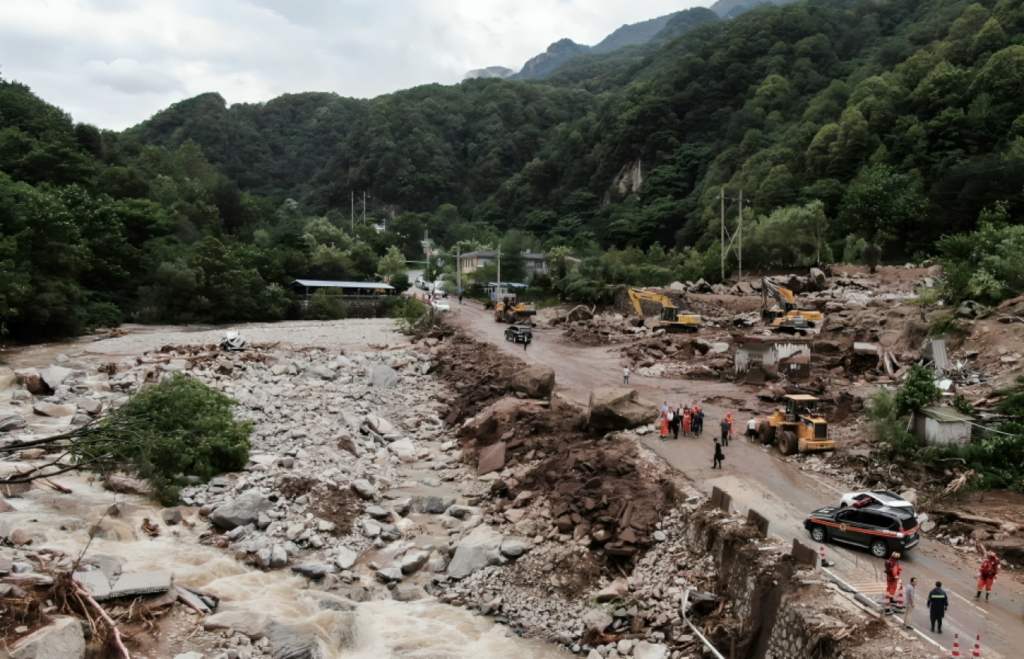
A landslide triggered by exceptionally heavy rainfall has claimed the lives of four people and left eight others missing in Chengde City, located in Hebei province, northern China. The incident, reported on Monday by state broadcaster CCTV, follows days of relentless downpours that have impacted large parts of the region.
The national emergency management department has dispatched inspection teams to assess what it described as “severe” flooding conditions in Hebei, a province that encircles the capital, Beijing.
Summary of Impacts
| Region | Incident | Impact |
| Chengde, Hebei | Landslide caused by heavy rainfall | 4 dead, 8 missing |
| Hebei (general) | Widespread flooding and record rainfall | 2 dead on Saturday, 4,600+ evacuated in Fuping |
| Shanxi province | Bus accident amid floods | 1 rescued, 13 missing |
| Beijing (Miyun) | Torrential rain, reservoir overflow | 3,000+ evacuated |
| Shandong province | Flash floods earlier in July | 2 dead, 10 missing |
| Sichuan province | Landslide on highway | 5 dead |
Torrential Rains and Emergency Response
In Fuping County (Hebei), more than 4,600 residents were evacuated over the weekend due to rising floodwaters. In neighbouring Shanxi province, a bus accident caused by floodwaters left 13 missing, while one person was successfully rescued.
Footage from CCTV revealed roads and farmlands submerged, while in Beijing’s Miyun district, over 3,000 people were evacuated due to flood risks. The local reservoir recorded its largest inflow since its construction over 60 years ago, prompting widespread concern.
Extreme Weather and Broader Climate Challenges
China has seen an uptick in natural disasters, particularly during the summer season, with some regions facing torrential downpours while others endure heatwaves.
Although China is the world’s largest emitter of greenhouse gases—a key driver of climate change and extreme weather—it is also a leading force in renewable energy development and has pledged to become carbon-neutral by 2060.
Earlier this month:
- Flash floods in Shandong province killed two and left 10 missing.
- A highway landslide in Sichuan province claimed five lives, sweeping several vehicles off a mountainside.
These incidents underscore the intensifying nature of climate-related disasters in China, reinforcing the need for robust emergency response mechanisms and long-term climate adaptation strategies.