Fertiliser allocated to farmers in Bhola is allegedly being diverted through waterways and smuggled to Myanmar, raising concerns over illegal trading networks and the availability of essential agricultural inputs. Urea and triple superphosphate (TSP) fertiliser have reportedly been moved in large consignments by boats and other vessels, with several shipments intercepted by law-enforcement agencies over recent months.
Information from police and the Coast Guard indicates that a network allegedly involving dishonest fertiliser dealers has been operating the smuggling route. Farmers in several parts of Bhola have complained that some dealers are selling fertiliser intended for local agricultural use on the black market in search of higher profits. From there, the fertiliser is reportedly being transferred towards Myanmar through maritime routes.
According to figures provided by the authorities, Coast Guard operations in the first eight months of the year resulted in the seizure of around 55 tonnes of fertiliser and the arrest of seven people. Police operations conducted in March and August resulted in the seizure of another 86 tonnes and the arrest of five people. Taken together, separate operations by the two agencies during the eight-month period resulted in the seizure of approximately 141 tonnes of fertiliser and the detention of 12 people.
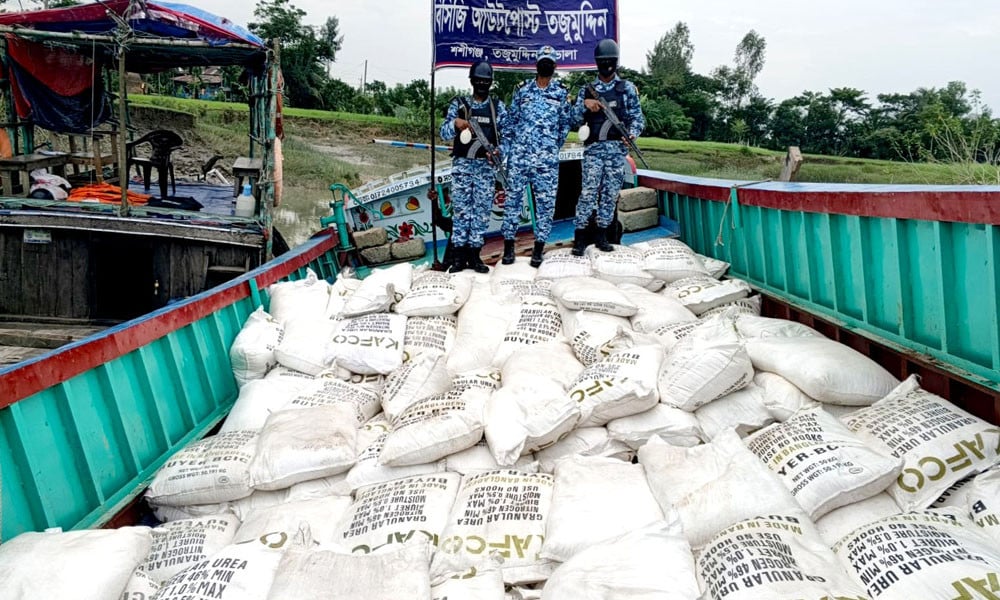
The latest seizure took place on Saturday, 5 September, near Muktijoddha Bazar in Tazumuddin upazila. Acting on confidential information, Coast Guard personnel conducted a special operation on the Meghna River and searched a suspicious trawler. They recovered around eight tonnes, equivalent to 160 sacks, of urea fertiliser allegedly being transported for smuggling to Myanmar. The vessel used to carry the fertiliser was also seized.
Those involved, however, managed to escape after apparently becoming aware of the Coast Guard operation. No arrests were made during the raid.
A significant seizure had also taken place in Char Fasson on 12 August. Police recovered 293 sacks of urea fertiliser from a lorry and a fishing trawler during a night-time operation. Four people were arrested in connection with the alleged smuggling attempt. Police said preliminary questioning indicated that the fertiliser had been loaded onto the trawler for transportation to Myanmar. The suspects were subsequently charged and sent to court.
Earlier, on 5 March, police seized 1,420 sacks, or approximately 71 tonnes, of urea and TSP fertiliser from four lorries at the Ilisha ferry terminal in Bhola Sadar. The vehicles were intercepted while preparing to travel towards Majuchowdhury Ghat in Lakshmipur. Three drivers reportedly fled after noticing the police presence, while one driver, identified as Mohammad Arman, 30, was detained.
Police said the fertiliser had been loaded onto the lorries earlier that afternoon from a Bangladesh Chemical Industries Corporation warehouse located near Bhola’s river terminal. Separate seizures had previously been made along routes connecting Manpura and Hatiya, where 760 sacks of fertiliser were recovered. Last month, local fishermen also reportedly prevented an attempted movement of around 3,000 sacks of fertiliser in the Char Nizam area along the Char Fasson-Manpura boundary.
The alleged diversion of fertiliser has also raised questions about the distribution system. A buffer warehouse operated under the state fertiliser distribution network in Bhola stores supplies intended for farmers across the southern region. Dealers collect fertiliser from the warehouse, but allegations have emerged that some dealers use representatives to collect supplies on their behalf rather than attending personally.
Farmers have also alleged that many authorised dealers do not maintain proper sales centres in the villages where they are supposed to serve. Instead, some allegedly operate nominal shops in urban areas, making it difficult for farmers in rural communities to obtain fertiliser directly. Farmers claim that part of the allocation is subsequently sold at inflated prices through unofficial channels.
The smuggling route appears to have changed over the past year. Previously, consignments were reportedly moved mainly by road, but increased risks on road routes have encouraged smugglers to rely more heavily on waterways. Large fishing boats and bulkheads used for carrying sand are reportedly being used to transport fertiliser from different river terminals in Bhola.
The issue is particularly significant because fertiliser availability directly affects agricultural production and farmers’ costs. Urea is a major source of nitrogen for crops, while TSP supplies phosphorus, an essential nutrient for root development and plant growth. Any diversion of government-allocated fertiliser can therefore place additional pressure on farmers, particularly if they are forced to purchase supplies through informal markets at higher prices.
Mohammad Sahabuddin Farazi, central president of the Bangladesh Farmers’ Unity Foundation, said farmers were facing difficulties obtaining fertiliser despite claims that there was no overall shortage. He blamed alleged syndicates and smuggling networks for disrupting supplies and called for stronger action to ensure that fertiliser allocated to farmers reaches them.
The Coast Guard has said it will continue operations against smuggling and illegal transportation along waterways. Its media officer, Lieutenant Commander Sabbir Alam, said regular patrols and operations were being conducted to prevent maritime smuggling and that such efforts would continue.
Bhola’s agricultural authorities, meanwhile, have maintained that there is currently no fertiliser shortage in the district. Deputy Director Mohammad Khairul Islam Mallik said monitoring of dealers had been strengthened to prevent the diversion of fertiliser. He said the authorities were reviewing the collection, sale and stock levels of fertiliser every month and maintaining strict oversight to ensure supplies allocated for Bhola’s farmers were not transported outside the intended distribution network.
The repeated seizures nevertheless highlight the scale of the challenge. While individual consignments have been intercepted, the authorities’ actions also suggest that substantial quantities may still be moving through less visible routes. Ensuring accurate dealer records, effective monitoring of stocks and accessible village-level sales points will be crucial if the authorities are to prevent subsidised agricultural inputs from being diverted into illegal trade.