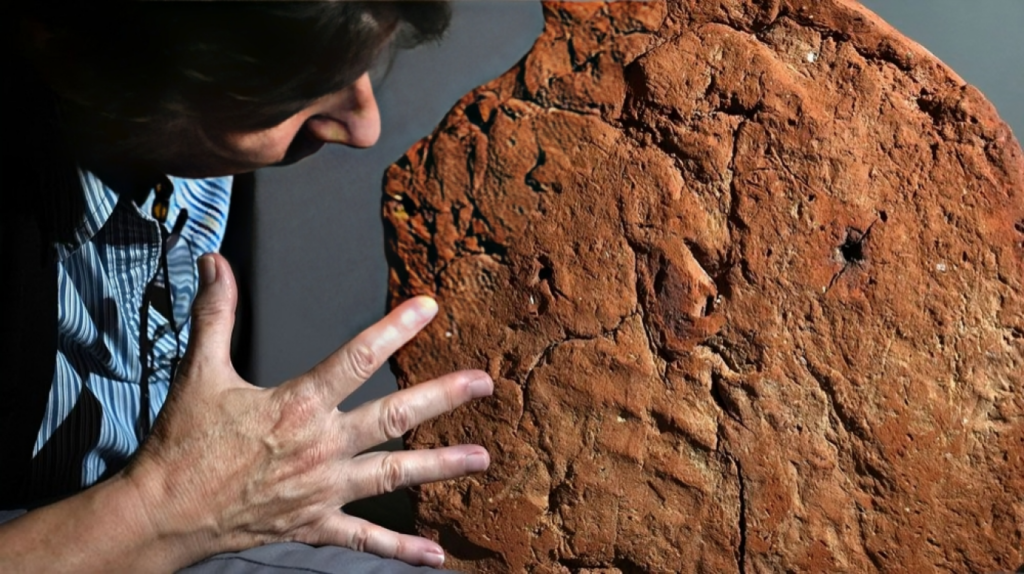
A rare and remarkable discovery has been made by British researchers at the Fitzwilliam Museum in Cambridge—a perfectly preserved handprint on a 4,000-year-old Egyptian artefact, offering a deeply human glimpse into the life of an ancient artisan.
The handprint was identified by the museum’s conservation staff on the underside of a soul house—a clay tray shaped like a dwelling. These objects were typically placed in tombs either to hold food offerings or serve as symbolic homes for the spirits of the deceased.
This specific artefact, believed to date from between 2055–1650 BC, was being examined ahead of the museum’s upcoming exhibition, Made in Ancient Egypt, when the imprint came to light.
“I have never seen such a complete handprint on an Egyptian object before,”
— Helen Strudwick, Senior Curator and Egyptologist, Fitzwilliam Museum
A Direct Touch from the Distant Past
The handprint is thought to have been left by the original maker when the piece was still unfired clay. As they picked it up, their hand pressed into the base, leaving behind a detailed impression. The print clearly shows all five fingers, as well as the resting point of the palm.
“When you see something like this, you feel very close to the person who left their mark on an object,” said Strudwick, calling it an “exciting moment” of connection across the centuries.
Despite the richness of the discovery, Strudwick emphasised that it is difficult to determine the identity of the individual behind the print. The hand is relatively small—comparable in size to her own—which raises possibilities.
“If this is a man’s handprint, it’s possible that he was quite young. Or perhaps a junior member of a workshop, someone responsible for moving pieces out to dry,” she speculated.
Exhibition: Made in Ancient Egypt
The soul house and other remarkable artefacts will be part of the Fitzwilliam Museum’s upcoming exhibition, which will open on 3rd October. The exhibition seeks to shift the focus away from the grandeur of pharaohs and temples, instead highlighting the makers behind ancient Egyptian objects—potters, jewellers, and sculptors.
“Understanding how these ancient objects were made is vital if we are to look after them properly,” Strudwick noted.
Exhibition Highlights
| Feature | Details |
| Exhibition Title | Made in Ancient Egypt |
| Opening Date | 3rd October |
| Focus | Ancient Egyptian artisans and their craftsmanship |
| Star Artefact | Soul house with preserved handprint |
| Time Period of Artefact | 2055–1650 BC (Middle Kingdom of Egypt) |
| Notable Loan | Major collection of antiquities from the Louvre Museum in Paris |
| Significance of Loan | Largest of its kind to come to the UK in nearly 20 years |
Shedding Light on Overlooked Craftsmanship
The museum has been conducting detailed research into the methods used by ancient Egyptian craftsmen since 2014. Yet, little is still known about the everyday lives of potters, who were historically considered of lower status than other artisans due to the perceived modesty of their materials.
Strudwick emphasised that such craftspersons were frequently overlooked by scholars.
“With new research techniques, we are now learning more and more about how these individuals lived, worked, and how they wanted to be remembered for eternity,” she said.
The upcoming exhibition represents a rare opportunity for the public to gain insight into the human hands—literally and figuratively—that shaped some of history’s most enduring artefacts.