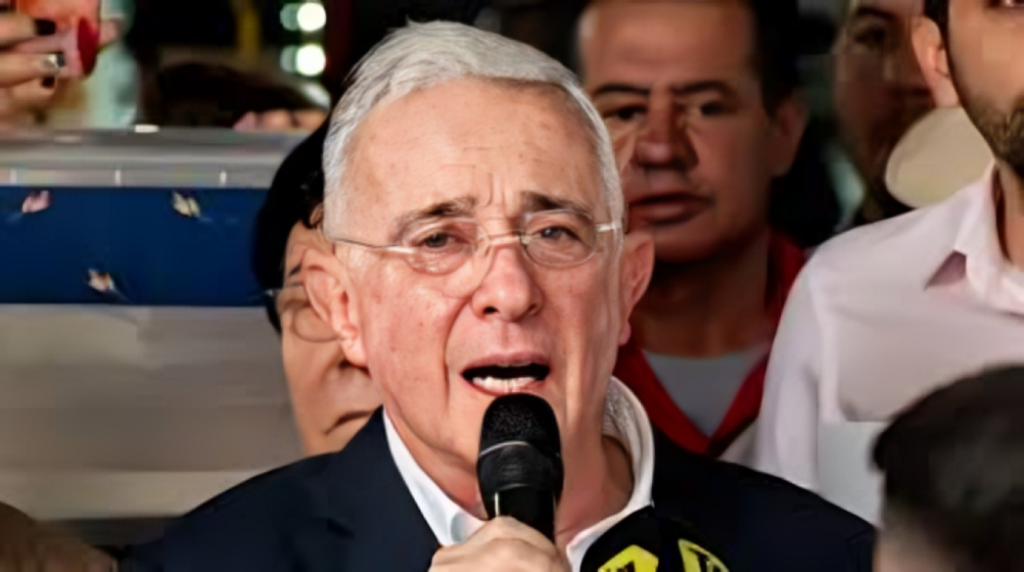
A Colombian court on Monday delivered a historic verdict, finding former president Álvaro Uribe guilty of witness tampering—marking the first time in the nation’s history that a former head of state has been convicted of a criminal offence.
Uribe, aged 73, who governed Colombia from 2002 to 2010, was found guilty of influencing right-wing paramilitary members to give false testimony concerning their alleged connections to him. The ruling has sent ripples through Colombian society and drawn international scrutiny.
“At the time the judge began to deliver her verdict, Uribe—attending the trial virtually—shook his head in apparent disbelief.”
The sentencing is scheduled for Friday, with Uribe facing a potential 12-year prison term.
Overview of Charges and Verdict
| Charge | Description |
| Witness Tampering | Uribe was found guilty of attempting to manipulate testimony from jailed paramilitaries. |
| Procedural Fraud | The court determined he attempted to deceive the judicial process. |
Background and Judicial Concerns
The conviction comes amid mounting concerns for Judge Sandra Heredia, who presided over the case. Even prior to the verdict, Colombia’s bar association had called for heightened protection due to threats and intense political pressure.
The Colombian President Gustavo Petro, a leftist and Uribe’s longstanding political rival, firmly defended the independence of the judiciary in response to criticism.
“Claims to the contrary are an insult that will not be tolerated,” Petro asserted after US Senator Marco Rubio denounced the verdict as “the weaponisation of Colombia’s judicial branch by radical judges.
Historical and Political Context
Paramilitary forces first emerged in 1980s Colombia as unofficial militias to counter Marxist guerrilla movements like the FARC. Over time, many of these groups became deeply involved in drug trafficking, further entrenching violence and criminality.
Uribe, a law-and-order hardliner, maintained close ties with the United States and was widely credited with significantly weakening insurgent groups. However, his legacy has been tainted by serious allegations of human rights violations and support for paramilitaries.
Historical Context
| Year | Event |
| 1997 | Uribe served as governor of Antioquia during a deadly paramilitary massacre. |
| 2002-2010 | Uribe’s presidency marked by intense anti-FARC military campaigns. |
| 2016 | FARC signed peace accord under President Juan Manuel Santos. |
| 2018 | Investigation against Uribe officially launched. |
| 2024 | Trial began in May with over 90 witnesses. |
Trial and Evidence
The prosecution presented compelling testimony, including from at least one former paramilitary who claimed that Uribe personally contacted him while incarcerated, asking him to alter his testimony.
Prosecutors alleged that Uribe attempted to manipulate testimonies to undermine Senator Iván Cepeda, who had earlier accused Uribe of ties to violent right-wing groups.
The case had faced multiple attempts to be dismissed by earlier attorneys-general, but was revived with new momentum under Attorney General Luz Camargo, a Petro appointee.
Divided Public Opinion
Despite the conviction, Uribe retains substantial support. He is still viewed as a national hero by many Colombians for his efforts in weakening guerrilla factions. Recent opinion polls continue to rank him as one of Colombia’s most popular political figures.
In 2019, large demonstrations were held in Bogotá and Medellín following his indictment. On Monday, smaller groups of loyalists rallied outside the courthouse, some wearing Uribe-themed masks and chanting: “Uribe, innocent!” Clashes later broke out between supporters and opponents.
Ongoing Legal Troubles
This case may not be the end of Uribe’s legal woes:
- He remains under investigation for his alleged role in a 1997 paramilitary massacre while he was governor.
- A complaint has been filed in Argentina under the principle of universal jurisdiction, citing his alleged role in over 6,000 extrajudicial executions and forced disappearances of civilians during his presidency.
Uribe’s Response
Uribe has vehemently denied the charges and characterised the entire legal process as “political vengeance” orchestrated by his enemies, particularly the current administration.
“This trial is not justice—it is persecution,” he previously stated in a public address.
This conviction not only reshapes the legacy of Colombia’s most divisive political figure, but also serves as a potent reminder of the enduring struggle between justice, power, and impunity in Latin America’s largest democracies.