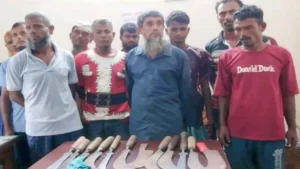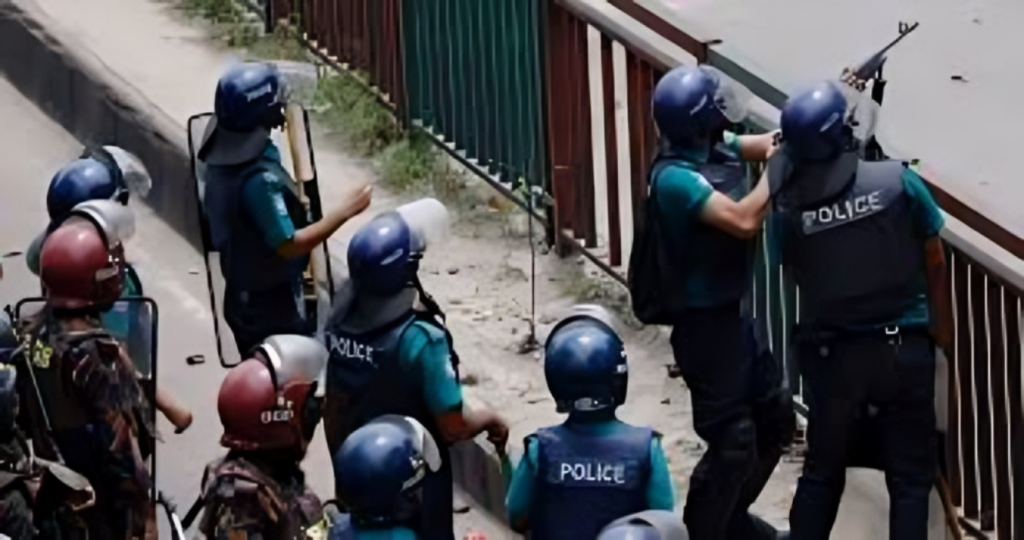
On 30 July last year, despite a 16-hour relaxation of the curfew across Rangpur Division, law enforcement agencies under the then Awami League government pressed forward with aggressive and widespread arrests aimed at suppressing the growing Anti-Discrimination Student Movement.
Suppression Amid Curfew Relaxation
Although the curfew was lifted from 6:00 am to 10:00 pm, the atmosphere in Rangpur city remained tense and fearful. Ordinary citizens largely stayed indoors, venturing out only for essential needs such as food and medicine.
Simultaneously, thousands of individuals—including teachers, guardians, women, and cultural activists—prepared to join the student-led uprising. Their goal: to catalyse a mass movement and demand an end to the autocratic regime.
Communication Blackout and Underground Organisation
With internet access shut down, student leaders from Begum Rokeya University, particularly comrades of martyr Abu Sayeed, were compelled to use alternative means to coordinate and organise. The blackout severely hampered communication and mobility.
“Even under threat of death, arrest, or disappearance, we continued operating from hiding on 30 July to mobilise students and intensify the resistance,”
— Rahamat Ali, student coordinator and comrade of Abu Sayeed
According to Rahamat, state forces and Awami League-affiliated groups were responsible for intimidation tactics, including mass arrests, enforced disappearances, and threats of violence, all aimed at silencing dissent and dismantling the protest.
Timeline of Repression
Following the death of Abu Sayeed—a student killed in police firing on 16 July—the student uprising surged in Rangpur, drawing mass participation and spiralling beyond the government’s control. In response, a harsh clampdown ensued even as curfews were eased across eight districts.
| District | Arrests on 30 July |
| Rangpur Metropolitan Area | 192 (22 legal cases filed) |
| Rangpur (outside metro) | 65 |
| Gaibandha | Not specified |
| Lalmonirhat | Not specified |
| Nilphamari | Included in RAB stats |
| Dinajpur | Not specified |
| Thakurgaon | Not specified |
| Panchagarh | Not specified |
| Kurigram | 5 |
RAB (Rapid Action Battalion) Operations
A press release by the Rapid Action Battalion detailed additional arrests on the same day:
| Area | Arrests by RAB |
| Rangpur Metro | 11 |
| Nilphamari | 29 |
| Gaibandha | 3 |
| Total | 43 |
In parallel, police confirmed the arrest of 65 activists linked to Bangladesh Nationalist Party (BNP) and Jamaat-e-Islami, highlighting the regime’s targeting of political opponents under the guise of security enforcement.
Civil and Political Backlash
The events of 30 July underscore the brutality and desperation of the authorities, as they sought to quash the largest youth-led uprising seen in Rangpur in decades. With protesters remaining resilient even under surveillance, repression, and threat of death, the day’s actions reflect the depth of resistance as well as the severity of authoritarian overreach.
Despite curfew easing, the tactical crackdown by law enforcement persisted, underscoring the regime’s fear of a unified civilian resistance.