Farmers in Bhurungamari upazila of Kurigram are continuing to face difficulties in obtaining fertiliser during the Aman rice and vegetable cultivation seasons, including early vegetable farming ahead of the Rabi season. While farmers say they are unable to secure fertiliser according to their needs, the Department of Agricultural Extension maintains that there is no actual shortage in the district. Officials argue that some farmers are attempting to collect more fertiliser than required, creating pressure at distribution points.
The contrasting claims have raised questions over whether government allocations are adequately matching demand at field level. Farmers have also alleged discrimination, favouritism and the influence of well-connected individuals in the distribution process.
Although the number of fertiliser sales centres has been increased to ease pressure, farmers say this has not addressed the underlying shortage between supply and demand. They claim that the quantity allocated remains considerably lower than what is required even according to the fertiliser application rates recommended by the agricultural authorities.
Farmers complain of unequal distribution
Farmers in several unions of Bhurungamari say they are repeatedly visiting designated sales points but returning without receiving the amount of fertiliser they need. Some allege that while an individual can obtain several sacks, three or four ordinary farmers sometimes have to share a single sack.
There are also allegations that influential individuals have collected fertiliser in advance and stored it for use throughout the season. Some farmers have raised concerns about political influence in obtaining supplies. They point to incidents in which stored fertiliser was recovered during local administrative drives as evidence that their concerns deserve attention.
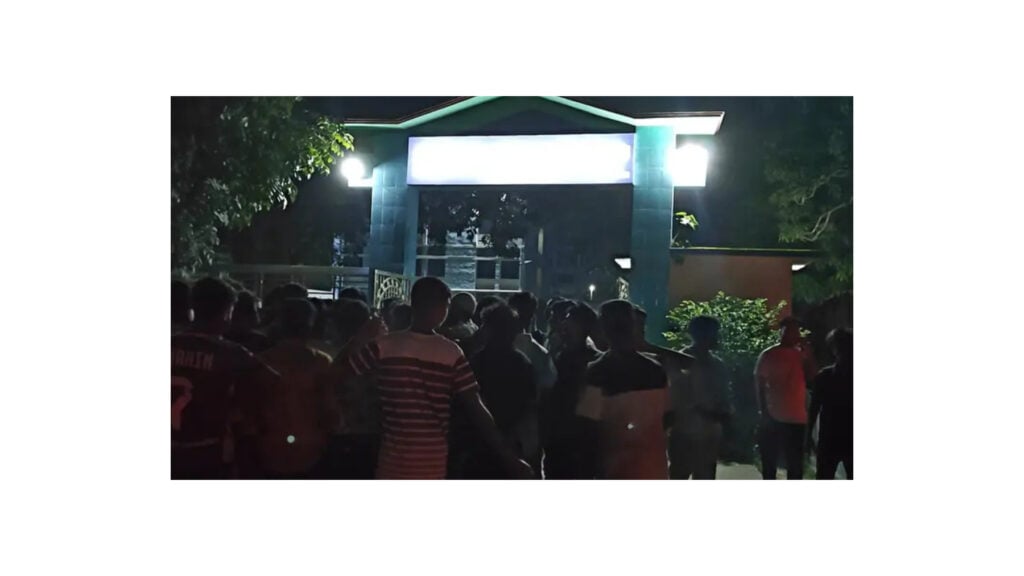
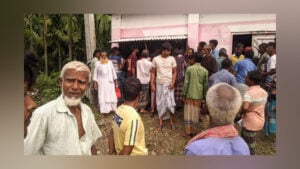
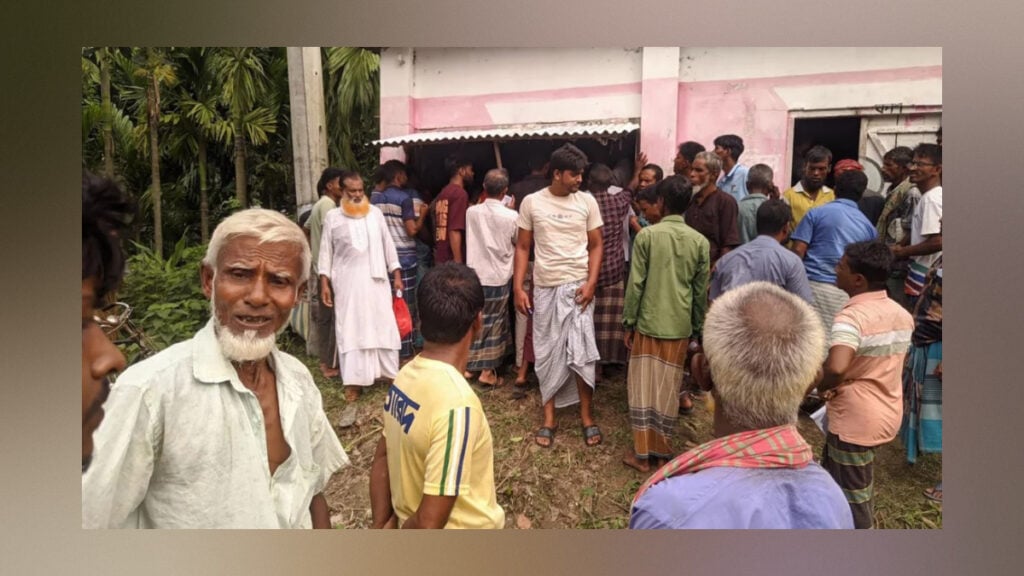
At several sales points, farmers were seen waiting in large numbers. Many expressed frustration after failing to obtain fertiliser despite visiting repeatedly.
Abu Bakkar, a farmer from South Bharatchhara village in Bangshonahat Union, alleged irregularities in the distribution system. He told Bangla Tribune that he had been repeatedly travelling to sales points in search of fertiliser but was still unable to obtain it. “I have been going around for fertiliser until I feel exhausted,” he said, alleging that fertiliser was being distributed according to personal connections rather than a uniform system.
The situation was also observed at the designated sales centre at Laxmir Mor in Ward No. 3 of the union on Thursday, 10 September, at around 9am. Some farmers were seen leaving with a full sack, while three or four others were taking one sack collectively. Despite this arrangement, at least 200 farmers reportedly returned without fertiliser.
Farmers alleged that those known to dealers or local political figures were receiving priority, while others were being turned away. Retailers and dealer representatives, however, denied the allegations.
Supply falls short at sales points
Motiur Rahman, a fertiliser seller at the sales centre, said the outlet had received only 40 sacks that day—30 sacks of DAP and 10 sacks of TSP. More than 300 farmers were waiting, he said.
According to him, two or three farmers had to share a sack, yet the available supply was still insufficient. No urea had been supplied to the centre, while the ward required at least another 150 sacks of fertiliser, he claimed.
Abul Hashem, a representative of BCIC-authorised dealer Messrs Janardhan Chandra Saha at Camp Mor in the union, also said the quantity of fertiliser being supplied was insufficient compared with local demand.
The pressure is particularly visible among farmers cultivating early vegetables. In Gunaiyer Kuthi Char along the Dharla? No—the source identifies the area as the char of the Dudhkumar River—farmers have already started cultivating early brinjal across the sandy riverine land. They say urea and DAP are needed at this stage of cultivation but remain difficult to obtain.
Mojammel Haque, a farmer from Gunaiyer Kuthi village, said farmers had been told they would receive 10kg of fertiliser each at the dealer point. However, he alleged that some people were obtaining several sacks through favouritism and payments, while ordinary farmers were returning after making four or five visits.
Allocation figures reveal a wide gap
Data from the Department of Agricultural Extension show that 121,175 hectares of land have been brought under Aman cultivation in Kurigram this year. Vegetable cultivation covers 2,250 hectares. Early brinjal has been planted on 345 hectares, with the area reportedly increasing. Cauliflower and cabbage together account for around 200 hectares.
In Bhurungamari alone, Aman rice has been cultivated on 16,900 hectares, while vegetables cover 440 hectares. Early brinjal has been planted on 273 hectares against a target of 690 hectares.
Agricultural officials say the recommended seasonal application rate for urea is 195kg per hectare for transplanted Aman. The recommended rate is 260kg per hectare for brinjal and cauliflower, and 390kg for cabbage.
Based on those rates, around 23,629 tonnes of urea would be required for the district’s 121,175 hectares of Aman cultivation. Around 65 tonnes would be required for the approximately 200 hectares of cauliflower and cabbage, while roughly 90 tonnes would be needed for 345 hectares of brinjal.
That puts the estimated urea requirement for the crops mentioned in the agricultural data at around 23,784 tonnes. In Bhurungamari alone, the estimated requirement for Aman and early brinjal stands at approximately 3,365 tonnes.
In contrast, the district received 12,483 tonnes of urea during July, August and September, according to agricultural department data. Bhurungamari’s allocation during the same three-month period was 1,403 tonnes.
The difference is also apparent in allocations of TSP and DAP. The estimated TSP requirement for the crops mentioned is around 6,164 tonnes, while Aman cultivation alone requires approximately 10,905 tonnes of DAP. Yet only 2,104 tonnes of TSP and 5,067 tonnes of DAP were allocated to Kurigram during the three months.
Agricultural department rejects shortage claim
The Department of Agricultural Extension does not regard the difference between the recommended application rates and allocations as evidence of a fertiliser shortage.
Abdullah Al Mamun, deputy director of the Department of Agricultural Extension in Kurigram, told Bangla Tribune that farmers sometimes use more fertiliser than necessary. He said around 50 per cent of the non-urea fertiliser applied at the recommended rate during the Boro season remains in the soil, reducing the requirement during the Aman season.
He also explained that when DAP is applied to the same land, there is no need to apply TSP separately. In such cases, the requirement for urea is also reduced by about 5 per cent, according to his assessment.
Responding to questions about allocations being lower than the recommended application rates, Mamun said the situation should not be described as a shortage. He said allocations and usage had traditionally been managed in this way.
Many Aman fields remain fertile during the season, while regular rainfall can also reduce the need for additional fertiliser in some areas, he said. Excessive urea application can even cause crops to bend or lodge, according to the official.
Mamun added that Bhurungamari had sought additional supplies of urea and DAP beyond its regular allocation.
The dispute therefore centres on a basic question: whether the available allocation is sufficient for actual field requirements or whether demand is being inflated by farmers collecting fertiliser beyond their immediate needs. Farmers say the problem is affecting cultivation at a crucial stage, particularly for early vegetables. The agricultural authorities, meanwhile, maintain that existing allocation practices are adequate and that the reported pressure does not necessarily indicate a genuine shortage.
With Aman cultivation continuing alongside preparations for Rabi vegetables, the gap between official assessments and farmers’ experiences remains a pressing issue in Bhurungamari.